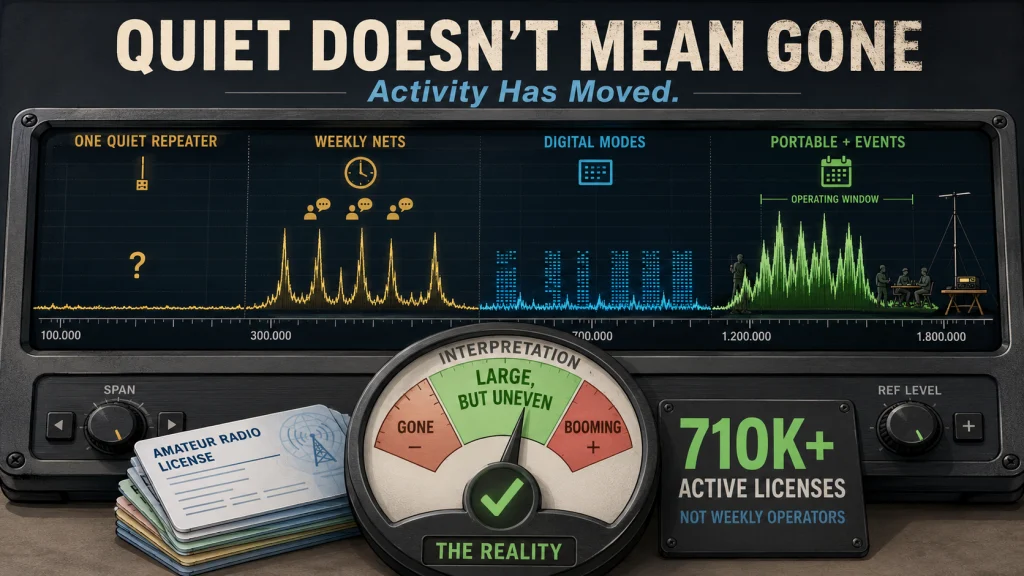
Ham radio is still a substantial hobby in the United States, with 710,788 active individual FCC licenses in the latest count checked on July 20, 2026. That total is below the 2018 high, so the honest answer is not that the hobby is booming everywhere. It is also not disappearing: activity remains visible in major operating events, digital modes, portable operation, local nets, and emergency-preparedness groups. Whether it feels active to you depends heavily on location, band, mode, schedule, and whether you know where local operators actually gather.
Is Ham Radio Still Popular? The Honest Answer
Is ham radio still popular? Yes, if popular means a large, established hobby with hundreds of thousands of licensed US operators and regular activity across voice, digital, portable, contest, and public-service operating. No, if popular means a mass-market activity that is growing quickly in every region and easy to hear on any frequency at any hour.
The argument usually goes wrong because people try to settle it with one observation. One person sees more than 700,000 active licenses and declares a revival. Another listens to one quiet repeater on a Tuesday afternoon and declares the hobby dead. Neither test measures the whole thing.
I use three separate questions instead: How many people hold active licenses? How has that number changed over time? Where can we verify that people are actually operating? Keeping those questions separate produces a less dramatic answer, but it is much more useful for someone deciding whether the hobby is worth pursuing.
The Official Numbers Show a Large but Mostly Flat Hobby
The latest ARRL table compiled from FCC public data files reported 710,788 active individual licenses after FCC actions through July 16, 2026. I checked that figure on July 20, 2026. The table excludes the need to guess from membership lists, social media groups, equipment sales, or anecdotes about how busy a particular frequency sounds.
Technician remains the largest license class by a wide margin. General and Amateur Extra together account for nearly half of all active individual licenses, which matters because it shows that a large share of the licensed population has moved beyond entry-level privileges. Advanced and Novice numbers continue to shrink because the FCC no longer issues those classes, not because current applicants are choosing against them.
| License class | Active licenses | Share of total | What the number tells us |
|---|---|---|---|
| Technician | 348,962 | 49.1% | The entry-level class remains the largest part of the licensed population. |
| General | 178,721 | 25.1% | A substantial group has upgraded for broader operating privileges. |
| Amateur Extra | 153,472 | 21.6% | Advanced operating interest remains significant rather than marginal. |
| Advanced | 25,509 | 3.6% | This legacy class declines naturally because no new Advanced licenses are issued. |
| Novice | 4,124 | 0.6% | This legacy class also declines because it is no longer issued. |
| Total | 710,788 | 100% | This is a population count, not a count of people who transmitted this week. |
The long-term comparison is more revealing than the current total alone. The US amateur population stood at 700,221 in September 2011, climbed to 755,430 at the end of 2018, and is now 710,788. Using those published snapshots, the current count is about 5.9% below the 2018 level but still about 1.5% above the 2011 milestone. That looks more like a mature hobby that peaked and pulled back than one that is either exploding or vanishing.
Recent application activity also needs careful handling. After the 43-day federal shutdown in 2025, ARRL VEC reported more than 2,500 amateur license applications waiting to be filed. That queue included exam sessions, new licenses, upgrades, and other filings, so it proves the licensing system still had active demand but cannot be converted into a clean annual new-license growth rate.
What License Counts Cannot Prove
An active license is valid evidence that a person remains authorized to operate. It is not evidence that the person transmitted yesterday, joined a club, checked into a net, used HF, tried a digital mode, or even finished programming a first radio. Amateur licenses normally run for ten years, so a person can remain in the active count through a long period of little or no operating.
I have worked with new licensees whose licenses remained active while their radios stayed unprogrammed for months. The obstacle was not a lack of legal privileges. It was the practical gap between passing an exam and finding a local repeater, understanding the channel settings, or knowing what to say during a first contact.
Field Note: A license count measures the size of the authorized population. It does not measure operating hours, contacts made, repeaters used, or the number of people who feel confident enough to transmit.
That distinction also cuts the other way. A person can be highly active without appearing in every public activity system. Casual simplex contacts, informal local groups, home experiments, listening, and unsubmitted logs leave little centralized evidence. There is no single nationwide meter that counts every active operator.
Before treating any number as proof that ham radio is healthy or dying, check what it actually measures:
- An FCC license total measures active authorizations held by individuals.
- An exam figure measures candidates or applications during a stated period.
- A contest log count measures submitted logs, not every participant or contact.
- An event entry may represent one operator, a family, or a large group.
- A digital reporting network measures activity visible to that network, not all radio use.
This is why I would not use age stereotypes, equipment sales, or a single social-media group as a substitute for operating data. The current FCC count does not include age information, and a quiet online community can be just as misleading as a busy one.

The Yaesu FT-60R is a dual-band VHF/UHF amateur handheld for 2 meter and 70 centimeter operation. It provides 5W output, CTCSS/DCS, DTMF, scanning modes, and 1,000 memory channels. The package includes a battery, charger, antenna, and belt clip.
Check On AmazonIf you click this link and buy, we earn a commission at no additional cost to you.
Are Ham Radios Still Used, or Are the Licenses Just Sitting There?
Ham radios are still used, but activity is easier to verify in defined events and reporting systems than through random listening. The 2025 ARRL Field Day received 4,369 entries representing 31,785 participants. That event is not a census of the hobby, yet it is strong evidence that tens of thousands of people were willing to organize stations, operate, log contacts, and report participation during one weekend.
Digital activity provides another visible signal. The 2026 ARRL International Digital Contest received 948 logs, while the 2025 public-log list contained 972 logs excluding checklogs. Those totals do not count every digital operator and should not be compared with the FCC population as if they were the same measure. They show that organized digital operating remains active enough to produce hundreds of documented entries in a specialized event.
| Activity indicator | Recent figure | Useful conclusion | What it cannot prove |
|---|---|---|---|
| Active individual FCC licenses | 710,788 | The US licensed population remains large. | How often each licensee operates. |
| 2025 ARRL Field Day | 4,369 entries and 31,785 participants | Large-scale group and individual operating remains visible. | Year-round activity or unique licensed participants nationwide. |
| 2026 ARRL International Digital Contest | 948 submitted logs | Documented digital-mode participation remains substantial. | All digital contacts or all digital operators. |
| 2025 licensing backlog after shutdown | More than 2,500 applications ready to file | Exam and licensing work continued during the interruption. | A clean count of new licensees or a full-year growth rate. |
I am not using the 2026 Field Day total here because, as of this article’s July 20, 2026 data check, the entry deadline had not yet passed. Waiting for a complete reporting period is less exciting than publishing a partial number, but it prevents a temporary count from being mistaken for a final trend.
The practical conclusion is that documented activity exists across different parts of the hobby. It is uneven, however, and no event total guarantees that your local repeater, preferred band, or available operating time will be busy.
Is Ham Radio Dying, or Is the Activity Moving?
The decline from the 2018 license high is real and should not be hidden behind promotional language. Some local repeaters are quiet, some clubs struggle to replace long-time volunteers, and the licensed population is not climbing the way it did during stronger growth periods. Calling every concern imaginary would be just as careless as calling the entire hobby dead.
What has changed is where and how people operate. A person who expects continuous conversation on one analog repeater may hear very little, while another operator in the same county is making scheduled net contacts, using digital voice, operating portable from a park, participating in an HF event, or making computer-assisted digital contacts. Activity can move without disappearing.
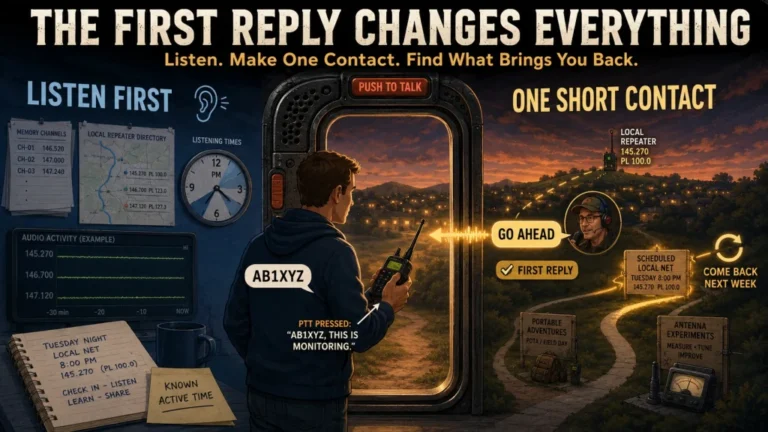
This matters because random listening is a poor discovery method in a scheduled hobby. Repeaters often become active around commute times or weekly nets. Portable stations may appear for a few hours and then leave. HF conditions change by band and time of day, and digital activity is concentrated in specific frequency segments rather than spread evenly across the dial.
The same pattern explains why two honest operators can give opposite answers about local activity. One lives near several active repeaters and an organized club. The other has weak coverage, no nearby net, antenna restrictions, and a work schedule that misses the busiest periods. Their experiences differ because the conditions differ, not because one of them is lying about the state of amateur radio.

The Xiegu G90 is a portable HF transceiver with RF output up to 20W. It has a detachable display unit and a built-in wide-range automatic antenna tuner. Its color LCD includes a spectrum display and waterfall for viewing signal activity around the operating frequency.
Check On AmazonIf you click this link and buy, we earn a commission at no additional cost to you.
Are Ham Radios Still a Thing If Your Local Repeater Is Quiet?
A quiet local repeater is relevant to your decision, especially if local voice communication is your main reason for getting licensed. It still does not answer whether the entire hobby is active. It tells you that one channel, in one coverage area, during one listening window did not produce activity.
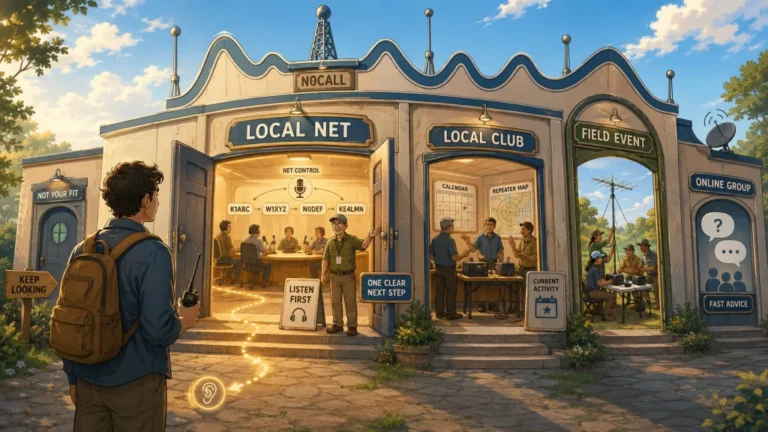
Before investing time in licensing, test the part of the hobby you would actually use. Someone interested in local conversation needs a different activity check from someone interested in portable HF, emergency-preparedness groups, digital contacts, or technical experimentation.
- Check several nearby repeaters rather than only the closest listing.
- Look for published weekly net times and listen during the scheduled window.
- Search for local club calendars, public operating events, and exam sessions.
- Listen at different times, including commute periods, evenings, and weekends.
- Separate local VHF or UHF silence from HF, digital, and portable activity.
- Decide whether the active part you find matches what you actually want to do.
If you are still deciding whether the overall experience fits you, start with whether ham radio fits as a hobby. For a clearer picture of the day-to-day experience, read what ham radio is like in practice before treating the national license count as a personal recommendation.
The next step is not to prove that every branch of amateur radio is thriving. It is to find one active path that matches your location, schedule, and reason for being interested. The practical ham radio guide for beginners can help you place that local activity check inside the larger decision.

The RTL-SDR Blog V4 is a receive-only software-defined radio using an R828D tuner and RTL2832U. It tunes from 500 kHz to 1.7 GHz and includes a portable VHF/UHF dipole antenna kit. The V4 also includes a 1 PPM TCXO, built-in HF upconverter, improved filtering, and an activatable bias tee.
Check On AmazonIf you click this link and buy, we earn a commission at no additional cost to you.
Final Thoughts: Ham Radio Is Smaller Than Its Peak but Far From Gone
The most defensible answer is that ham radio remains a large, active, and changing hobby, but it is not growing across every measure. The active individual license count has fallen from the 2018 high, while major events and digital operating still produce clear, documented participation. Both facts can be true at the same time.
I would not decide based only on a national total or one silent frequency. Check the activity that exists where you live, on the bands and modes you would realistically use, at the times you are available. Ham radio is still popular enough to offer many active paths, but finding the right path is now more important than assuming activity will automatically come to you.
FAQs
📻 How many ham radio operators are licensed in the United States?
The latest count checked on July 20, 2026 showed 710,788 active individual FCC amateur licenses. That is a license population, not a count of people who operate every week.
📉 Is the number of ham radio licenses going down?
Yes, the current total is below the 755,430 reported at the end of 2018. The decline is real, but the current population remains slightly above the 700,221 milestone reported in September 2011.
🗣️ Why is my local ham radio repeater so quiet?
Activity may be concentrated around scheduled nets, commute periods, or other repeaters. Check several systems and published net times before concluding that local amateur radio is inactive.
💻 Are digital modes replacing voice operation?
Digital modes have added visible activity, but they have not replaced voice across the hobby. The balance depends on local interests, available equipment, bands, and operating goals.
🧭 Is ham radio worth starting if activity is declining?
It can be, provided you verify an active path that matches your goal. A nearby net, portable operating group, digital community, or HF interest is more relevant to your decision than the national trend alone.
🧓 Is ham radio only an older person’s hobby?
The current FCC license-count table does not publish age data, so it cannot prove that stereotype. Judge the local and online communities you would actually join rather than assuming the national population has one age profile.