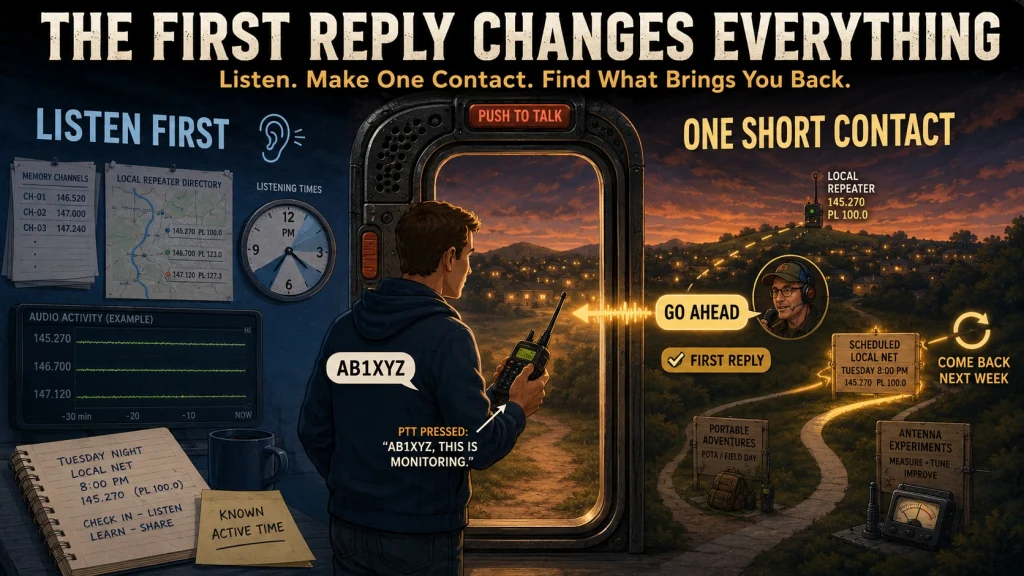
Ham radio feels less like owning one device and more like entering a collection of small operating worlds. Your first weeks are usually spent listening, learning when local activity happens, and working up the nerve to make a short contact. Some operators settle into local conversations, while others prefer HF, digital modes, portable operating, or antenna experiments. The hobby becomes rewarding when you find one activity that gives you a reason to turn the radio on again.
What Is Ham Radio Like in the First Few Weeks?
The first time I keyed up on a local repeater and another operator came back, I was not sure what to say. I understood what the controls did, but that did not automatically make me comfortable having an on-air conversation. That gap between knowing how a radio works and knowing what to do with it is the part most beginner explanations skip.
For many new operators, the first weeks are quieter than expected. You look up nearby repeaters in RepeaterBook, save a few likely frequencies, and listen at different times of day. Some channels are busy during a commute, some come alive only for a scheduled net, and some listed repeaters may sound nearly silent from your location. The practical lesson is that local activity matters more than the number of frequencies stored in memory.
This article is about that lived experience, not the license process, equipment recommendations, or a detailed programming tutorial. For the wider question of whether the activity fits your interests, the guide to understanding ham radio as a hobby places this day-to-day experience in the larger picture. Here, the focus is what happens after the theory, when you begin listening for real people and deciding whether you want to join them.
Field Note: On that first repeater contact, the radio was not the difficult part. The hesitation came after another person answered and the moment stopped being a test of equipment. It became a real conversation with call signs, pauses, and another operator waiting for me to continue.
That first phase is not wasted time. Listening reveals which repeaters are active, how operators identify, how long typical exchanges last, and whether the local culture sounds welcoming or formal. It also prevents a common mistake: assuming an empty channel at one random hour means there is no amateur activity in the area.

The Icom IC-V86 is a portable 2-meter FM handheld amateur radio covering 144 to 148 MHz. Amazon lists 207 channels and identifies the unit as a portable VHF two-way radio. The listing also describes the radio as water resistant.
Check On AmazonIf you click this link and buy, we earn a commission at no additional cost to you.
A Realistic Map of the First Month
There is no universal weekly schedule for amateur radio. Someone near several active repeaters may hear conversations immediately, while a rural operator may need to wait for a net or explore a different band. Instead of treating the first month as a deadline, I find it more useful to view it as four small stages that can overlap.
| Stage | What You Are Doing | What Usually Feels Unfamiliar | Useful Sign of Progress |
|---|---|---|---|
| Listening | Checking local repeaters, simplex activity, and scheduled nets | Long quiet periods followed by sudden activity | You know when and where one real conversation is likely to happen |
| Recognizing the rhythm | Noticing call signs, pauses, check-in order, and common topics | The language sounds more formal than an ordinary phone call | You can follow who is speaking without feeling lost |
| Making a brief contact | Identifying on a repeater, answering a call, or checking into a net | You may plan the first sentence and forget the second | You complete a short exchange and know how to end it cleanly |
| Finding your corner | Repeating the activity you enjoyed or trying a different operating style | The range of possibilities can feel larger than expected | You have a specific reason to get on the air again |
The key distinction is between collecting options and developing a routine. Ten programmed repeaters do not create a hobby by themselves. One net you recognize, one simplex contact that went well, or one digital mode you want to understand can give the experience enough shape to continue.
Listening Is Participation, Not a Failure to Start
New operators sometimes judge a listening-only evening as a failure because they did not transmit. I do not see it that way. If you learned that a repeater carries a traffic net at a certain time, that operators leave a clear pause before responding, or that a channel is inactive during your available hours, you gained information that changes your next move.
Listening becomes unproductive only when it has no next step. Give it a purpose: identify one active time, write down the basic rhythm, and decide whether you want to return as a participant. That turns passive monitoring into a low-pressure way to learn the local environment.
Making the First Contact Feels Formal Until It Does Not
The etiquette is usually simpler than it sounds from the outside. On a repeater, a new operator may identify and say they are listening, respond when invited during a net, or answer another station. On simplex, the contact may begin with a short call and a pause for a reply. The hard part is rarely memorizing a script; it is accepting that another person might answer.
I have watched new licensees delay that moment because they believe the first contact needs to be impressive. It does not. A call sign, a name, a general location, and a brief reason for being on the air are enough to support a normal exchange. The other operator does not need your full radio history, and you do not need to sound like an announcer.
The first contact often feels short because the operator is concentrating on several things at once: the call sign, the push-to-talk timing, what the other person said, and what should come next. Repetition reduces that mental load. After a few exchanges, the radio becomes less of an object demanding attention and more of a doorway into the activity.
Three Common Paths Into a First Conversation
A scheduled net is often the most predictable path because there is a net control operator and a clear invitation to check in. A repeater conversation is less structured but still gives you the benefit of established local activity. A simplex call feels more open-ended because there may be no one listening nearby, so silence tells you less about your ability than beginners often assume.
- Scheduled net: Best when you want a known time, an expected check-in process, and a defined beginning and end.
- Repeater contact: Best when you already hear local operators and want a short, ordinary exchange.
- Simplex contact: Best when you know another operator is nearby or local activity is common on the chosen frequency.
These are not levels you must complete in order. They are different social conditions. Choose the one that removes the largest source of uncertainty for you, whether that is timing, range, or not knowing who is available.
What the Ham Radio Daily Experience Can Include
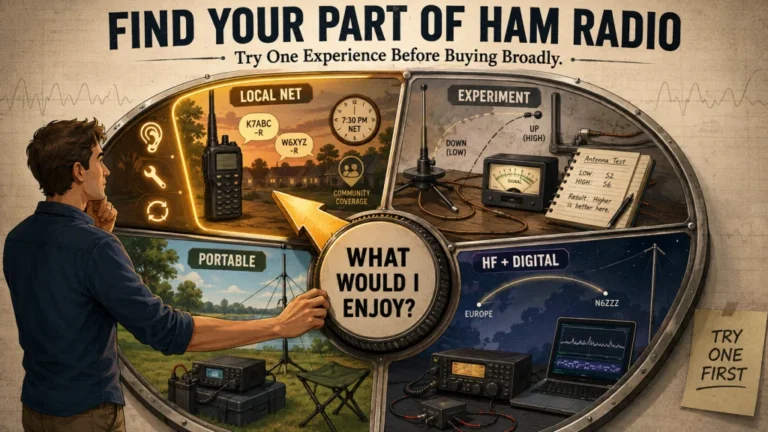
What a ham radio operator does from day to day is rarely the same from one person to the next. One person may use a local FM repeater during a commute. Another may spend an evening making HF contacts, while someone else watches FT8 signals decode on a screen or adjusts an antenna to see whether a distant station becomes easier to hear. All of those activities belong to the same hobby, but they do not feel like the same pastime.
This variety is the main reason the question “What is it like to be a ham radio operator?” has no single answer. Some operators value conversation. Some prefer technical experimentation with only brief exchanges. Others like portable operating because the radio gives a hike or campsite a specific challenge. A person can enjoy amateur radio without wanting to participate in every mode, band, event, or community.
Local Conversation and Scheduled Nets
Local FM activity often feels closest to a community channel. Conversations may cover signal reports, weather, local events, equipment problems, or ordinary daily life. Nets add structure by giving operators a regular meeting time and a reason to test whether their stations are working.
The social experience depends heavily on the area. One repeater may have a friendly daily group, another may be used mainly for formal nets, and a third may be quiet despite appearing in a directory. That local variation is why the first weeks involve more listening than a conceptual beginner guide suggests.
HF Contacts and the Search for Distance
HF operating feels different because conditions become part of the activity. A station that is strong one evening may be weak or absent the next, and an operator may listen across several frequencies before finding a conversation or calling frequency. Some people enjoy that uncertainty because each contact feels partly like communication and partly like solving a changing signal problem.
Others find it frustrating. If you want guaranteed conversation at a fixed hour, casual HF tuning may not satisfy you. If you enjoy seeing what the bands allow today, the variability is the attraction rather than a defect.
Digital Modes and Technical Experimenting
FT8 can look surprisingly quiet from the operator’s side. The radio passes short, timed digital signals while software displays stations that were decoded. The activity is less conversational than voice, but it gives immediate feedback about propagation and whether a signal is being heard beyond the local area.
Antenna experiments create another version of the hobby. The satisfying moment may not be a long conversation at all. It may be noticing that a change reduces noise, improves a signal report, or makes a station readable that was previously buried. This is where amateur radio starts to feel more like a workshop than a social channel.

The Xiegu G90 is an HF transceiver with RF output up to 20W. It has a detachable display unit and a built-in wide-range automatic antenna tuner. The radio also includes a color LCD spectrum display with waterfall for viewing surrounding signal activity.
Check On AmazonIf you click this link and buy, we earn a commission at no additional cost to you.
What Does Ham Radio Sound Like?
It does not have one sound. The experience changes with the band, mode, signal strength, interference, and propagation. A clear local FM signal can sound close to ordinary two-way voice communication, while a weak HF single-sideband signal may fade, hiss, and require more concentration to understand.
| Operating Sound | What You Hear | What the Experience Feels Like |
|---|---|---|
| VHF or UHF FM voice | Clear speech when the signal is solid, with brief noise as weaker signals drop | Local, immediate, and conversation-focused |
| HF single-sideband voice | Speech mixed with hiss, fading, crowded signals, and changing clarity | More dependent on careful listening and conditions |
| FT8 | Short groups of closely spaced digital tones repeating in timed cycles | Measured, visual, and focused on decoding and signal reach |
| Morse code | Rhythmic tones at different speeds, sometimes dense during an event or contest | Skill-based and pattern-driven, even when you are only listening |
The phrase “the bands have personalities” is useful as long as it is not taken literally. The personality comes from a combination of the mode, the people using it, and the conditions at that moment. A busy contest weekend sounds nothing like a slow weekday net, even when both are amateur radio.
Listening across these sounds can tell you more about fit than reading a list of features. Someone who dislikes noisy voice signals may still enjoy clean local FM or digital decoding. Someone who finds digital contacts too automated may prefer the unpredictability of live conversation.
Why Some New Operators Stay Active and Others Drift Away
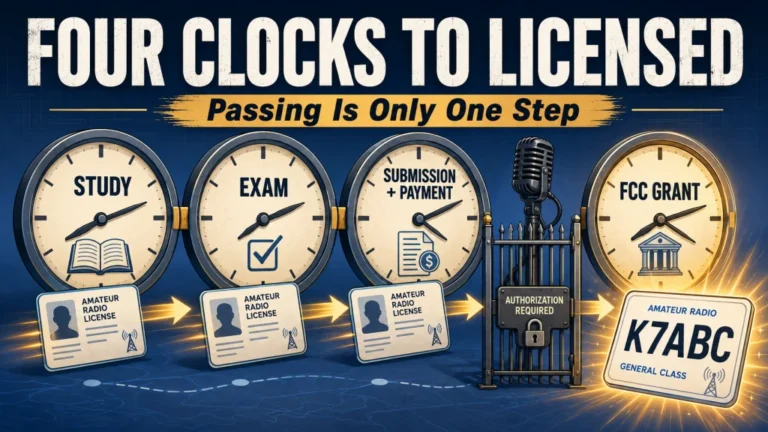
Passing an exam creates permission to operate, not a reason to operate. The people who continue usually discover a specific activity that fits their interests, schedule, location, and tolerance for learning. Without that connection, the radio can remain charged and ready while never becoming part of daily life.
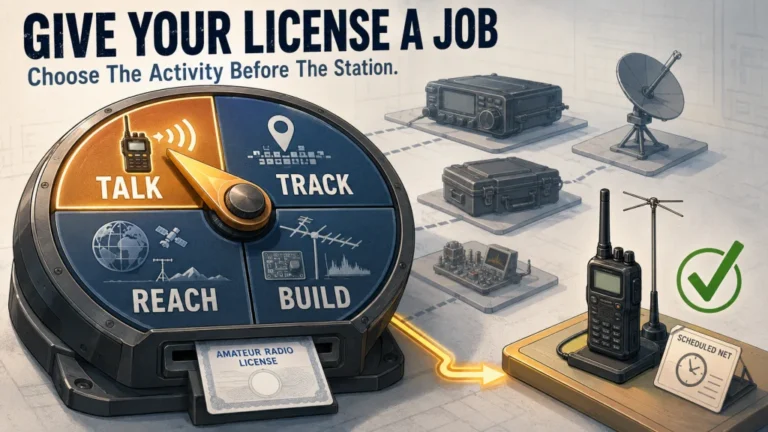
A common mistake is treating the hobby like a checklist that must be completed all at once: local repeaters, HF, digital modes, emergency communication, antennas, and every piece of operating etiquette. That approach turns curiosity into homework. The more useful question is not “How do I do all of ham radio?” but “Which experience was interesting enough that I would practice it again?”
Signs That You Have Found an Activity That Fits
- You check when a particular net meets because you want to hear or join it again.
- You remember a station or conversation and want to improve the next contact.
- You become curious about why a signal changed rather than only feeling annoyed by it.
- You choose one small operating goal without feeling pressure to master the whole hobby.
- You begin recognizing call signs, voices, sounds, or operating patterns that were unfamiliar a few weeks earlier.
None of those signs requires constant activity. Some operators are on the air daily, while others return for a weekly net, an occasional portable trip, or a particular event. Frequency of use matters less than whether the experience has a clear purpose for you.
When the Experience May Not Fit Your Expectations
Ham radio may disappoint someone who expects instant conversation every time the radio is turned on. Activity varies by location and hour, HF conditions change, and even a correctly operating station can hear silence. The hobby asks for some tolerance of waiting, experimenting, and trying a different time or activity.
It may also feel wrong if you want communication only with people you already know. Amateur radio can support planned contacts, but much of its character comes from reaching unfamiliar operators, joining established activity, or exploring what is available. Recognizing that mismatch early is more useful than forcing yourself to enjoy a version of the hobby that does not suit you.
A Low-Pressure Way to Test the Experience
You do not need to sample every corner of amateur radio before deciding whether it feels worthwhile. A better test is one repeatable experience. Choose a local net, a known simplex contact, an evening of supervised HF listening, or a basic digital-mode demonstration, then return to it enough times for the unfamiliar procedure to stop dominating your attention.
- Choose one activity: Pick the part that sounds interesting, not the part you think a “real” operator is supposed to prefer.
- Observe the rhythm: Note when people are active, how contacts begin, and how they end.
- Participate at the smallest useful level: Make a short contact, check into a net, or follow one complete digital exchange.
- Repeat before judging: The first attempt measures unfamiliarity as much as enjoyment.
- Keep or replace the activity: Continue if curiosity grows. Try a different corner of the hobby if it feels flat.
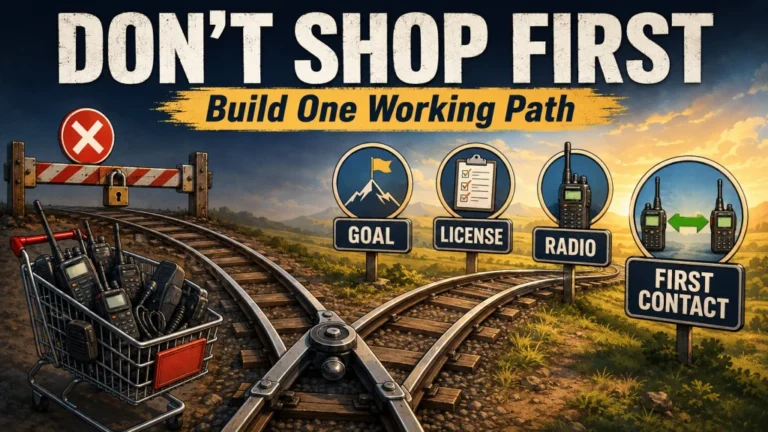
This decision path protects beginners from a common trap: assuming one silent repeater, awkward contact, or confusing evening represents all of amateur radio. It also prevents the opposite mistake of buying deeper into the hobby before any part of the operating experience has become personally meaningful.
For a broader sequence from curiosity to a workable first direction, the practical ham radio guide for beginners connects the experience to the next decisions without requiring you to pursue every path at once.
Final Thoughts: Find the Part You Want to Repeat
What is the ham radio experience like? At first, it is a mix of listening, uncertainty, short bursts of activity, and small moments when the procedures begin to make sense. It can feel social, technical, exploratory, or methodical depending on which part you choose.
The first contact matters, but it is not the finish line. The more useful milestone is finding one activity you want to repeat without needing someone to tell you that you should. Once that happens, the radio stops being a gadget you are trying to justify and becomes a tool for an experience you already value.

The RTL-SDR Blog V4 is a receive-only software-defined radio using an R828D tuner and RTL2832U. It tunes from 500 kHz to 1.7 GHz and includes a portable VHF/UHF dipole antenna kit. The V4 also has a built-in HF upconverter, improved filtering, a 1 PPM TCXO, and an activatable bias tee.
Check On AmazonIf you click this link and buy, we earn a commission at no additional cost to you.
FAQs
📻 What do ham radio operators talk about?
Local conversations may cover signal reports, weather, community events, technical questions, travel, or ordinary daily life. The topic depends on the group and operating setting, so listening first is the quickest way to understand the local style.
🎧 Can I listen for a while before making a contact?
Yes. Listening helps you identify active times, understand check-in patterns, and hear how operators end an exchange. Give the listening a purpose so it leads to a clear next step rather than becoming permanent hesitation.
🗣️ Does ham radio sound like a walkie-talkie?
Local FM voice can sound similar when the signal is strong. HF voice often includes more fading, hiss, and crowded signals, while digital modes and Morse code sound completely different.
🤝 Is the first ham radio contact usually awkward?
It often feels awkward because you are managing the radio, call signs, timing, and conversation at the same time. A brief exchange is enough, and the procedure usually feels more natural after a few contacts.
🕒 How often do active ham radio operators get on the air?
There is no standard schedule. Some operate daily, while others join a weekly net, use the radio on trips, or return for occasional events. The useful measure is whether the activity has a purpose that fits your life.
🧭 How do I know which part of ham radio I will enjoy?
Choose one experience and repeat it after the initial unfamiliarity fades. If you remain curious about the people, signals, conditions, or technical problem, that is a stronger sign of fit than trying every activity once.