Ham radio is a licensed two-way radio service that can support local conversations, emergency communication networks, technical experimentation, outdoor operation, and long-distance contacts when the license, equipment, antenna, and conditions all fit the goal. A US beginner normally starts by passing the 35-question Technician exam, paying any separate exam-session charge, and then paying the $35 FCC application fee after the application enters the FCC system. You can listen before earning a license, but you must wait for an active FCC call sign before transmitting. The smartest first decision is not which radio to buy, but what you actually want the station to do.
Ham Radio for Beginners Starts With the Right Expectation
Ham radio is a licensed radio service, not a single gadget or one fixed style of communication. A handheld can connect a new operator to a local repeater, a mobile station can improve coverage from a vehicle or home, and an HF station can reach across states or countries when the operator has the required privileges and the propagation cooperates. None of those outcomes comes automatically from owning a radio. The license class, operating band, antenna, terrain, local activity, and station setup all affect what is realistically possible.
That is the central idea behind this beginner ham radio guide. It gives you the complete overview needed to decide whether the hobby fits, while leaving detailed exam preparation, equipment selection, and programming procedures to their own guides. I am not talking about advanced contest stations, complex antenna modeling, commercial radio systems, or equipment repair here. The goal is to help a US adult understand the commitment, choose a sensible direction, and avoid spending money before the use case is clear. These are the basic ideas a beginner should understand before detailed licensing or setup instructions become useful.
Amateur radio is also a large active community rather than a disappearing technical curiosity. FCC-derived figures reported through July 16, 2026 showed 732,565 active individual US licenses. That number does not tell you whether the repeaters near your house are busy or whether a local club fits your interests, but it does show that beginners are entering a service with substantial national participation and many different operating paths.
What Ham Radio Actually Is
At its simplest, amateur radio lets licensed individuals communicate with other licensed operators on frequencies assigned to the Amateur Radio Service. A direct radio-to-radio contact can work without a cell tower, a commercial carrier, or an internet account. Repeaters can extend local VHF and UHF coverage, while HF bands can support regional and worldwide communication by using the atmosphere to carry signals beyond the local horizon.
The phrase “works without the internet” needs one important condition. A basic simplex or self-contained HF contact can be independent, but some repeaters, digital systems, and linked networks use commercial power or internet connections as part of their normal operation. Ham radio gives operators the ability to build communication paths that do not depend on one commercial network, but it does not make every station or repeater immune to infrastructure failure.
The service is open and cooperative. Operators identify with FCC-issued call signs, follow band and operating rules, and generally communicate where other listeners can hear them. It is not a private replacement for a phone call, and it is not a guaranteed emergency lifeline to any person or agency. Its value comes from trained operators, working equipment, practical antennas, shared procedures, and other stations prepared to receive and respond.
| Communication path | What it can realistically support | What changes the result |
|---|---|---|
| Handheld to handheld | Short local contacts | Terrain, buildings, antenna height, and distance |
| Handheld or mobile through a repeater | Wider local or regional coverage | Repeater location, access settings, activity, and site reliability |
| HF station | Regional, national, or international contacts | License privileges, antenna, band conditions, noise, and operator skill |
| Portable field station | Communication from parks, campsites, events, or temporary locations | Battery capacity, antenna deployment, terrain, weather, and setup time |
This range is what makes the hobby feel confusing at first. The same hobby can mean a five-minute local repeater conversation or an evening spent working distant stations on HF. Choosing between those paths before buying equipment removes most of the early confusion.

The Yaesu FT-60R is a 5W dual-band VHF/UHF handheld amateur transceiver for 2 meter and 70 centimeter operation. The listing includes 1,000 memory channels, scanning, a lighted keypad, and NOAA weather alert reception. It comes with a battery, charger, antenna, and belt clip.
Check On AmazonIf you click this link and buy, we earn a commission at no additional cost to you.
Why People Get Into Ham Radio
A useful way to sort beginner interest is into three broad starting points: emergency preparedness, technical curiosity, and outdoor recreation. These paths overlap, but they create different first priorities. Someone interested in neighborhood emergency communication needs to learn which local frequencies and groups are actually used. Someone interested in radio technology may care more about antennas, propagation, digital modes, and station experimentation. A hiker or camper may care most about weight, battery life, terrain, and whether another operator will be listening.
Emergency preparedness attracts people because amateur stations can communicate when ordinary networks are congested, damaged, or unavailable. The realistic version is less dramatic than many advertisements make it sound. A radio is useful only when it can reach a prepared station, the operator knows the correct procedures, and the equipment still has power. Joining local nets and learning how emergency communication groups operate is more valuable than putting an unopened radio in a closet.
Technical interest can begin with something as simple as wondering why one antenna hears a signal that another misses. From there, an operator can learn about electronics, radio wave behavior, digital communication, computer interfaces, and practical station design. You do not need to build equipment from scratch or become an engineer. The hobby works just as well for someone who wants to understand enough to configure and improve a modest station one step at a time.
Outdoor operators bring radios to parks, trails, summits, campsites, and community events. A Technician license and a VHF/UHF station can support local portable contacts, while broader HF privileges open additional long-distance possibilities from the field. Terrain matters more than the number printed on the radio box. A low-power station from a clear mountaintop can outperform a higher-power handheld used from the bottom of a wooded valley.
Key point: The best starting path is the one you will actually practice. Emergency readiness, technical learning, and outdoor operation all become more useful through repeated real use, not by collecting equipment for a future situation.
What the US Ham Radio License Involves
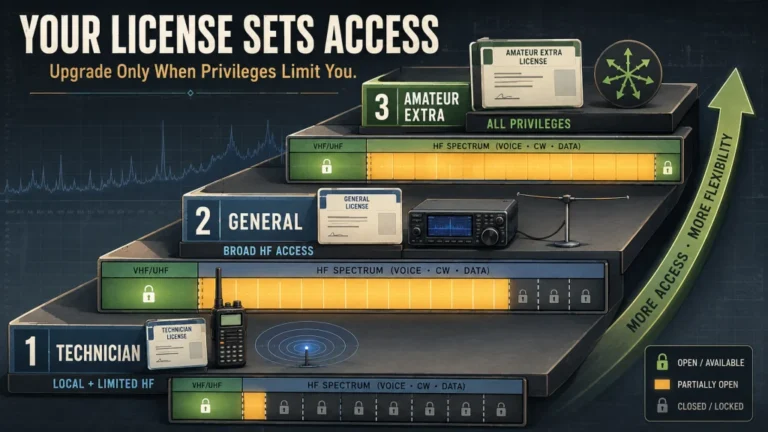
The FCC offers three current operator classes: Technician, General, and Amateur Extra. Technician is the entry-level license and gives access to all amateur bands above 30 MHz, including the VHF and UHF bands where many beginners start with local repeaters and simplex contacts. It also includes limited privileges on certain HF band segments. General adds broad HF voice and data privileges, while Amateur Extra provides all available US amateur operating privileges.
The first exam has 35 questions covering regulations, operating practices, electronics, antennas, radio wave behavior, and safety. You need 26 correct answers to pass. Exams given from July 1, 2026 through June 30, 2030 use the current 409-question Technician pool. You do not answer all 409 questions during the test; the exam draws 35 questions from that active pool.
The money flow causes more confusion than the exam structure. A Volunteer Examiner session may charge its own examination fee, which is separate from the FCC. After a successful new-license application reaches the FCC system, the applicant pays the current $35 FCC application fee directly to the FCC. That fee is not the price of the test, and an operator-class upgrade is normally exempt from the FCC application fee even though the new exam session may have its own charge.
Licenses are normally valid for ten years. Passing the exam does not authorize immediate transmission if the first license has not yet been granted. A first-time applicant must wait until the FCC database shows the assigned call sign and active license. The full sequence, fee details, privileges, and renewal rules are covered in the guide to how the US ham radio license works.

The ARRL Ham Radio License Manual 6th Edition is a Technician-class study guide for the current exam cycle. It covers amateur radio rules, radio fundamentals, circuits, propagation, antennas, equipment, operating regulations, and safety. The book also includes the complete Technician question pool for exams beginning July 1, 2026.
Check On AmazonIf you click this link and buy, we earn a commission at no additional cost to you.
What a First Ham Radio Setup Can Cost
There is no honest single price for getting started because “first setup” can describe three very different levels. A person who only wants to listen and learn needs less equipment than someone trying to reach a local repeater reliably. A beginner planning for HF needs a radio, antenna system, power arrangement, feed line, and enough space or portability to deploy the station. Quoting only the radio price hides the parts that determine whether the station works.
The ranges below reflect ordinary US retail pricing reviewed in July 2026. They are planning ranges, not required spending targets or promises. Used equipment, existing power supplies, borrowed club stations, simple wire antennas, and local assistance can lower the total. Premium features, digital voice systems, difficult antenna installations, or a completely new home station can raise it substantially.
| Starting level | Approximate July 2026 range | What the range assumes |
|---|---|---|
| Listen and learn | $0 to $150 | An existing receiver, an online receiver, or basic receive-capable equipment without a complete transmitting station |
| Practical first VHF/UHF station | $75 to $500 | A handheld or modest local station plus the programming, power, mounting, or antenna items genuinely needed for the location |
| HF-capable station | $900 to $2,500 | A new entry-level or midrange HF radio with power, feed line, antenna, connectors, and basic installation needs |
The lower end of a range is not automatically the best value, and the upper end is not automatically a better beginner choice. A $100 handheld that reaches an active local repeater may be more useful to its owner than a four-figure HF radio connected to an antenna that cannot be installed properly. The complete communication path matters more than the most impressive item on the desk.
Field Note: The equipment question often arrives immediately after an exam session, sometimes before the new operator has checked when the call sign will be granted. I usually bring the conversation back to one question: who do you want to communicate with, from where, and over what distance? Until that answer is clear, a radio recommendation is mostly permission to buy rather than useful guidance.
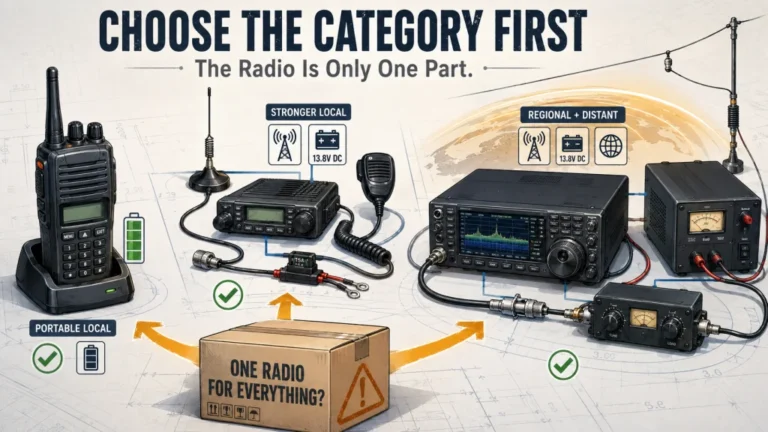
Before choosing equipment, separate the radio type from the operating goal. A handheld, a vehicle radio, a home VHF/UHF station, and an HF station solve different problems. The broader guide to choosing a ham radio by use case explains those equipment paths without assuming every beginner needs the same capability.
What You Can Actually Do With Ham Radio
The hobby can support far more than casual voice conversations, but license privileges and station design still set the boundaries. A beginner might start by listening to a local net, making a repeater contact, or practicing simplex communication with another licensed operator. Later interests can include public-service events, emergency communication training, portable operation, radio direction finding, digital messaging, propagation experiments, or long-distance HF contacts.
Digital communication is another broad area rather than one feature. Some modes exchange keyboard messages, position reports, telemetry, images, or weak-signal contact information. The correct band, mode, software, interface, and license privileges all matter. A Technician license does not create unrestricted HF data privileges across the popular HF bands, so the operating plan must stay inside the privileges of the license actually held.
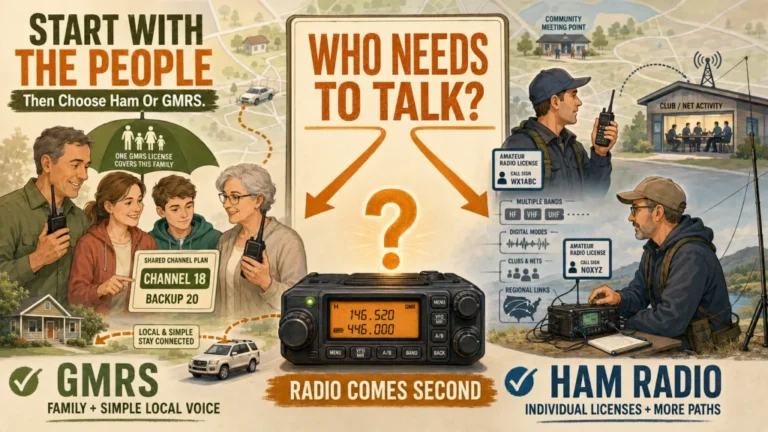
Families need one additional expectation. Amateur licenses are issued to individuals, not to an entire household. A licensed control operator may supervise certain station operation under the rules, but family members who want independent transmitting privileges need their own licenses. For a household, the practical question is not only whether one person enjoys radio, but whether the others are willing to learn and participate.
Public-service and emergency activity also adds a procedural side that casual operating may not require. Local nets, message formats, check-in methods, and the organizations active in the area all shape how useful a station becomes. A beginner does not need to master that structure immediately, but should know that preparedness value comes from practice with a real group, not from equipment alone.

The Xiegu G90 is a portable HF transceiver with up to 20W of RF output. It has a detachable display unit, a built-in wide-range automatic antenna tuner, and a color LCD spectrum display. The package includes the transceiver, multifunction microphone, power cable, remote-head cable, firmware cable, and operating manual.
Check On AmazonIf you click this link and buy, we earn a commission at no additional cost to you.
Who Ham Radio Is For, and Who May Not Need It
Ham radio fits people who are willing to earn an individual license, learn basic operating rules, and practice with equipment before depending on it. It is especially rewarding when the person enjoys one or more parts of the process: talking with other operators, improving a station, learning technical concepts, volunteering, experimenting with signals, or taking radio outdoors. The learning curve is real, but it can be kept small by choosing one first activity.
The hobby may be a poor fit when the only requirement is private, effortless communication with people who do not want licenses. It may also disappoint someone who expects guaranteed long range from a handheld, refuses to install or deploy an appropriate antenna, or has no interest in finding local activity. Those are not character flaws. They are signs that another communication service or device may match the situation better.
Housing restrictions can also change the answer. A renter, condominium owner, or person under private HOA covenants may have limits on permanent antennas. PRB-1 concerns state and local land-use regulation and does not override private HOA covenants, CC&Rs, or rental agreements. Portable and indoor arrangements may still work, but an HF plan that assumes a large permanent outdoor antenna should be checked before the radio is purchased.
The same reality applies to outdoor users. A handheld can be useful on a trail when licensed partners or active repeaters are within reach, while a satellite messenger may solve a different problem when the requirement is reaching a monitoring service or non-ham contact from a remote area. Understanding the exact communication partner is more important than deciding that one technology is universally best.
A Practical Decision Path Before You Start
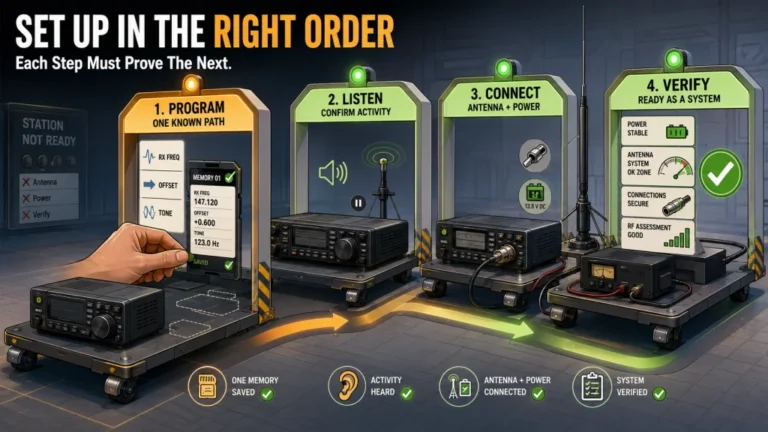
Getting started with ham radio becomes manageable when the decisions are made in the right order. I have seen new operators reverse that order by buying a handheld first, searching for a use afterward, and then discovering that the license, band, antenna, or local coverage does not match the original expectation. The following sequence keeps the first commitment small while still moving toward real operation.
- Write down one specific communication goal, including who you want to reach and from where.
- Decide whether the likely path is local VHF/UHF, portable operation, or broader HF communication.
- Check the license privileges needed for that path before choosing equipment.
- Look for real local activity, repeaters, clubs, nets, and operating opportunities.
- Set a budget for the complete station, including antenna, power, feed line, programming, and mounting needs.
- Listen before transmitting so the local operating rhythm is familiar.
- Buy only enough equipment to complete the first useful activity.
- Upgrade after identifying a real limitation, not because a feature list looks impressive.
This sequence also reveals when the plan needs to change. If there is no active repeater within practical reach, a handheld-centered plan may need a better antenna, a mobile or home station, or a different operating goal. If an HOA blocks the intended permanent antenna, portable HF may be more realistic than a fixed installation. A good starting plan adapts to the location instead of pretending the same station works for everyone.
Do not wait until every part of the hobby makes sense. Learn enough to pass safely, listen to real operators, and complete one small contact path. Confidence grows from a working sequence, not from reading every possible answer before turning on a radio.

The RTL-SDR Blog V4 is an RX-only software-defined radio dongle using an R828D tuner and RTL2832U. The listing states that it can tune from 500 kHz to 1.7 GHz and connects to a personal computer. It includes the V4 dongle and a multipurpose portable VHF/UHF dipole antenna kit.
Check On AmazonIf you click this link and buy, we earn a commission at no additional cost to you.
Final Thoughts: Choose the Purpose Before the Radio
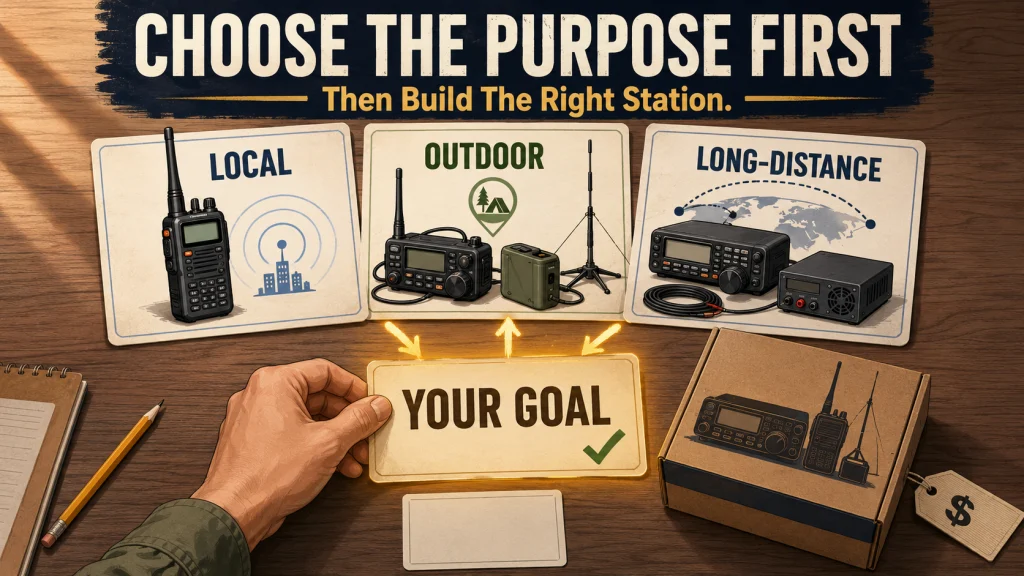
Ham radio can be a communication tool, a technical hobby, a public-service skill, or an excuse to carry an antenna into the woods. Its flexibility is the attraction and the source of most beginner confusion. The correct first station depends on the license class, desired distance, communication partner, local activity, terrain, antenna options, and budget. No single radio or setup can be the best answer across all of those conditions.
Start by naming one thing you want to do. Then learn the license requirement, find the people or signals involved, and build the smallest complete station that can do that job. That approach costs less, gets you operating sooner, and gives every later upgrade a reason.
Explore More Beginner Ham Radio Guides
The next guide depends on which question is still unresolved. One path helps you decide whether the hobby is worth pursuing, another turns that interest into a practical starting plan, and the third sorts the hobby by real-world use case.
| Guide | What it helps with |
|---|---|
| Ham Radio as a Hobby | Evaluate the benefits, limitations, time commitment, and learning curve before you commit. |
| How to Get Started With Ham Radio | Move from initial interest to licensing, listening, local activity, and a realistic first operating goal. |
| Practical Ham Radio Uses | Find the most relevant path for preparedness, outdoor recreation, family communication, experimentation, or long-distance operating. |
Pick the guide that answers the decision immediately in front of you. There is no advantage in planning an advanced station before you know whether local communication, portable operation, or HF is the reason you want a license.
FAQs
📻 Do I need a license to listen to ham radio?
No license is required merely to listen. A license and active call sign are required before you transmit on amateur frequencies.
📝 How hard is the Technician ham radio exam?
The exam has 35 questions, and 26 correct answers are required to pass. It tests regulations, operating practices, electronics, antennas, propagation, and safety rather than requiring advanced engineering knowledge.
💰 How much does it cost to start ham radio?
The new-license process includes any separate exam-session charge and the $35 FCC application fee. As of July 2026, a practical first VHF/UHF setup commonly falls around $75 to $500, while a complete new HF-capable station often begins closer to $900.
🌎 Can a Technician license talk around the world?
Technicians have limited HF privileges and several possible long-distance paths, but worldwide communication is not guaranteed. General class is the practical license level for broad HF voice and data access.
🏕️ Is ham radio useful for hiking and camping?
It can be useful when there are reachable repeaters, licensed partners, or portable operating opportunities. Terrain, antenna height, battery planning, and who is listening matter more than the radio’s advertised maximum range.
🚨 Will ham radio always work when cell service fails?
No communication system always works. Amateur radio can operate independently of phone and internet networks, but success still depends on power, antennas, trained operators, usable frequencies, and another prepared station.
👨👩👧 Does one ham radio license cover the whole family?
No. Amateur operator licenses are issued to individuals. Family members who want independent transmitting privileges need their own licenses.
🔧 Should I buy a radio before taking the exam?
You can, but decide on the first use case before buying. Listening first and checking local repeater activity can prevent you from choosing a radio that does not match the distance, band, or location involved.