A new US Technician license may take a few well-aligned days or several weeks, with study readiness and exam availability usually accounting for most of the calendar. The current 2026-2030 Technician pool contains 409 questions, while the exam draws 35; after passing, a new applicant must pay the $35 FCC application fee and wait for the call sign to appear in the Universal Licensing System before transmitting. The most useful estimate is therefore a personal schedule built from each stage rather than a promised licensing date.
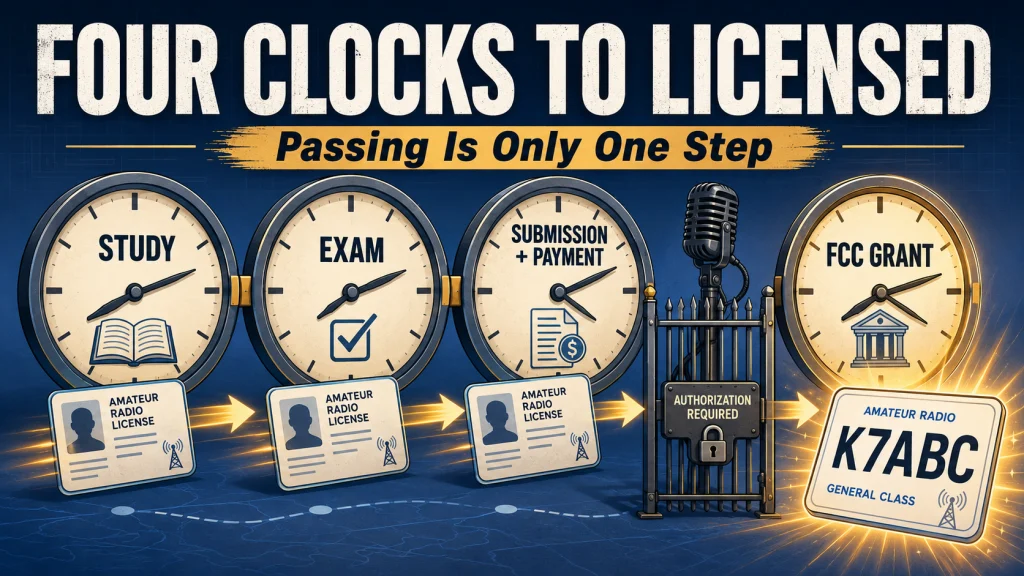
The Real Timeline Has Four Separate Clocks
The question “how long does it take to get a ham radio license?” sounds as though it should have one clean answer. It does not, because four clocks are running: your study time, the wait for an available exam, the VE and VEC submission process, and the FCC payment and grant process. One fast stage cannot cancel a delay in another.
As of July 2026, the Technician exam uses the 2026-2030 pool, which became effective on July 1, 2026. The pool has 409 questions, but each Element 2 exam contains 35 questions. You do not sit through all 409, and the size of the public pool should not be mistaken for the length of the test or the number of facts every candidate will master at the same speed.
Across Technician exam sessions, I have seen candidates arrive after months of preparation and others compress the work into a short window. The calendar alone never tells me whether someone is ready. A candidate who studies for three weeks with regular review may be better prepared than someone who spends a longer period opening a study page only occasionally.
This article covers the timeline for earning a first US Technician license, from the first study session through the appearance of a call sign. It does not compare study courses or teach the exam material in depth, and it does not cover the different operating rules that may apply to an existing licensee completing an operator-class upgrade.
How Long to Study for a Ham Radio License
Study time is the largest part of the schedule that you control, but it is also the easiest part to estimate badly. Prior experience with electronics, radio procedure, basic math, and regulations can shorten the learning curve. A first-time candidate who is balancing work, family, and unfamiliar technical vocabulary may need a steadier pace.
The ranges below are planning examples, not measured averages, pass-rate claims, or guarantees. I use them to help candidates think about study rhythm and available attention. The right path is the one that gives you enough repetition to recognize the concepts without turning preparation into a memory sprint that disappears the day after the exam.
| Planning path | Example schedule | Who it may fit | Main risk |
|---|---|---|---|
| Accelerated | Several focused study blocks over 2 to 4 days | A candidate with related technical knowledge, flexible time, and strong practice results | Memorizing answer patterns without retaining the operating concepts |
| Steady | About 30 to 60 minutes on most days for 2 to 4 weeks | A first-time candidate who wants regular review without taking over the entire week | Continuing to read without checking whether weak topics are improving |
| Longer | Two to four study sessions per week for 6 to 10 weeks or more | A candidate with limited free time, test anxiety, or little technical background | Losing continuity between sessions and repeatedly restarting the same material |
Field Note: At exam sessions, the difference I notice is rarely that one candidate studied for exactly the correct number of days. The better signal is whether the person can work through unfamiliar wording without falling apart when a question does not look exactly like the practice version.
Use practice performance as a readiness check, but do not treat one lucky score as proof. Look for consistent results across multiple mixed exams and review the reasons behind missed answers. For a deeper look at preparation options and license classes, use the Technician license exam resources after deciding how much weekly study time you can realistically protect.
Exam Availability Can Be Faster or Slower Than Your Study Plan
A candidate can be ready on Friday and still wait if the nearest in-person team tests once a month. Another candidate may find a remote session the same day or later that week. Current ARRL and HamStudy listings include both in-person and remote sessions, but each team controls its own registration cutoff, fee, identification requirements, technology rules, and available seats.
Do not wait until the night before your target date to inspect the session details. Some teams allow walk-ins, while others require advance registration or close registration when their slots fill. Remote testing may remove the drive, but it can add camera, room, computer, internet, and scheduling requirements that need to be solved before exam day.
- Confirm whether the session is in person or remotely supervised.
- Check the date, time zone, registration deadline, and seat availability.
- Verify the team’s exam fee and accepted payment method.
- Read the identification, FRN, email, calculator, and room requirements.
- Ask whether additional license elements may be attempted at the same session.
- Confirm what happens if you arrive late, lose the remote connection, or need to reschedule.
The 35-question Technician element is only part of the appointment. Identity checks, instructions, the examination itself, grading, any additional element, and final paperwork all use time. Session listings often reserve a block rather than promising a fixed testing duration, so read the team’s instructions and avoid placing another commitment immediately afterward.
Retesting also depends on the coordinating VEC and the local team. Under the ARRL VEC fee structure, one fee covers one attempt at each available element; another attempt at the same failed element requires a different exam design and an additional fee if the team has time and permits the retest. Other VEC procedures may differ, so ask before relying on a same-session second attempt.
A useful strategy is to identify a realistic session before your preparation is finished, then work backward from that date. This gives the study plan a deadline without forcing you to test before you are ready. It also exposes scheduling problems early enough to choose a different team or format.
Readers who need the broader sequence before selecting a test date can follow the complete ham radio starting process. That keeps the exam in context with the FRN, licensing steps, first equipment decision, and first contact that follow.

The C920x records Full HD 1080p video at 30 fps for computer-based video sessions. Autofocus and automatic light correction help keep the image clear as room lighting changes. It also includes built-in audio and supports common meeting platforms such as Teams, Meet, and Zoom.
Check On AmazonIf you click this link and buy, we earn a commission at no additional cost to you.
Passing the Exam Does Not Immediately Create Transmit Authority
After you pass, the Volunteer Examiners complete the session records and the Volunteer Examiner Coordinator submits the application data to the FCC. The speed of that handoff depends on the team’s process, the VEC, weekends, holidays, data issues, and whether anything on the application needs correction. A certificate showing that you passed is valuable proof, but a new Technician applicant cannot use it as a substitute for an FCC grant.
When the FCC receives a feeable new-license application, it issues an application file number and sends payment instructions to the applicant’s email address. The current FCC application fee is $35, and the applicant has 10 calendar days from the date the file number is issued to pay it. The examination charge collected by a VE team or VEC is separate, varies by session, and is not the FCC application fee.
The $35 FCC fee applies to new licenses, renewals, rule-waiver requests, and vanity call sign requests. Ordinary operator-class upgrades and requests for a sequentially issued call sign are exempt from that application fee. Those exemptions matter later, but a person applying for a first Technician license should budget for both the team’s exam charge and the separate $35 FCC payment.
Warning: Do not transmit merely because the exam team said you passed or because the FCC application appears as pending. For a new license, wait until the assigned call sign appears as granted in the FCC Universal Licensing System.
Payment is one delay the candidate can control. Use an email address you monitor, check the spam folder, and respond promptly when the notice arrives. Paying quickly does not guarantee an immediate grant, but missing the payment window can stop the application and turn a short timeline into a new filing problem.
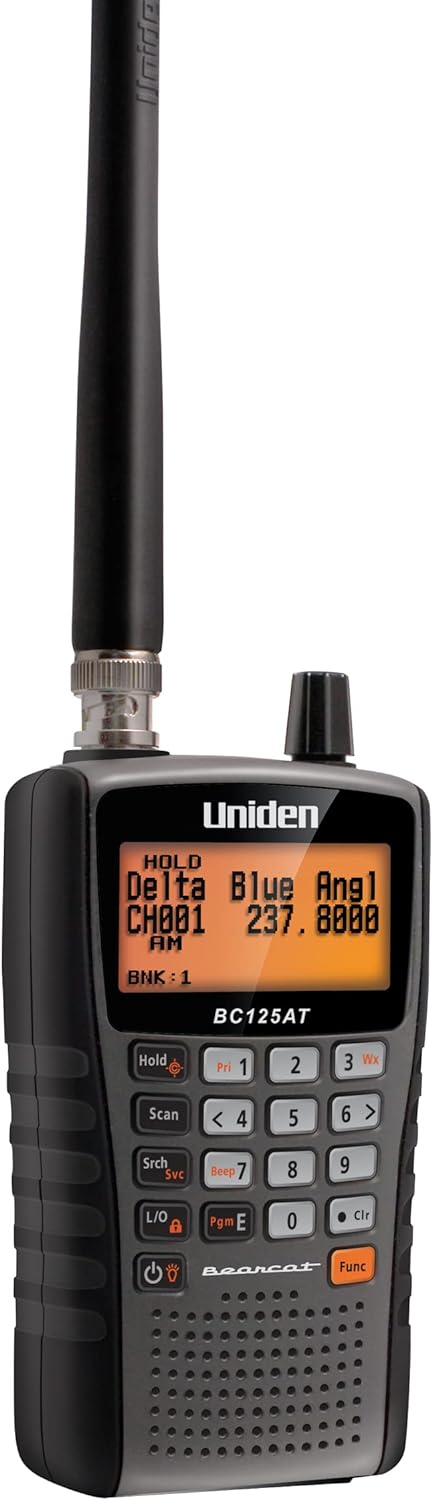
The BC125AT is a handheld scanner with 500 alpha-tagged channels for organizing monitored frequencies. Close Call RF Capture helps detect nearby transmissions, and the scanner covers aviation, marine, railroad, racing, and other supported analog services. Its compact handheld format gives a new operator a way to listen and learn while waiting for transmit authority.
Check On AmazonIf you click this link and buy, we earn a commission at no additional cost to you.
Build Your Estimate From Dependencies, Not One Average
At this point, stop looking for an average and write down the dates that apply to you. Choose a study window, identify an actual session with available registration, and leave the post-exam portion open until the application reaches the FCC. This turns a vague estimate into a schedule that can be adjusted when one stage changes.
The final grant deserves the largest uncertainty buffer because it sits outside the candidate’s direct control. Electronic submission and prompt payment can keep a clean application moving, but I would not plan a trip, public event, emergency exercise, or first on-air schedule around an assumed one-to-three-business-day result.
| Stage | What controls the time | Fast example | Reason to add buffer |
|---|---|---|---|
| Account and FRN preparation | Correct identity information, working email, and account access | Completed before booking the exam | Name, password, or record problems can delay registration |
| Technician study | Starting knowledge, daily time, retention, and practice consistency | Several intensive days | Many candidates need several weeks to learn comfortably |
| Exam scheduling | Local calendar, remote seats, registration cutoff, and time zone | A same-day or next-day opening may exist | The suitable team may test only weekly or monthly |
| VE and VEC submission | Team workflow, VEC process, data accuracy, weekends, and holidays | Prompt electronic handling | Corrections or delayed session processing add time |
| FCC fee payment | How quickly the applicant sees and pays the notice | Paid as soon as the file number is available | The applicant has a 10-calendar-day payment window |
| FCC grant and call sign | FCC processing and whether the application is clean | Processed without a record issue | No exact grant time should be promised |
For personal planning, add the stages rather than choosing one headline number. Someone following the steady study path might reserve two to four weeks for preparation, add the actual wait to the selected session, then leave extra time for submission, payment, and the FCC grant. A candidate on the accelerated path can shorten the study stage, but the later dependencies still remain.
Planning rule: Your target date should include a study buffer, an exam-booking buffer, a submission and payment buffer, and an FCC-processing buffer. Do not treat exam day as the finish line.
This approach also makes delays easier to diagnose. If you are not ready, adjust the study stage. If you are ready but no suitable session is available, search a wider area or compare remote options. If you have passed, track the application and payment steps instead of studying harder for a test that is already complete.
What a Verifiable Fast Path Actually Looks Like
Here is a dated availability example, not an expected result: on July 23, 2026, the ARRL exam search showed both in-person and remote sessions scheduled for that day. A candidate who was already prepared, met the team’s registration requirements, found an open seat, passed, received prompt electronic submission, paid the FCC fee immediately, and encountered no application problem could complete the process within a short calendar window. The example proves that exam access can be fast for some people; it does not establish a standard licensing time.
The useful lesson from that example is preparation, not speed. The candidate already has an FRN, uses a monitored email address, has matching legal identification, reads the team’s instructions, and produces stable practice results before taking the seat. Those details remove avoidable interruptions and give the VE team a clean record to submit.
Pick a desired call-sign date, assume a next-day FCC grant, and schedule an activity that requires transmitting immediately afterward.
Book the earliest suitable exam you can genuinely prepare for, pay promptly after passing, and keep the first operating date flexible until the call sign is granted.
Use the example as a checklist rather than a forecast. If the exam seat, identity information, payment access, or application record is not ready, move the target date instead of compressing the missing step. A short result remains possible, but the planning value comes from removing preventable delays.

The H390 connects by USB-A and works without a separate software installation for basic computer audio. Its rotating noise-canceling microphone is designed to reduce unwanted background noise during conversations. In-line controls provide quick volume and mute access, while the 6.23-foot cable gives some freedom to reposition during a remote session.
Check On AmazonIf you click this link and buy, we earn a commission at no additional cost to you.
How to Estimate Your Own License Date
Start with a target exam date rather than a target call-sign date. Choose a session whose registration rules you can meet, then count backward to create enough study sessions for your schedule. If the date forces you to rush through weak topics, move the exam instead of pretending the FCC stage will somehow repay the lost preparation time.
Next, separate the date you pass from the date you may transmit. After the exam, watch for the FCC application and payment step, then check the Universal Licensing System for the granted call sign. This prevents the common mistake of treating congratulations from the exam team as the final licensing action.
- Choose a study path based on available weekly time, not enthusiasm on the first day.
- Identify at least one primary exam session and one backup session.
- Complete the FRN and account checks before the registration deadline.
- Budget separately for the exam team’s fee and the $35 FCC application fee.
- Monitor the email address attached to the application after passing.
- Keep the first transmission date flexible until the call sign is granted.
If you are deciding whether the overall commitment fits your life, the broader ham radio guide for beginners places this licensing timeline beside equipment, operating goals, and what happens after the call sign arrives. The exam may be the first visible milestone, but it is only useful when it leads to an operating path you intend to use.
Final Thoughts: Plan for the Dependencies You Can See
A realistic answer is measured as a sequence, not a single promise. Your study may take several focused days or several steady weeks, the suitable exam may be available immediately or later, and the application still has to move through the VE, VEC, payment, and FCC stages. The process can be quick, but quick is an outcome of aligned steps rather than a deadline anyone can guarantee.
I would set the exam date when practice results are stable, complete the account work early, pay the FCC promptly, and avoid scheduling any transmission-dependent activity until the call sign appears in ULS. That plan may feel less exciting than “licensed in one day,” but it is far more useful when you are deciding how much time to commit.

The GT-5R is a dual-band handheld ham radio configured to transmit on 144-148 MHz and 420-450 MHz. The listing includes an 1800mAh battery and supports 128 channels, VOX, FM reception, and CHIRP programming. It is also listed as compatible with most BAOFENG UV-5R accessories, making it a practical first handheld to prepare for use after the license grant.
Check On AmazonIf you click this link and buy, we earn a commission at no additional cost to you.
FAQs
⏱️ How fast can you get a ham radio license?
The shortest practical route is to be exam-ready before booking, take the earliest suitable opening, pay the FCC fee promptly, and monitor ULS for the grant. A same-week result is possible in favorable conditions, but it should be treated as an example rather than a deadline.
📚 How much ham radio exam prep time should I plan?
As a planning example, some candidates use several intensive days, many prefer two to four steady weeks, and others need six weeks or longer. Choose the pace that produces consistent practice results and understanding, not the shortest calendar.
📡 Can I transmit immediately after passing the Technician exam?
No, not when applying for a first license. Wait until the FCC grants the application and the assigned call sign appears in the Universal Licensing System.
💳 How much does a new ham radio license cost?
The FCC application fee for a new amateur license is currently $35. The exam team or VEC may charge a separate session fee, and that amount varies by team.
💻 Is a remote ham radio exam faster than an in-person exam?
It may provide an earlier opening or remove travel time, but it is not automatically faster. Registration cutoffs, available seats, time zones, camera and room rules, and the team’s submission process still affect the schedule.
📧 What should I do if the FCC payment email does not arrive?
Check the spam folder, confirm the email address used on the application, and look for the application by FRN in the FCC systems. Contact the exam team if the session has not been submitted or if the application information appears incorrect.
📝 Can I take the General exam during the same session?
Some teams allow candidates who pass Technician to attempt the next element during the same session, while policies and fees vary. Verify that option with the selected team before exam day and prepare separately for the additional exam.