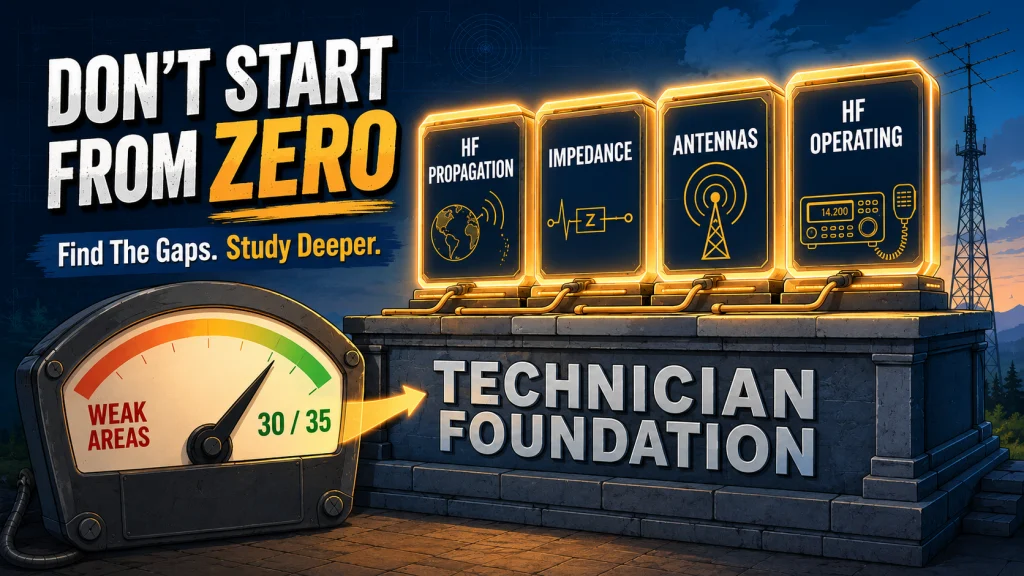
The General exam uses the same 35-question format as Technician, and 26 correct answers are required to pass, but the study task is different. As a Technician, you can reuse your foundation in regulations, operating practice, safety, antennas, and basic electronics while spending most of your effort on deeper HF propagation, HF operating, impedance, circuits, and antenna fundamentals. I recommend studying by measured performance rather than committing to a universal number of hours: identify your weak areas, learn the concepts that keep producing misses, and continue until your full Element 3 practice results are stable and comfortably above the passing line. This approach prepares you for the exam without making you relearn Technician material from the beginning.
How to Study for the Ham Radio General License After Technician
The useful starting point for how to study for the ham radio General license is not a new stack of flashcards. It is recognizing that the exam format stays familiar while the center of gravity moves toward HF. You will still answer 35 multiple-choice questions and need 26 correct answers, but Element 3 expects more than recognition of basic terms. It asks you to connect operating choices, propagation conditions, rules, antennas, and circuit behavior.
I recommend treating Technician knowledge as your foundation, not as proof that General will take care of itself. A Technician who is comfortable programming a repeater may still have little experience choosing an HF band by time of day, interpreting impedance, or separating a feed-line problem from an antenna problem. That gap is normal. Your study plan should expose it early instead of hiding it behind repeated easy questions.
Key point: Do not restart amateur radio from page one, and do not treat General as a slightly longer Technician quiz. Keep the concepts you already understand, then concentrate your study where Element 3 adds depth.
What General Study Adds to Technician Material
The largest change is the amount of HF context. General study goes further into the ionosphere, band characteristics, solar conditions, regional versus long-distance propagation, and the reasons one band may work while another appears quiet. A memorized answer can get one practice question right, but understanding the relationship between frequency, time, and propagation helps with an entire family of questions. It also makes the material useful after the exam.
Operating practice expands in the same way. Technician preparation introduces legal operation and basic station procedure, while General adds more situations involving HF voice, digital operation, band selection, interference avoidance, and frequency privileges. The regulations also become more specific because the operator has access to more HF segments and must know where particular modes and license classes fit.
Electronics and antenna topics usually require the biggest adjustment for someone who studied Technician mainly by recognition. Expect more work with circuits, reactance, impedance, resonance, feed lines, matching, antenna behavior, and basic calculations. You do not need to become an antenna engineer. You do need enough understanding to identify what changes when frequency, component value, line loss, or impedance changes.
| Study area | Technician foundation | General-level change |
|---|---|---|
| Regulations | Operator responsibility, identification, permitted communications, and basic band awareness | More detailed HF privileges, mode limits, frequency segments, and operating situations |
| Operating | Local contacts, repeaters, simplex, basic digital concepts, and station procedure | HF voice and data practices, interference management, band choice, and wider operating scenarios |
| Propagation | Basic radio-wave behavior and introductory propagation | Ionospheric layers, band characteristics, solar effects, skip, and time-dependent HF decisions |
| Electronics | Components, simple circuits, power, and basic measurements | More circuit relationships, reactance, impedance, resonance, and calculation-based questions |
| Antennas and feed lines | Common antenna types, SWR, connectors, and basic safety | Design fundamentals, matching, line loss, radiation behavior, and practical trade-offs |
The table is not a percentage comparison between the two pools. A defensible overlap percentage would require a question-level matching method, including a rule for deciding whether two differently worded questions test the same knowledge. For study purposes, the more useful conclusion is simpler: preserve the shared foundation, but expect General questions to ask what the concept does and when it matters.

This 40-count pack contains BIC Xtra-Smooth mechanical pencils with 0.7 mm medium points and No. 2 lead. The lead is designed to resist smudging and erase cleanly, and the pencils write without sharpening. The pastel barrels provide a ready supply for handwritten electronics notes and calculation practice.
Check On AmazonIf you click this link and buy, we earn a commission at no additional cost to you.
Use Technician Knowledge Without Letting It Hide Weak Areas
Your Technician preparation still matters. Safety, basic station control, electrical principles, antennas, feed lines, operating responsibility, and radio-wave behavior do not disappear when you open an Element 3 question pool. Familiar vocabulary reduces the amount of new material you must absorb. The danger is assuming that recognizing the vocabulary means you can apply it at General depth.
Begin with one full Element 3 practice exam before structured review. Do not treat the result as a prediction of whether you will pass. Label each miss by topic and note whether it came from an unknown fact, a confused rule, a calculation problem, or two similar answers you could not separate. The purpose is to establish a baseline that tells you where explanation will save more time than additional repetition.
Field Note: I have seen Technicians make opposite mistakes when they begin General preparation. Some repeat every basic topic as though their existing license taught them nothing, while others assume familiar terminology means Element 3 is only another Technician test. The efficient path sits between those extremes: skip what you can explain correctly, but investigate anything you only recognize.
Use that baseline to divide the pool into three working groups:
- Ready: You answer correctly and can explain why the other choices are wrong.
- Unstable: You often answer correctly but rely on wording, memory, or elimination rather than understanding.
- Needs instruction: You repeatedly miss the topic or cannot explain the underlying relationship.
Spend little time on the first group, review the second with spaced practice, and use explanatory material for the third. This prevents a high volume of easy questions from creating false confidence. It also keeps your General preparation focused on the material that can still cost you points.

This five-count BIC Brite Liner pack includes assorted-color highlighters with chisel tips. The pack gives you several colors for separating categories in a study notebook or error log. The chisel tips make the set useful for marking key rules, formulas, and recurring weak topics during review.
Check On AmazonIf you click this link and buy, we earn a commission at no additional cost to you.
Build a Study Plan Around Performance, Not a Universal Hour Count
There is no honest study-hour promise that fits every Technician. Someone who recently passed Element 2, works with electronics, and already listens to HF starts from a different place than an operator who earned Technician years ago and has used only local repeaters. Available time matters too. A schedule should control the rhythm of study, while practice performance determines when you are ready.
Choose a schedule you can repeat without rushing. A short daily session can work well for someone who retains material through frequent contact, while longer sessions may fit a weekend schedule better. In either case, separate learning from testing. Reading explanations and working topic questions build knowledge; full practice exams measure whether that knowledge survives when subjects are mixed.
| Available study time | Suggested session structure | When to advance |
|---|---|---|
| 20 to 25 minutes | One weak topic, followed by a short mixed review | Move on when you can explain the rule or relationship without relying on answer wording |
| 45 to 60 minutes | Concept lesson, focused questions, then review of prior misses | Add full exams after all major topic areas have received an initial pass |
| Long weekend block | Two or three focused units separated by breaks, not one continuous question marathon | Stop adding new material when accuracy drops and review the error log instead |
A practical readiness target is several consecutive full Element 3 practice exams at about 85 percent, which is roughly 30 correct answers out of 35. I use that as a buffer, not as an official requirement or a guarantee. The score matters only when it comes from fresh, mixed exams and your misses are not concentrated in one neglected subject. Three strong tests produced by memorizing the order of a small question set are less useful than one honest test that exposes a recurring weakness.

This light-green Yunbaoit visual timer provides a 60-minute countdown and includes a night-light feature. It runs without a ticking sound and offers three alert modes: mute flash, low, and loud. The visible countdown fits timed 20- to 60-minute General study sessions without requiring a phone timer.
Check On AmazonIf you click this link and buy, we earn a commission at no additional cost to you.
Use a Four-Step General Exam Study Loop
The most reliable way to prepare for Element 3 is a loop, not a one-way trip through a book. Each pass should tell you what to study next. That keeps the question pool from becoming a pile of disconnected facts and prevents you from spending equal time on topics with very different needs.
- Review: Use your latest mixed-exam misses to choose the next topic that needs attention.
- Learn: Read or watch an explanation for the weak concept before drilling the answer choices.
- Practice: Work focused questions until you can separate similar answers for the right reason.
- Verify: Return to mixed full exams and check whether the weak topic remains stable under exam conditions.
Keep a compact error log while you repeat the loop. Record the concept, the mistake you made, and one sentence explaining the correct rule or relationship. Do not copy the entire question. The goal is to capture why you missed it, because the same misunderstanding may appear under different wording.
Note: Calculation questions deserve their own line in the log. Write the formula, identify the units, and solve a few variations without looking at the choices. Memorizing the position of a numerical answer is fragile; recognizing the relationship lets you handle a changed value.
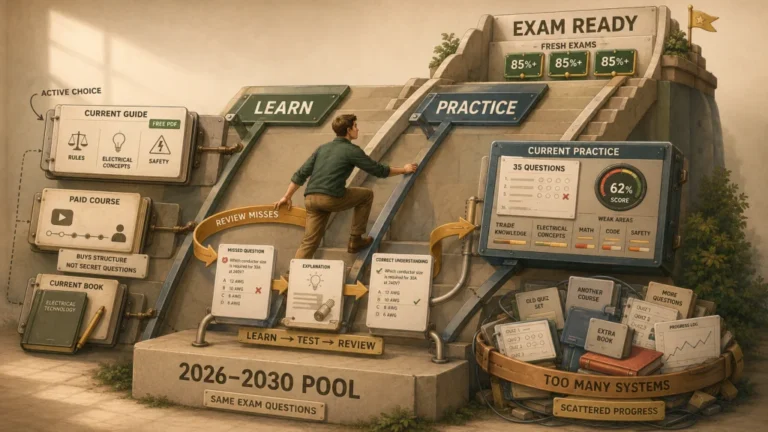
This loop also tells you when to stop adding resources. If a second explanation resolves the concept and your mixed-test performance improves, another course or book may add volume without adding clarity. Use a new resource to solve a defined problem, not to postpone the practice exam that would show whether the problem is gone.

This Five Star one-subject spiral notebook uses college-ruled paper in an 8.5 by 11 inch format with 100 sheets. The listing also includes access to the Five Star Study App, and the cover color may vary. The notebook gives a dedicated place to keep a compact General exam error log, formulas, and one-sentence explanations of recurring mistakes.
Check On AmazonIf you click this link and buy, we earn a commission at no additional cost to you.
Choose Resources by the Job They Need to Do
No single study resource has to perform every job. Practice systems are best for exposure, repetition, and score tracking. A manual or structured lesson is more useful when propagation, electronics, or antenna questions remain confusing after you read the answer explanation. The right resource mix depends on whether your problem is recall, understanding, or consistency.
HamExam General practice tests and HamStudy Element 3 practice provide free ways to work with the General question pool and take repeated practice exams. Use either one consistently enough to see patterns in your performance. Switching platforms every few sessions can make progress harder to judge because the scoring views and study modes differ.
The current ARRL General Class License Manual is the comprehensive physical reference named in this study plan. It is most useful when you need a connected explanation of HF propagation, circuit behavior, impedance, or antenna fundamentals rather than another pass through isolated answers. Read the relevant section after your error log identifies a weakness, then return to questions to verify that the explanation changed your performance.
A structured paid course can help an operator who learns better from sequenced lessons and guided review. The Ham Radio Prep General course is one option, not a requirement for passing. Before paying, identify what the course must solve for you, such as weak electronics explanations, lack of study structure, or difficulty maintaining a schedule. Free practice remains sufficient for many candidates who can research missed concepts independently.
Decide Separately Whether to Attempt General in the Same Session
A new candidate may be allowed to attempt General after passing Technician during the same exam session, but that is a session opportunity, not a study method. The VE team must permit it, enough time must remain, and the candidate should arrive prepared for Element 3. Policies and practical limits can vary by team and session format, so confirm them before assuming a second exam will be available.
The decision is straightforward if you are already scoring at your readiness target on full General practice exams. Taking Element 3 while the testing process is fresh may be efficient. If you have only skimmed the General pool, an immediate attempt can still provide experience, but it should not be confused with a planned upgrade strategy. The separate guide to taking multiple ham radio exams in one day covers the session-specific decision without turning this article into an exam-logistics guide.
Existing Technicians do not need to create artificial urgency. Your license remains useful while you study, and the General exam will still be there after you understand why the additional HF material matters. Schedule the test when your performance is stable, not because a course calendar or another operator says everyone should finish within the same number of days.
Know When You Are Ready to Schedule the Exam
A passing practice score is necessary, but one passing score is a weak signal. Readiness means your performance holds across fresh full exams, your weak areas are no longer producing clusters of misses, and you can explain the major concepts without depending on one platform’s wording. Stable results with room above the passing line matter more than repeating one target number in every stage of the plan.
Before scheduling, check four things:
- You have worked through every Element 3 topic area at least once.
- Your recent full practice exams remain above the passing line with a consistent margin.
- No single topic repeatedly accounts for most of your missed questions.
- You are using the question pool that will be active on your actual exam date.
If one condition is missing, fix that condition instead of restarting the whole course. A propagation weakness calls for propagation review. A score that falls only when calculations appear calls for formula practice. A stale question pool calls for updated material, not more repetition of the old pool.
Once all four conditions hold across several fresh exams, more study can become avoidance rather than preparation. Do not wait until every question feels easy or every score is perfect; the actual passing standard is 26 correct answers out of 35. Set an exam date while the material is active, then use the remaining study sessions to maintain weak areas instead of reopening the entire pool.
For the broader licensing sequence, including where General fits after Technician, review planning your Technician-to-General upgrade. Readers who still need to compare the privileges and limits of each class can also use the guide to ham radio license classes and privileges. Those decisions are related to studying, but they should not interrupt a study plan once you have already chosen to pursue General.
Final Thoughts: Study the Added Depth, Not the Entire Hobby Again
The efficient General candidate does not ignore Technician knowledge or spend weeks proving it again. Protect the concepts you already own, use your error patterns to guide review, and direct explanation-heavy study toward HF propagation, operating practice, electronics, impedance, antennas, and the additional regulations that keep producing misses. Then use full Element 3 exams to measure whether the improvement survives outside a focused topic drill.
I would rather see a Technician schedule the exam after several stable full-exam results than chase a study-hour estimate that says nothing about readiness. The exam requires 26 correct answers, but a consistent margin reduces the chance that one weak topic or unfamiliar wording controls the outcome. Study until your performance and understanding agree, then take the next step.
General preparation is also a useful time to define what you want the added HF privileges to support, such as regional voice communication, digital contacts, or longer-distance operating. That operating goal should guide any later HF equipment decision, because passing the exam expands where you may operate but does not determine which station fits your antenna limits, available space, budget, or learning goals.
FAQs
📝 How many questions are on the General ham radio exam?
The General exam contains 35 multiple-choice questions. You need at least 26 correct answers to pass.
📚 Is the General exam much harder than Technician?
It is deeper rather than simply longer. The format is the same, but General places more weight on HF propagation, operating practices, electronics, impedance, antennas, and detailed frequency privileges.
⏱️ How long should I study for the General license?
Use performance instead of a universal hour estimate. Continue until you have covered every topic, corrected recurring weak areas, and produced stable results on fresh full Element 3 practice exams.
🎯 What practice score should I reach before testing?
A practical target is about 85 percent, or roughly 30 correct answers out of 35, on several consecutive full exams. That is a preparation buffer, not an official rule or a guarantee.
🧠 Should I memorize the General question pool?
Question repetition helps with recall, but do not rely on wording alone. Learn the underlying rule or relationship for propagation, electronics, calculations, and antenna questions so a differently phrased question does not expose the same gap.
🧪 Can I take General immediately after passing Technician?
A VE team may allow another exam element in the same session when its policy, time, and format permit it. Confirm the session rules in advance and attempt General only if you have prepared for Element 3.
🔄 Can I use the same study app I used for Technician?
Yes, if the app or website includes the active Element 3 General pool for your exam date. Reset or change the selected license class so Technician questions do not inflate your apparent readiness.