The best off-road ham radio setup combines a legal group service, a route-appropriate transceiver, a secure antenna, dependable vehicle power, and a practiced operating plan. Start by deciding who must communicate with whom, then choose the equipment that supports that path. Amateur radio can be a strong convoy and local-contact tool, but terrain, coverage, and the availability of another station still limit it. Keep a phone, satellite device, or registered emergency beacon in the plan when the trip requires a dependable outside contact.
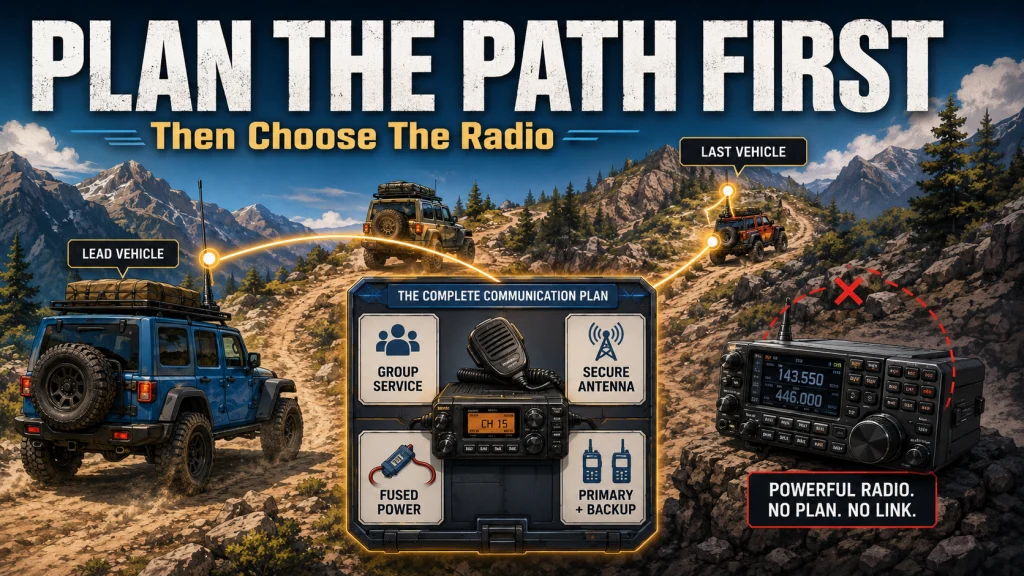
The Off-Road Communication Plan Comes Before the Radio
When people search for the best ham radio for offroad travel, they often begin with the transceiver. The real failure usually starts earlier: one driver buys a ham mobile, another brings GMRS handhelds, a third assumes everyone will use a local repeater, and nobody agrees on channels, licenses, call signs, check-in timing, or what to do when a vehicle drops out of the group. Even excellent equipment struggles when the communication plan is improvised on the trail.
I see the same ordering mistake after license exams: a new operator asks what radio to buy before deciding what contact they want to make. For an off-road group, the first question is even narrower: who must be able to answer during this trip? Once that is clear, the broader process of choosing a mobile ham radio becomes much easier because every feature has a job instead of merely looking impressive.
Field Note: The radio question I hear after exam sessions often arrives before the new licensee has decided what the radio must do. In a vehicle build, that order can produce a technically capable transceiver that does not match the convoy’s service, the local network, the available mounting space, or the route’s terrain.
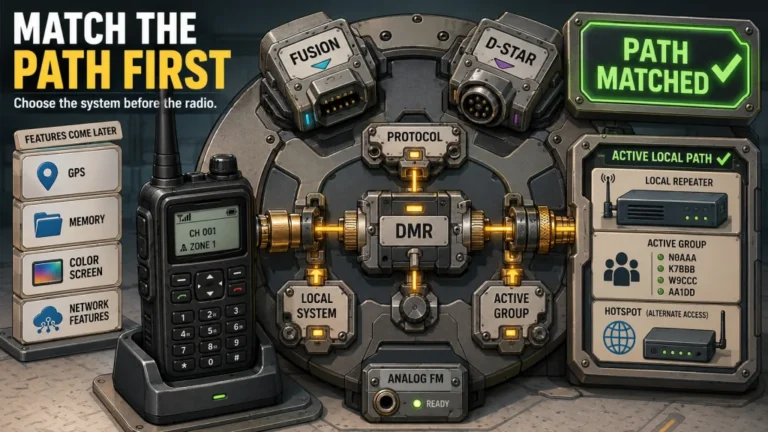
A useful buying rule is simple: define the communication path before comparing radios. Write down the people who need to communicate, the primary service, the expected distance between vehicles, the terrain, the outside contact, and the failure mode that matters most. That one page will remove many unsuitable choices before price or feature comparisons begin.
First Decision: Is Ham Radio the Group Service?
Ham radio fits an off-road group when the people who will independently control transmitting stations hold the appropriate amateur privileges and are willing to use amateur operating procedures. When I help a new operator sort out a mobile purchase, I separate this legal service decision from the equipment decision because no radio feature can correct a service mismatch. It is a poor group choice when only one vehicle is licensed, the rest of the convoy expects license-free communication, or the group has already standardized on another legal service. Do not force the entire trip around one person’s radio collection.
GMRS may be the more practical group path when family members or a recurring convoy already use it, but transmitting requires the appropriate GMRS license and Part 95E-certified equipment. A ham license does not authorize GMRS transmission, and a ham transceiver does not become legal GMRS equipment because it can be programmed to the frequency. The detailed trade-offs belong in a dedicated ham radio and GMRS comparison, but the buying decision here is straightforward: choose the service the group can legally and consistently use.
| Group situation | Practical direction | Reason |
|---|---|---|
| Most drivers are licensed amateurs | Build the ham plan around confirmed simplex and repeater paths | The group can use amateur frequencies legally and practice one operating procedure |
| The convoy already uses GMRS or CB | Keep that service as the primary group channel | Changing services may reduce compatibility instead of improving communication |
| Only one or two vehicles use ham radio | Use ham as a secondary link, not the only convoy plan | The licensed vehicles may reach local operators or repeaters without isolating the rest of the group |
| No terrestrial path is dependable | Add an outside-contact device designed for that role | More radio power does not create a responder or overcome every terrain blockage |
This decision should be made before mounting hardware or programming memories. The best service is the one the intended users can operate legally, understand under stress, and test on the actual route.

Midland MXT275 is a 15-watt GMRS mobile radio with an integrated-control microphone. The listing includes a detachable external magnetic-mount antenna and eight repeater channels, giving a convoy a compact vehicle-based GMRS option. It fits a group that has deliberately chosen GMRS as its shared service instead of trying to make an amateur transceiver serve that role.
Check On AmazonIf you click this link and buy, we earn a commission at no additional cost to you.
Choose Radio Requirements From the Route and Cabin
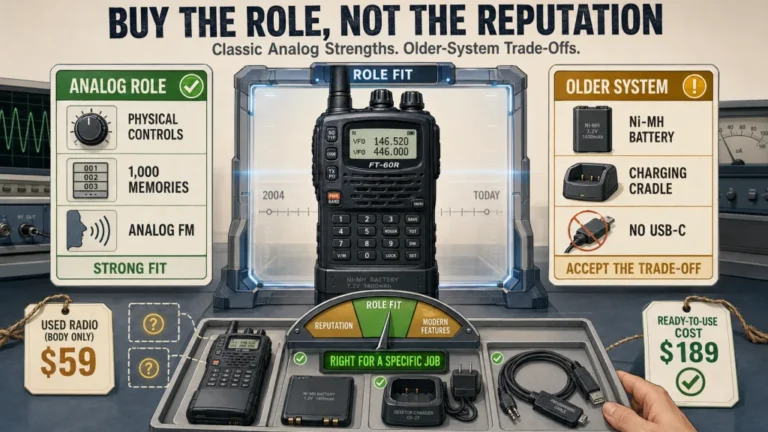
An off-road ham radio should cover the bands and modes used by the group’s confirmed simplex plan and the repeaters that are genuinely useful along the route. Dual-band capability is often practical for local VHF and UHF work, although a trip built around one known analog path may not benefit from additional modes. Digital voice, data, or APRS features earn their place only after the group verifies a compatible network, shared workflow, and fallback procedure. I treat those features as unproven for a trip until the group has tested the same protocol it plans to use.
Control layout matters more in a moving vehicle than it does on a desk. Large, readable channel information, controls that can be identified without prolonged attention, a secure microphone position, and a detachable control head can matter more than another menu page. A detachable head is especially useful when the radio body needs ventilation under a seat or in a cargo area while the display must remain visible without entering an airbag deployment zone.
Receiver behavior also deserves attention. Ignition noise, charging electronics, strong nearby transmitters, and crowded local RF environments can make an otherwise capable radio unpleasant to use in the vehicle. Hybrid and electric drivetrains, inverters, auxiliary batteries, and high-current charging systems can add another layer of RF noise. A specification sheet cannot prove clean reception in a particular vehicle, so test the complete installation with the engine or drive system active and the normal electronics running.
Current draw, cooling, connector support, programming support, and parts availability complete the requirement list. For a Jeep or similar trail vehicle, transmit power is only one part of the buying decision. Antenna placement, terrain, vehicle spacing, repeater access, and the ability to select a lower power level often influence the usable path more than the highest advertised output.
Key point: Buy enough radio for the confirmed path, not enough features for every path you might imagine using someday.
For a deeper comparison of the radio body itself, use the same route and cabin requirements when reviewing dual-band mobile radio choices. That keeps the comparison tied to controls, installation fit, support, and operating role rather than a generic feature score.

Retevis RT95 is a 2-meter and 70-centimeter dual-band mobile ham radio for vehicle installation. Amazon lists a 13.8-volt input and a 4.88 by 6.42 by 1.54-inch chassis, which suits cabins where power and mounting space are part of the buying decision. Its rotatable display and CHIRP support are listed features that can simplify an installation built around planned channel memories.
Check On AmazonIf you click this link and buy, we earn a commission at no additional cost to you.
The Antenna Is the Most Exposed Part of the System
A mobile radio can be protected inside the cabin while the antenna takes every branch strike, vibration cycle, rainstorm, dust cloud, and low-clearance obstacle. Antenna survivability therefore belongs in the communication plan from the beginning. A heavy-looking mount still fails the test if it damages the vehicle, creates a poor RF connection, or places the whip where it will be repeatedly torn away.
Start with the vehicle material and the mounting surface. A steel roof can provide a useful conductive surface, while aluminum, composite panels, fiberglass tops, racks, and accessory panels may require a different mounting and grounding strategy. Practical height helps line-of-sight communication, but a tall antenna that cannot clear branches or a garage may spend more time folded down than transmitting.
Gain also needs context. On open roads, a flatter radiation pattern may be useful, while steep or uneven terrain can reduce the advantage of some higher-gain designs. The correct choice balances pattern, height, branch clearance, flexibility, and the way the vehicle body shapes the signal. The mobile ham radio antenna guide should be read as a system-matching decision, not as a search for the longest whip.
- Use a mount that remains secure under vibration and repeated body movement.
- Protect coax from sharp edges, pinch points, hot surfaces, moving hinges, and cargo abrasion.
- Weather-seal exposed connections without creating a water trap.
- Check the antenna in both operating and folded positions before the trip.
- Carry a realistic field-repair option, such as a spare whip, short coax jumper, connector protection, and the tools needed for the installed mount.
A spare antenna that cannot attach to the vehicle is not a backup. The repair plan should match the exact mount and cable path already installed. For the physical routing and placement decisions, follow a vehicle-specific mobile antenna installation process rather than copying a generic drilling location from another vehicle.

Comet SBB-5NMO is an NMO-mount dual-band mobile antenna for 2-meter and 70-centimeter use. The Amazon listing specifies 146/446 MHz operation, 3 dBi gain, and a 200 W PEP rating. Its mobile format fits a vehicle antenna system where mount security, branch clearance, and coax routing are planned as part of the complete installation.
Check On AmazonIf you click this link and buy, we earn a commission at no additional cost to you.
Power and Mounting Must Survive the Vehicle, Not Just the Driveway
A clean power arrangement is built around the radio manufacturer’s instructions, appropriate fusing, suitable wire, and the vehicle manufacturer’s guidance for two-way radio equipment. Battery location, current monitoring systems, alternator behavior, accessory circuits, airbag wiring, and electronic control modules vary by vehicle. That is why a universal wiring shortcut is a bad fit for an article about off-road use.
The power plan should answer two different questions: can the vehicle support the radio while operating, and can the radio be shut down without flattening the starting battery? A radio left active during a long stop may not look like a major load, but the risk changes when the vehicle also powers lights, refrigeration, navigation devices, compressors, or charging equipment. An ignition-controlled arrangement, low-voltage protection, or a disciplined shutdown procedure can all work, depending on the radio and vehicle.
Mounting has the same two-part test. The radio and control head must stay secure over vibration and rough movement, but they must also remain outside knee space, pedal travel, airbag zones, and likely impact paths. A microphone should not become a loose object or swing into the controls when the vehicle drops into a rut.
Ventilation matters even when the radio is rated for normal mobile output. Dusty cargo compartments, seat covers, packed gear, and tight consoles can block airflow and trap heat. A ham radio for overlanding should be installed where its cooling path can remain open after the vehicle is fully loaded, not only while the cabin is empty in the garage.
Warning: This article defines buying and planning requirements, not a complete vehicle installation procedure. Follow the radio manual, vehicle guidance, fuse requirements, and safe mounting practices for the exact installation.
Once power, ventilation, and crash-safe placement are treated as buying filters, many radios remove themselves from the shortlist. That is useful progress, not a limitation.
Program an Operating Plan the Whole Group Can Follow
Stored memories become useful only after the group agrees on how to use them. The operating plan tells every vehicle which channel comes first, what to try next, how often to check in, and what action to take when someone disappears from the group. Without those decisions, a radio display full of repeater names is only a directory.
The printed card matters because menus, phone notes, and shared messages may not be available when the group is separated. Keep the card short enough to read under poor light and stressful conditions. It should use plain channel names that match the radio memories in every participating vehicle.
- Primary group frequency and mode.
- Backup frequency and a simplex fallback.
- Confirmed repeaters, including required access settings.
- Each licensed operator’s call sign.
- Check-in intervals and regroup points.
- Lost-vehicle procedure, including how long to wait before changing channels or returning to the last known point.
- Outside contact, route details, and the time at which missed communication becomes a concern.
The plan should also define who changes channels and when. If every driver starts scanning, searching, or experimenting independently, the convoy can miss one another even though all radios work. One person should call the change, and the group should acknowledge it before moving.
Test the system in stages before departure. First, verify each stored channel while parked. Next, test with engines, chargers, lights, and normal vehicle electronics running. Finally, hold a short group shakedown run with safe microphone use, realistic spacing, the intended antennas, and at least one planned fallback. That process turns an off-road ham radio setup into a known path rather than a collection of equipment.
After the trip, spend a few minutes reviewing missed calls, confusing channel names, weak locations, damaged hardware, and battery or shutdown problems. Update the printed card while the details are fresh. A short post-trip review prevents the same small failure from becoming the next trip’s emergency.
Keep a Separate Outside-Contact Backup
Ham radio works only when a usable path and a listening station exist at the same time. I do not count a repeater listing as an outside-contact guarantee until it has been tested from the route and at a relevant time. A repeater may be out of range, temporarily unavailable, blocked by terrain, or quiet when help is needed. Simplex may keep the convoy together without providing any path to someone outside the group.
A phone is useful where cellular coverage is dependable. A satellite messenger may support routine or emergency messaging depending on the device, service plan, sky view, and operating conditions. A properly registered personal locator beacon is designed for distress alerting to search-and-rescue authorities, not routine convoy coordination. These tools serve different endpoints, which is why one should not be treated as a universal substitute for the others.
Choose the outside-contact tool by the endpoint it must reach. A trip may need group voice communication, a named outside contact, a distress alert, or several of those functions. The distinction is explained more fully in the comparison of ham radio and satellite contact, but the practical rule here is to assign each device one clear job.
An outside-contact plan should include the person receiving the itinerary, expected check-in times, the route and alternates, vehicle descriptions, and the point at which a missed check-in should trigger action. Radio equipment inside the convoy does not replace that arrangement. It supports it.

Garmin inReach Mini 2 is a compact satellite communicator for two-way messaging beyond cellular coverage. The listing includes interactive SOS support through Garmin Response and navigation features, giving it a distinct outside-contact role from the convoy radio. It fits trips where the communication plan needs a separate satellite path rather than treating a repeater listing as a guaranteed emergency link.
Check On AmazonIf you click this link and buy, we earn a commission at no additional cost to you.
Match the Setup Group to the Confirmed Route
System types are more useful here than model names because exact radios change while the operating roles remain stable. These are research-based planning categories, not claims of HamRigs hands-on testing or product rankings. For 4×4 travel, compare equipment only after the controls, antenna, power demand, network compatibility, and backup role have been defined for the route.
| Setup group | Best fit | What must be confirmed before buying |
|---|---|---|
| Compact analog mobile system | A licensed group using known analog simplex channels and repeaters | Band coverage, simple controls, mounting space, cooling, antenna fit, and power demand |
| Digital or APRS-capable mobile system | A group with a confirmed compatible network and a practiced digital or position-reporting workflow | Protocol match, local infrastructure, programming process, group adoption, data coverage limits, and analog fallback |
| Portable handheld backup | Communication outside the vehicle, a temporary replacement, or a short-range fallback | Battery plan, weather protection, compatible memories, external antenna options, and realistic in-vehicle limitations |
A handheld is valuable as a backup because it can leave the vehicle, not because it duplicates a properly installed mobile station. Inside a metal cabin with a small antenna, it may have a weaker path than the main system. Keep its memories aligned with the printed plan and test it from both inside and outside the vehicle.
The digital or APRS-capable group requires the most discipline. A feature is not a communication path until the local network exists, the group uses the same protocol, the radios are programmed correctly, and everyone knows what the display or position report means. Keep an analog simplex fallback even when the digital plan is strong.
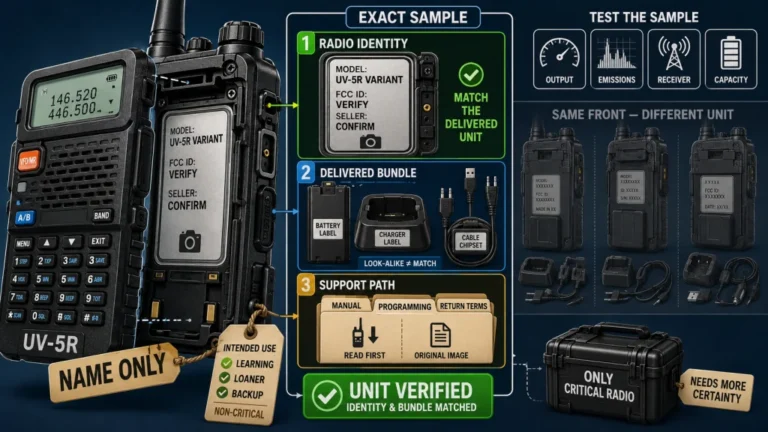
The compact analog system is often the most direct starting point, although a cramped dashboard, composite roof, unusually high electrical noise, or a route with no relevant repeaters can change the decision. Once one setup group clearly fits, turn its confirmation column into a buying checklist: verify the radio’s current US availability, exact controls, supported modes, power demand, cooling needs, included accessories, warranty, and programming support before comparing prices.

Yaesu FT-65R is a compact 5-watt handheld transceiver for 144/440 MHz amateur operation. Its dual-band format makes it suitable as a portable backup when those bands match the group’s programmed plan. Because it can leave the vehicle with the operator, it fits the article’s handheld-backup role without duplicating the installed mobile station’s role.
Check On AmazonIf you click this link and buy, we earn a commission at no additional cost to you.
Final Thoughts: Build One Tested Path Before Adding Features
The strongest off-road communication setup is the one the whole group can use legally and predictably. Decide the service, map the primary and fallback paths, choose a radio that fits the cabin and electrical system, install an antenna that can survive the route, and print the operating plan. Then test the complete system with the vehicles configured as they will be on the trip.
I would rather see a new operator leave with one tested simplex channel, one confirmed repeater, a secure antenna, and a clear outside-contact plan than with a radio full of unverified memories. More features can be added later. Start by making sure the lead vehicle can call and the last vehicle knows exactly how to answer.
FAQs
🚙 What type of ham radio works best in an off-road vehicle?
A mobile radio usually provides the most practical vehicle platform when it matches the group’s bands, modes, controls, antenna system, power capacity, and mounting space. The correct output level depends on terrain, antenna placement, vehicle spacing, and the available simplex or repeater path.
📻 Can the whole convoy use my ham radio license?
No. For normal independent operation, each person controlling a transmitting amateur station needs the appropriate amateur license privileges. If the group is not licensed, choose a legal group service instead of assuming one amateur license covers every vehicle.
🗺️ Do I need repeaters for off-road communication?
Not always. Simplex may be the better convoy path at short or moderate spacing, while a confirmed repeater can extend contact beyond the group. Program both when the route and local systems support them.
🌲 Is a taller mobile antenna always better on trails?
No. Height can help, but branch clearance, mount strength, vehicle material, radiation pattern, and the ability to keep the antenna upright all matter. A shorter antenna that remains intact and usable may be the better trail choice.
🔋 Will a mobile ham radio drain the starting battery?
It can if it remains powered during long stops or shares the electrical system with other heavy accessory loads. Match the wiring and shutdown plan to the radio manual, battery arrangement, alternator capacity, and vehicle guidance.
🛰️ Can ham radio replace a satellite messenger or PLB?
No single tool replaces every function. Ham radio can support group and local communication when a path and listening station exist, while satellite messaging and registered distress beacons serve different outside-contact or emergency roles.