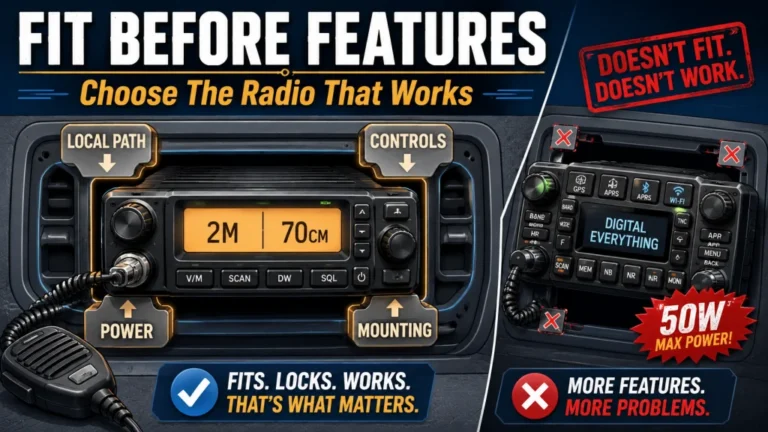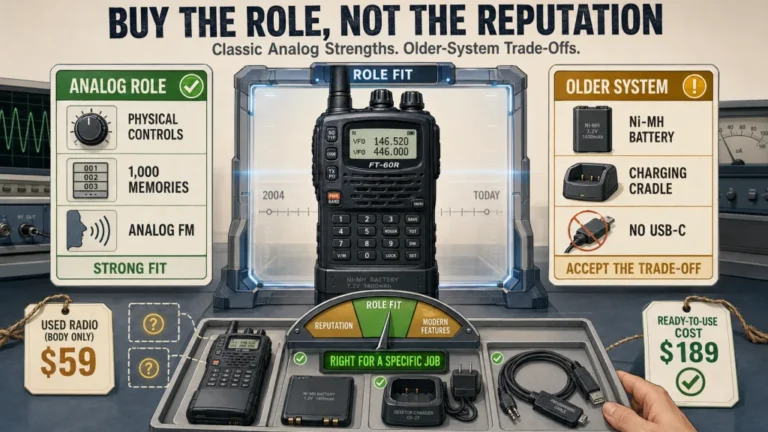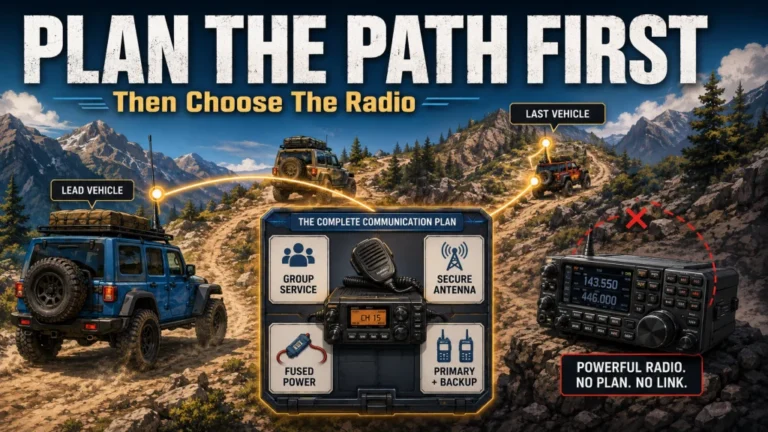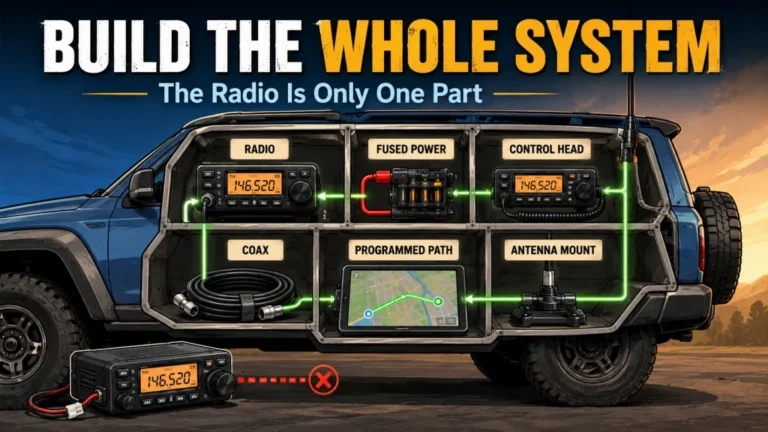
The best ham radio for emergency preparedness is the handheld that fits a communication path you have already tested, not the one with the loudest range claim. Start with licensed operators, reachable contacts, local simplex and repeater options, weather information, and a backup that does not depend on amateur radio. Then judge the radio by repeatable power, verified environmental protection, usable controls, receiver behavior, and antenna options. No handheld guarantees contact outside an affected area, so the plan matters more than any single specification.
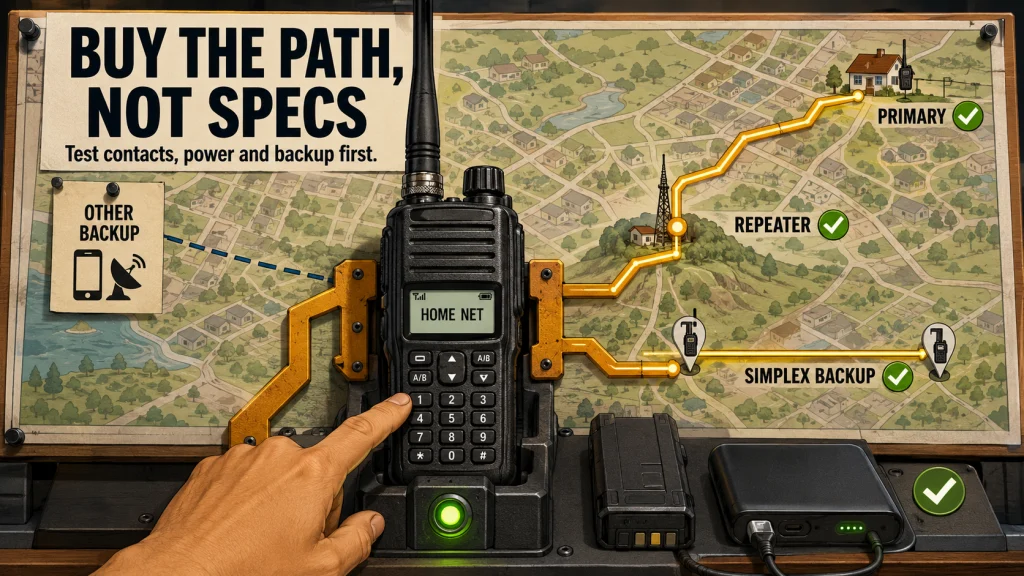
The Best Emergency Handheld Starts With a Communication Plan
An emergency handheld is useful only when someone knows whom to call, where that person will be listening, and what to do when the first path fails. I would rather see a modest radio tied to two practiced local contacts than a feature-heavy radio sitting on an unknown frequency. The practical test is not whether the display looks prepared. It is whether the operator can turn it on, select the correct saved channel, identify with a legal call sign, and reach a person who expects the call.
This article is about choosing a handheld for a household or personal preparedness plan. It does not promise rescue, replace emergency services, or cover vehicle-mounted radios in depth. For the broader role of licensing, nets, repeaters, and planning, start with using ham radio in emergencies before treating equipment as the solution.
Field Note: The equipment mistake I see most often begins before anyone compares batteries or weather ratings. A new operator buys a handheld first, then tries to invent a use for it. Reversing that order exposes weak plans quickly because the required people, path, and power source become obvious before money is spent.
Build the Communication Path Before Comparing Radios
Write down the paths the radio is expected to support. A household plan may include direct amateur simplex between licensed family members, one or more local repeaters, a scheduled net, receive-only weather information, and a separate service for people who do not hold amateur licenses. Each path has a different legal and technical requirement, so one handheld should not be assumed to cover every person or purpose.
| Communication Need | Question to Answer First | What the Radio Must Support |
|---|---|---|
| Local amateur simplex | Are both operators licensed, within tested terrain, and using the same plan? | Correct amateur band, simple channel recall, and a workable antenna position |
| Local repeater or net | Is the repeater reachable from the places where the radio will be used? | Correct frequency, offset, access tone, and a saved backup path |
| Weather information | Is manual reception enough, or is automatic alerting required? | The exact receive and alert features stated in the manual |
| Family or group coordination | Who is licensed, and which radio service can every participant legally use? | Equipment certified or authorized for the selected service |
| Contact beyond the local area | What still works if repeaters, cellular service, or local power fail? | A separate phone, satellite, or other planned backup where justified |
Do not infer legal authority from a radio’s technical ability to tune a frequency. Amateur transmitting normally requires an amateur license, while GMRS transmitting requires equipment certified for GMRS under Part 95E. Holding a ham license or owning an amateur transceiver does not make that transceiver legal for ordinary GMRS transmission. Narrow safety-of-life provisions exist for genuine distress, but they are not a substitute for choosing the correct service and practicing legally before an emergency.
Next, identify actual contacts rather than vague destinations such as “someone downtown” or “the local authorities.” Find the repeaters and nets that are relevant to your area, then verify them with a practical repeater search process. A frequency stored from an old list has little preparedness value until it has been heard, programmed correctly, and tested from the locations that matter.
Power Resilience Matters More Than a Large Battery Number
Battery capacity is useful only when you can recharge or replace it repeatedly under the conditions in your plan. Start by identifying the battery chemistry, nominal voltage, charging input, pack availability, and whether the radio can operate while connected to external power. A large proprietary pack may run longer on day one but become a weak point if the only charging cradle depends on household AC power.
USB-C deserves a closer look than the connector shape. Some radios charge from a basic USB source but do not work with every USB-C to USB-C cable or power-delivery bank. Others use a USB-C port only for programming, require the radio to be off, or charge the battery without powering the receiver. Test the exact cable, wall adapter, vehicle adapter, and battery bank that will be stored with the radio.
- Verify whether the supplied cradle accepts a practical DC input or only a wall adapter.
- Check whether vehicle charging is direct, cradle-based, or dependent on an inverter.
- Confirm whether an AA battery case is available and whether it permits full-power transmission.
- Record the charging time from the power bank or vehicle source you will actually use.
- Store spare lithium-ion packs at an appropriate partial charge and inspect them periodically for swelling or damage.
- Run a realistic receive, transmit, and standby test instead of trusting an unexplained runtime claim.
A stated duty cycle matters because a radio that spends most of the day in standby behaves differently from one used during a busy net. If a runtime figure does not explain how much time was spent transmitting, receiving, scanning, and illuminating the display, it is not a planning number. Measure your own routine and write the result in the equipment log.
Key point: Two smaller charging paths that you have tested can be more resilient than one oversized battery with a single proprietary charger.

This Anker power bank has a 20,000mAh battery and a built-in USB-C cable. A single USB-C device can receive up to 65 watts, while total output across supported connections reaches 87 watts. The unit also provides a separate USB-C port and USB-A output for charging compatible devices.
Check On AmazonIf you click this link and buy, we earn a commission at no additional cost to you.
Read Environmental Ratings as Test Claims, Not Survival Promises
Words such as rugged, weatherproof, and outdoor-ready are marketing language unless they are tied to a defined rating and stated test conditions. Look for the exact IP code in the official manual, then read the qualifications around battery latches, accessory covers, speaker openings, and connected microphones. A rating that applies with every cover closed may no longer apply while the radio is charging or using an external accessory.
Keep water resistance, immersion resistance, dust protection, impact resistance, and cold-weather operation separate. An immersion rating does not prove the radio survives a drop onto concrete, saltwater exposure, freezing rain, or repeated use with wet controls. Likewise, a drop-test statement does not establish water protection. The correct buying question is not “Is it rugged?” but “Which specific failure is this rating intended to resist?”
A protective pouch, dry storage bag, and simple operating discipline may solve more real problems than paying for an undefined toughness claim. For a radio that will leave the house regularly, compare the conditions in your emergency plan with the same exposure questions used when selecting ham radio for hiking and camping.

The BTECH UV-PRO is a dual-band VHF/UHF handheld with a published IP67 environmental rating. Its package includes a 2600mAh lithium-ion battery and a USB-C charging cable. The radio also includes GPS, Bluetooth connectivity, programmable channels, and NOAA weather alert functionality.
Check On AmazonIf you click this link and buy, we earn a commission at no additional cost to you.
NOAA Reception Is Not the Same as NOAA Alerting
A handheld may receive NOAA Weather Radio channels without monitoring for an alert while you are listening elsewhere. Another radio may detect the general alert tone, while a dedicated receiver with SAME capability can be programmed for selected areas and alert types. Those are different functions. A specification that says weather receive does not automatically include tone alerting, background monitoring, or SAME decoding.
Check the manual for what happens when weather alert monitoring is enabled. Does it interrupt amateur reception, scan weather channels periodically, require the radio to remain on a weather channel, or disable another function? Then test the feature during a scheduled local alert test where available. A feature that has never been configured or heard is not yet part of the emergency plan.
Receiver quality also matters near strong local transmitters. A handheld can have a sensitive receiver on paper yet become difficult to use when nearby commercial, paging, broadcast, or amateur signals overload the front end. Sensitivity alone does not describe selectivity, strong-signal handling, desense, or intermodulation behavior. Treat those claims as research-based unless there is a repeatable, attributable test for the exact radio.
Note: A handheld with NOAA reception is not a complete substitute for a dedicated household warning method. Keep phone alerts, local warning systems, and a battery-backed weather receiver in the plan when those tools serve the household better.

This portable NOAA weather radio features an upgraded DSP chip and a 13-inch telescopic antenna, delivering clear reception from seven NOAA stations and early alerts for tornadoes, hurricanes, and severe storms. It's simple to operate with one hand, compact and durable, with a wristband for easy carrying while camping, traveling, or running. Powered by two AA batteries, it runs continuously for about two weeks, keeping you informed even during power outages. Its small size and thoughtful design also make it a practical gift, backed by a 12 month warranty and 24/7 customer support.
Check On AmazonIf you click this link and buy, we earn a commission at no additional cost to you.
Controls Under Stress Should Favor Recall, Not Menu Memory
Emergency use is a poor time to remember a multi-step menu sequence. The radio should provide direct, repeatable access to the channels in the written plan, with channel names that make sense to every licensed operator who may use it. A saved memory called “RPT 1” is less useful than a label that identifies the area, function, or net clearly within the display limit.
Test the radio with the screen brightness reduced, the keypad locked, and gloves on if those conditions are realistic. Verify how to unlock the controls, stop a scan, change volume, select the backup channel, and disable an accidental transmit lockout. If one side key can activate an alarm, flashlight, monitor function, or broadcast receiver, make sure an accidental press will not leave the operator confused about why normal reception stopped.
- Can the primary and backup memories be reached without entering a programming menu?
- Does the display show a useful channel name, frequency, or both?
- Is the speaker understandable in a vehicle, outdoors, and in a noisy room?
- Can the operator identify low battery, transmit lockout, and active scan states quickly?
- Are written channel labels and brief operating steps stored with the radio?
Flashlights, sirens, color screens, and hundreds of memory slots can be convenient, but they are secondary. One correctly programmed memory, one readable label, and one practiced backup channel matter more than a long feature list that requires a manual every time the radio is turned on.
Antenna Position and Terrain Set the Coverage Boundary
Handheld range changes with terrain, building materials, operator body position, antenna efficiency, frequency, and the location of the other station. The difference between a basement, a second-floor window, and an open ridge can be larger than the difference between two ordinary handheld power settings. That is why wattage alone cannot establish a reliable distance.
The stock antenna should be tested because it is the antenna most likely to remain attached during a quick evacuation. An external antenna option can add value at home, in a vehicle, or at a planned operating position, but it also adds cable, adapters, strain, and setup time. A better external antenna can improve the path while also exposing a basic handheld receiver to stronger unwanted signals, so more signal is not automatically cleaner reception.
Create a small coverage map from actual checks. Mark where simplex works, where the primary repeater is reachable, where an elevated position helps, and where the path fails. Repeat the test with the radio held normally rather than placed perfectly on a windowsill. For a broader comparison of handheld limitations and buying factors, use the handheld ham radio selection guide without assuming the most capable general-purpose radio is automatically the best emergency choice.
Warning: A repeater may lose commercial power, internet linking, antenna feed line, or site access during the same event affecting your household. Keep a tested simplex option and another communication method in the plan.

This ABBREE handheld antenna uses an SMA-Female connector and is listed for 144/430 MHz VHF/UHF operation. The antenna is approximately 18.8 inches long and uses a foldable design. Its verified compatibility list includes radios such as the BaoFeng UV-5R and BF-F8HP PRO.
Check On AmazonIf you click this link and buy, we earn a commission at no additional cost to you.
Choose a Radio Role Before Choosing a Feature Set
There is no universal winner because preparedness plans ask different jobs from a handheld. Instead of naming a model, place the intended radio into one of four roles and require evidence for the features that matter in that role. This keeps a preparedness purchase from becoming a contest over maximum power, the largest display, or the longest menu.
| Radio Role | Priorities | Trade-Off to Accept |
|---|---|---|
| Basic local-plan radio | Simple memories, clear speaker, repeatable charging, easy lock and unlock, local repeater support | Fewer advanced modes may be preferable to a complicated interface |
| Rugged outdoor radio | Verified environmental rating, secure battery, glove-friendly controls, protected accessory ports | More weight and cost do not automatically improve receiver performance |
| Digital-network radio | Compatibility with the local amateur network, maintained codeplug, usable analog fallback, trained operators | Network access may depend on repeaters, backhaul, configuration, and local adoption |
| Backup or loaner radio | Identical channel layout, low replacement burden, clear labeling, battery commonality | A backup should be simple and known, not merely cheap and unopened |
A household relying on one local analog repeater may need a very different radio from a trained group using a local digital network. Digital capability adds value only when the network, programming, and people already exist. A rugged rating adds value only when the radio will face those conditions. Match evidence to the job instead of buying every capability at once.
Use This Preparedness Checklist Before Calling the Radio Ready
A radio is not ready when the box is opened or the battery icon reaches full. It is ready when the complete path has been programmed, labeled, tested, powered, and documented. Use the following checklist as an acceptance test for the equipment and the plan together.
- The intended transmitters hold the licenses required for the amateur paths in the plan.
- Primary simplex, repeater, net, and receive-only channels are programmed and recalled from memory.
- Call signs, contact names, check-in times, channel purposes, and fallback steps are printed.
- The primary repeater has been tested from the home, meeting point, and likely travel route.
- A simplex path has been tested without assuming the repeater remains available.
- The battery, spare pack, cradle, vehicle source, cable, and power bank have been tested together.
- Weather receive and any claimed alert function have been configured and verified separately.
- Every licensed operator can select the primary and backup channels without consulting a long manual.
- The radio and batteries follow a written inspection, charging, and practice schedule.
- A phone, satellite, personal locator, or other backup is included where the risk and location justify it.
Use the schedule below as a starting rhythm, then adjust it for the battery manufacturer’s instructions, local climate, storage conditions, and the consequences of a failed contact. The purpose is not to create busywork. It is to catch a swollen pack, changed repeater, missing cable, or forgotten control sequence before an outage exposes it.
| Suggested Rhythm | What to Check | Useful Practice |
|---|---|---|
| Monthly quick check | Inspect packs and contacts, confirm the stored charge state, power up the radio, and recall the primary and backup memories. | Listen for a known local signal and confirm that every operator can unlock the keypad and adjust volume without the manual. |
| Every season or roughly every three months | Retest charging from the vehicle source and power bank, review printed contacts, and confirm that repeater details and net schedules are still current. | Run a short drill from a planned location using normal receive and transmit activity without deliberately deep-discharging a lithium pack. |
| Before higher-risk weather, travel, and after real use | Charge to the state required by the plan, inspect cables and weather protection, replace damaged items, and restore anything consumed during the last use. | Unplug the normal household charger and rehearse the primary path, simplex fallback, and non-radio backup in sequence. |
The backup decision matters most when the plan depends on reaching beyond the local radio path. Amateur radio and satellite services solve different problems, so compare the limitations in ham radio versus satellite phones before treating either one as a universal emergency answer. Even a carefully chosen handheld remains one part of a layered plan, not the layer that replaces all the others.
Final Thoughts: Buy the Path You Can Practice
The best emergency ham radio is the one whose legal users, channels, contacts, power sources, controls, and coverage have already been verified. Start with the path, then use specifications to remove weak candidates. That order prevents impressive but irrelevant features from hiding a missing contact, an untested repeater, or a charger that fails when household power is unavailable.
Make the final decision only after a complete rehearsal: leave the normal charger unplugged, select the saved channel from memory, make the planned contact, move to the backup path, and record what failed. The radio that survives that ordinary practice session is more valuable than one selected from emergency language on a product page.
FAQs
📻 What is the most important feature in an emergency ham radio?
Reliable access to the channels and contacts in your tested plan matters more than any single feature. After that, prioritize repeatable power, clear controls, a usable receiver, and an antenna setup that works in your terrain.
🔋 Is USB-C charging enough for emergency preparedness?
Only after you test the exact radio, cable, power bank, vehicle adapter, and operating state. A USB-C connector does not guarantee support for every USB-C power source or charging method.
🌦️ Does NOAA receive mean the radio will wake me for warnings?
No. NOAA reception, general tone alerting, background weather monitoring, and SAME area-specific alerting are separate capabilities. Check the exact manual and verify the function during an available local test.
📡 Will a higher-watt handheld reach farther in a disaster?
Not by a predictable distance. Terrain, antenna position, buildings, the receiving station, and repeater availability often matter more than a small difference in handheld power.
🪪 Can an unlicensed family member use my ham radio in an emergency plan?
Ordinary amateur transmission requires the operator to be properly licensed. Genuine distress rules are narrow and should not be used as the operating plan, so choose a legal family service and correctly authorized equipment for unlicensed participants.
🛰️ Can a handheld ham radio replace a satellite messenger?
Not reliably. A handheld depends on a reachable radio path and trained operators, while a satellite device depends on sky view, service status, subscription terms, and its own network. Use the tool that covers the failure modes in your location.