The Yaesu FT-60R still makes sense for a specific buyer: someone who wants a conventional dual-band analog handheld, values physical controls and mature documentation, and does not need modern charging or digital features. Its long production life supports confidence in parts knowledge and owner familiarity, but age alone does not prove better receiver performance, durability, or value. This review separates current official specifications, attributable owner patterns, and the limits of what HamRigs has not directly tested. The buying decision should come down to current price, package contents, battery condition, and whether its older operating system fits the job you actually need it to do.
The FT-60R Is Still Current, but That Does Not Settle the Buying Decision
A useful Yaesu FT-60R review has to begin with an unusual fact: Yaesu introduced this handheld in 2004 and still lists it in its current US handheld lineup. That is a remarkable service life for a consumer radio, yet it does not automatically make the design timeless. It means the radio has survived long enough to build a deep body of documentation, accessories, programming knowledge, and owner experience. It also means buyers must judge a 2004 power system and interface against what similarly priced handhelds offer now.
I often hear new licensees ask which handheld has the strongest reputation before they have identified a local repeater or decided how the radio will be used. That reverses the decision. A radio can be well regarded and still be the wrong first purchase if the buyer mainly wants USB-C charging, digital voice, GPS, or the lightest possible daily carry. The FT-60R earns consideration for a simple analog role, not because every older radio deserves a nostalgia bonus.
This is an FT-60R-specific assessment for US beginner-to-intermediate amateur operators. It covers analog repeater and simplex use, programming, ownership costs, and the practical meaning of its specifications. It does not turn into a digital-radio comparison, an emergency communications plan, or a broad handheld roundup.
Evidence Status: What This Review Can and Cannot Prove
Review status: Research-based. HamRigs did not perform a hands-on inspection, instrumented receiver test, drop test, water-ingress test, battery-cycle test, or long-term ownership test for this article.
Official Yaesu material is used for design, frequency, memory, power, and accessory facts. Current US dealer listings are used to audit package contents and street price, while long-term owner reports are used only to identify recurring ownership themes. Each section names the type of evidence in ordinary prose instead of presenting those different sources as equivalent.
| Claim type | Evidence used | What it can support |
|---|---|---|
| Official specification | Current Yaesu product material and operating documentation | Frequency coverage, rated output, memory structure, power system, controls, and listed accessories |
| Current market status | Yaesu’s active US listing and current authorized-dealer listings checked in July 2026 | Whether it is still sold, approximate new price range, and current package descriptions |
| Owner pattern | Attributable long-term reports across different ownership periods | Recurring praise or complaints worth checking, not controlled comparative proof |
| HamRigs testing | No direct product testing completed for this review | No firsthand claims about receiver superiority, durability, emissions, or battery longevity |
That distinction matters because the FT-60R is often praised with words such as rugged, sensitive, and proven. Those words may reflect genuine owner experience, but they are not interchangeable with laboratory comparison data. I would rather leave a performance question open than turn a large review count into a specification the manufacturer never published.
Current Status, Package Contents, Warranty, and Price
Yaesu USA’s current product catalog shows that, as of July 2026, the FT-60R remains in the active VHF/UHF handheld list rather than the legacy-products list. Current US dealer prices checked for this review put a new unit at roughly $160 to $180 before temporary promotions, shipping, or bundled extras. That price is important because the FT-60R is no longer competing only with very cheap analog radios. It also sits beside newer analog handhelds with lithium-ion batteries, lighter bodies, faster charging, and in some cases direct USB charging.
Package contents require more care than most reviews give them. The radio uses the FNB-83 7.2-volt, 1,400 mAh nickel-metal hydride battery. A current US dealer listing identifies the FNB-83, SBH-13 charging stand, battery charger, antenna, belt clip, and manual as supplied items, while Yaesu’s accessory database identifies the SAD-24B as the current replacement for the older PA-48B and separately lists the SAD-25B with the SBH-13. Those descriptions do not line up cleanly, so confirm the exact cradle and adapter part numbers in writing before ordering.
Warranty check: Current US dealers advertise a three-year manufacturer warranty, but Yaesu’s current FT-60R page contains an obvious copy error that names a different radio in its warranty sentence. Use the authorized dealer’s written terms, the warranty card in the box, and the purchase receipt as the controlling evidence rather than repeating that broken page text.
There is no normal user firmware-update path to evaluate. Yaesu lists manuals and product material for the FT-60R, but no downloadable FT-60R firmware, and the radio has no USB service interface for feature updates. What you buy is essentially the operating platform you keep. That can be reassuring for someone who wants a fixed-purpose analog radio, but it also means no future update will add modern charging, digital modes, GPS, or a redesigned menu.

The Yaesu FT-60R is a 5-watt dual-band FM handheld for the 2-meter and 70-centimeter amateur bands. It provides 1,000 memory channels along with wideband receive coverage and CTCSS/DCS functions. The verified listing includes a rechargeable battery, charger, antenna, and belt clip.
Check On AmazonIf you click this link and buy, we earn a commission at no additional cost to you.
Core Design: A Traditional Analog Handheld With Real Depth
Yaesu’s published specifications show that the US FT-60R transmits analog FM on the 2-meter and 70-centimeter amateur bands, with rated output levels of 5 watts, 2 watts, and 0.5 watt when powered by the standard battery. Its wideband receiver covers the aircraft band and large portions of VHF and UHF, with cellular ranges blocked in the US version. The radio is not a true dual-receive handheld that plays two independent signals at once. Its dual-watch and priority functions alternate checks between selected channels or frequencies.
Memory capacity is generous even by current analog standards. The radio provides 1,000 numbered memory channels, alphanumeric labels, and ten memory banks that can organize the same stored channel into more than one working group. A commuter could keep local repeaters in one bank, public-service event channels in another, and travel repeaters in a third without duplicating the actual memory entry. That structure is more useful than a huge undivided channel count, especially after the list grows beyond what anyone can remember by number.
- Analog FM transmit on 144 to 148 MHz and 430 to 450 MHz for the US model
- Wideband receive across 108 to 520 MHz and 700 to 999.990 MHz, with blocked cellular segments
- CTCSS and DCS functions, including split-tone arrangements
- VFO, memory, bank, priority, weather-alert, and programmed-range scanning
- Automatic repeater shift, odd-split memories, memory-only mode, and two assignable front keys
The practical advantage is not that every owner needs all of those functions. It is that the radio can remain simple after setup. A new Technician may program six local repeaters, assign readable names, and operate almost entirely from the channel knob. The deeper scan and bank functions are there when the operator grows into them, rather than being forced into daily use.
Controls and Charging: Familiar Operation, Older Power Assumptions
The FT-60R uses a mechanical power and volume knob, a detented tuning dial, a separate squelch ring, a full keypad, and a monochrome display. That layout gives the radio a conventional appliance-like feel. Power, volume, channel selection, and squelch do not require a touchscreen or nested graphical menu, and the radio can be operated with a short printed cheat sheet once the memories are built.
The trade-off in that control layout is physical density. Several owners like the separate controls, while other reports describe the concentric dial and squelch arrangement as easy to disturb or the center volume knob as awkward to grip. The display also carries small status icons that can be harder to read than the large frequency digits. This is a good reason to handle the radio before buying when vision, gloves, or reduced finger dexterity are part of the use case.
The power system is the clearest sign of the design’s age. Nickel-metal hydride remains usable and replacement packs are still listed, but it is heavier and more charge-management-sensitive than a modern lithium-ion pack. Yaesu advises against leaving the battery on charge for days and notes that an aging pack may cause the radio to shut down or restart during transmit when voltage collapses under load. A used radio that receives normally but resets at 5 watts may have a tired battery rather than a failed transceiver.
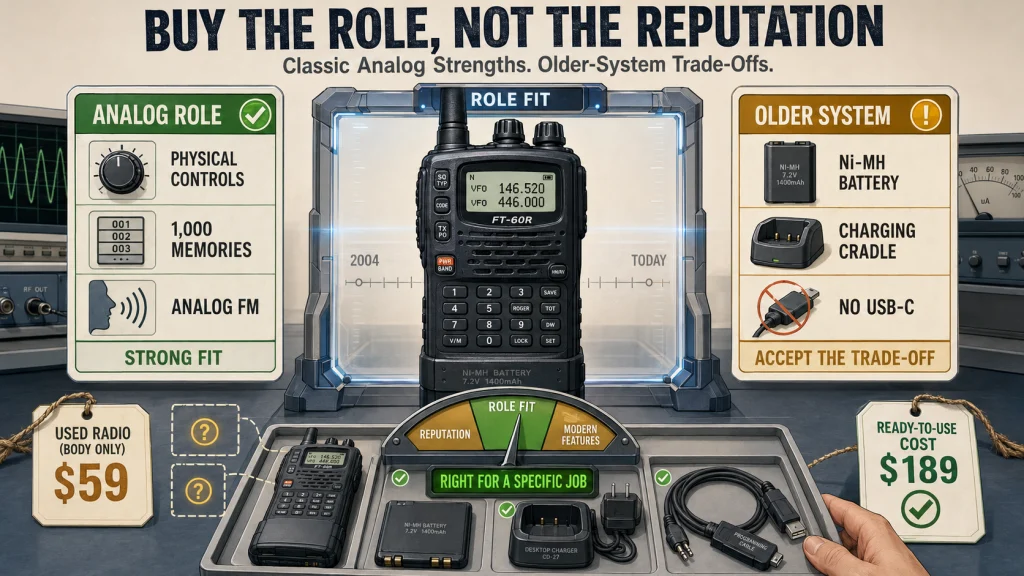
Decision rule: Compare the complete ready-to-use cost, not only the radio price. Include the condition of the battery, the exact charger supplied, any programming cable you need, and the cost of replacing missing accessories. A cheap used body with an exhausted pack and no correct charger can cost more than a verified new package.
Once that total is visible, the age of the design becomes a concrete trade-off rather than a vague complaint. You can decide whether the familiar controls are worth the extra weight, charging time, or replacement-battery cost in your own setup.

This Aimtobest FNB-83 replacement battery uses 7.2-volt Ni-MH chemistry and is rated at 1800mAh. The verified listing identifies compatibility with the Yaesu FT-60R and related FT-60 models. It is rechargeable and is sold as an FNB-83 family replacement pack.
Check On AmazonIf you click this link and buy, we earn a commission at no additional cost to you.
Receiver and Audio: Useful Specifications, Limited Comparative Proof
Yaesu’s published receiver specifications list a double-conversion superheterodyne design, sensitivity figures across multiple frequency ranges, narrow-FM selectivity figures, and at least 400 mW of rated audio output into 8 ohms at 10 percent distortion. Those numbers establish that the FT-60R was designed as more than a minimal repeater appliance. They do not prove that it rejects strong nearby signals better than every newer handheld or that its speaker will sound louder in every outdoor setting.
Long-term owner reports add a different kind of evidence. They repeatedly praise clear receive audio, usable transmit audio, and stable operation in radio-dense areas. Other owners describe the speaker as only moderately loud, question sensitivity on particular bands, or report that the accessory jack can be fussy with a speaker microphone. These reports are worth treating as inspection targets, not as a vote that settles performance. Local RF conditions, antenna choice, accessory fit, hearing, and the condition of a decades-old used unit can all change the result.
A first-time buyer also needs to separate receiver quality from handheld range. The same FT-60R may reach a nearby repeater from an open hill and fail from inside a reinforced building, because line of sight, terrain, antenna position, and repeater height dominate the link. Buying this radio for its reputation will not turn a stock handheld antenna into a mobile or base antenna. When local coverage is marginal, the correct next comparison is often radio type and antenna placement, not another claim about handheld sensitivity.
Durability Claims Need a Narrow Reading
Yaesu’s product material describes a rugged die-cast, water-resistant case. That is meaningful, but it is not the same as a published IP ingress rating. The current US product material does not give the buyer a specific immersion depth, dust level, or test duration that can be compared directly with a radio carrying an IP54, IP67, or IPX7 label.
Third-party listings sometimes connect the FT-60R to MIL-STD-810 language. Without the exact standard revision, methods, procedures, and manufacturer test documentation for the current production unit, that reference should not be converted into a waterproof claim or an unlimited drop guarantee. A radio that survives years of careful field use can still be damaged by a loose accessory cover, a hard impact on the control shafts, corrosion, or water entering a connector.
Owner history is strongest as evidence that long service is possible. Reports include units used for many years, batteries replaced while the radio continued working, and controls or labels wearing before the electronics failed. They also include complaints about microphone-jack fit, charger contact, and aging displays. For a used FT-60R, inspect the antenna connector, knobs, battery latch, accessory jack, keypad, display contrast, charging behavior, and full-power transmit before treating appearance as proof of condition.
Programming and Daily Use: Easy After the System Makes Sense
Front-panel programming follows a traditional Yaesu sequence: set the receive frequency, configure repeater shift and access tone, choose the desired power level, store the channel, and then add a label or bank assignment. None of those steps is technically difficult, but the information is spread across several manual sections. New operators often enter the frequency correctly and then forget that the tone mode, tone value, and transmit offset are separate settings.
I see the same broader mistake after license exams: the buyer evaluates a radio by how quickly one frequency can be typed into the VFO, then discovers that daily operation depends on clean memory organization. For the FT-60R, build one known-good repeater memory, test transmit and receive, save a clean backup, and only then import a long channel list. The detailed front-panel radio programming process is useful when you want to understand what the software is changing rather than treating the cable as a magic fix.
Computer programming remains viable because current CHIRP releases support the FT-60R, and dedicated commercial programming software is also available. The cable is not a generic USB audio lead: the radio uses a four-contact TRRS connection and requires the correct serial-level conversion in the cable. Cable chipset, driver behavior, connector seating, radio clone mode, and the upload-download sequence are all common failure points.
Pro Tips: Read from the radio before editing, save the untouched image, make a small change, and write it back before building hundreds of memories. This confirms that the cable, driver, software version, and radio sequence work together. It also gives you a recovery file if a later import rearranges banks, tone modes, or labels.
After the test succeeds, keep the front-panel steps available anyway. A cable is efficient for bulk work, but understanding one manual memory is what lets you correct a tone or add a repeater when the computer is not beside the radio.

This Valley Enterprises programming cable uses an FTDI USB chipset and is designed for compatible Yaesu radios including the FT-60R. It uses a USB Type-A computer connection and provides TX and RX activity indicators. Programming software is not included with the cable.
Check On AmazonIf you click this link and buy, we earn a commission at no additional cost to you.
The Ownership Path Is Still Viable, With Conditions
Yaesu’s current accessory listings still include the FNB-83 battery, the six-AA battery tray, charging parts, DC power cables, antenna adapters, cloning cable, headsets, and speaker microphones for the FT-60R family. That is a stronger ownership position than an old radio supported only by auction listings. It gives a new buyer a realistic path to replace normal wear items without immediately depending on unverified old stock.
Availability is not the same as permanent support. A part can remain in the catalog but be intermittently stocked, replaced by a newer part number, or priced high enough to change the value calculation. Yaesu USA also advises owners to confirm that a product is still serviceable before sending it for repair. For a new purchase, keep the receipt and record the exact included accessory part numbers. For a used purchase, assume the battery is a consumable unless its load behavior is demonstrated.
The accessory jack deserves a practical inspection when a speaker microphone or programming cable is central to your use. Long-term owner reports are mixed, with some describing years of trouble-free use and others reporting intermittent seating or unintended behavior when a plug is not fully positioned. Test the exact accessory you plan to use while receiving, transmitting, moving the cable, and changing channels. Compatibility on a product page does not prove that a worn jack and a particular plug will remain secure in motion.

The Yaesu CT-44 is a microphone adapter listed by Yaesu for the FT-60R accessory system. Yaesu describes it as an adapter from a two-conductor female microphone connection to the radio's single jack. The FT-60R operating manual also identifies the CT-44 as an optional accessory for external microphone connections.
Check On AmazonIf you click this link and buy, we earn a commission at no additional cost to you.
Who the FT-60R Fits Best
The FT-60R fits an operator who wants one dependable analog role and prefers conventional controls over feature density. It is especially sensible when local activity is mostly FM repeaters and simplex, the buyer values mature documentation, and the radio will be organized into named memories rather than constantly reconfigured. Someone who already understands why they want memory banks, a separate squelch control, and wideband receive can make better use of it than someone buying only because other operators call it a classic.
It can also be a reasonable first handheld when the local repeater environment is known and the buyer is willing to learn the memory workflow. Before deciding, compare it within the broader handheld radio selection framework, then check whether the same job can be handled at lower total cost through current budget handheld choices. The goal is not to buy the cheapest radio. It is to avoid paying for history when the actual use case needs only a few local analog channels.
Move to a different design when any of the following is a firm requirement:
- Digital voice operation on a local network
- Built-in GPS or location features
- Direct USB-C charging or charging without a proprietary radio cradle
- A published, verifiable ingress-protection rating
- A lighter body for everyday carry
- A lower ready-to-use total after battery, charger, and programming costs
Emergency use needs a separate standard. The FT-60R can be part of a prepared analog station, but a long production history does not establish battery readiness, local coverage, weather resistance, or interoperability for your plan. Evaluate those requirements through a complete emergency radio readiness checklist rather than assuming that a rugged reputation answers every preparedness question.
Verdict: Is the Yaesu FT-60R Worth It?
The FT-60R is worth considering when a verified new package falls near the lower end of its current price range, the buyer wants a straightforward analog handheld, and the older battery and charging system are acceptable. Its strongest case is not a single headline specification. It is the combination of physical controls, deep memory organization, mature documentation, active accessory listings, and a large body of long-term owner experience.
It becomes harder to justify when the price approaches newer radios with features you will actually use, or when a used unit needs a battery, charger, cable, and accessory repairs. Do not pay extra merely because the model has been sold for more than two decades. Pay for a confirmed role, a complete package, and a condition you have tested.
Based on the current catalog, published specifications, dealer package information, and owner evidence reviewed here, the FT-60R remains a viable analog tool, but it is no longer the automatic answer to “what handheld should I buy?” Start with the full radio choice by license and use, then return to the FT-60R only if its specific controls, memory system, and ownership path solve that job better than the alternatives.
Final Thoughts: Buy the Role, Not the Reputation
The Yaesu FT-60R has lasted because its basic analog job remains useful, not because time stopped in 2004. A buyer who wants local FM repeater access, named memory banks, physical knobs, and established support may find that the design still fits cleanly. A buyer who needs modern power, verified weather protection, digital features, or the lowest complete cost should keep comparing.
Before purchasing, verify the exact US model, package contents, current warranty terms, battery behavior, charger, accessory-jack fit, and full-power transmit. That ten-minute audit tells you more about present value than hundreds of generalized recommendations. Long service life is evidence worth respecting, but fit and condition are what make the radio worth owning today.
FAQs
📻 Is Yaesu FT-60R worth it for a new ham?
It can be, when the new operator mainly needs analog repeaters and simplex, accepts the Ni-MH charging system, and wants physical controls. It is a weaker fit when digital voice, GPS, USB-C charging, low weight, or the lowest total cost matters more.
🔋 How old is the battery design in the FT-60R?
The standard FNB-83 is a 7.2-volt, 1,400 mAh Ni-MH pack from the radio’s original design era. Replacement support still exists, but battery age and voltage under transmit load matter more than whether a used pack can power the display.
💻 Can CHIRP program the Yaesu FT-60R?
Yes, current CHIRP releases support the FT-60R. Use the correct four-contact programming cable with the required level conversion, read and save the original radio image first, and test a small write before importing a large list.
🌧️ Is the FT-60R waterproof?
Do not treat it as waterproof. Yaesu describes the case as water-resistant, but the current US product information does not provide a specific IP ingress rating that supports immersion or dust claims.
📡 Does the FT-60R have better range than cheaper handhelds?
Not automatically. Handheld range depends heavily on terrain, building loss, antenna position, repeater height, and the local noise environment, so a 5-watt rating or strong owner reputation cannot guarantee a longer path.
🧾 What should I check in an FT-60R ham radio review?
Look for a clear separation between official specifications, direct testing, and owner reports. Also check the review date, current package contents, price, warranty terms, battery condition, programming support, and whether the writer is comparing total ownership cost rather than reputation alone.