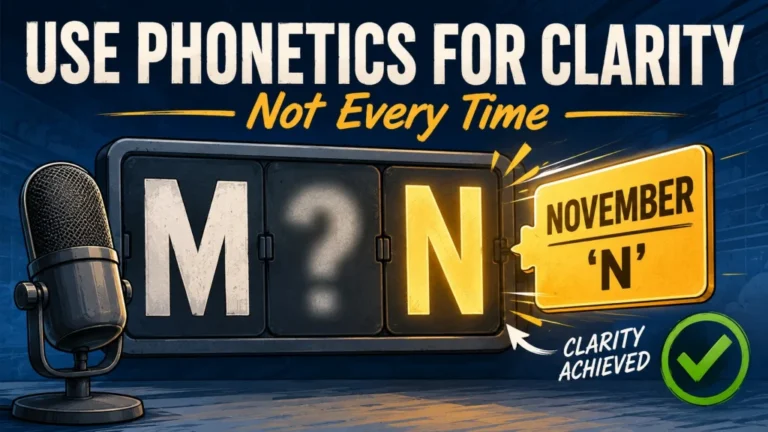
Good repeater behavior starts with separating FCC requirements from local operating customs. You must identify correctly, avoid prohibited transmissions and deliberate interference, and yield to emergency communications, while practices such as saying “monitoring,” avoiding CQ, or waiting through a particular courtesy tone are conventions that can vary by system. Listen long enough to understand what the repeater is doing, make one clear transmission, and leave room for other stations to enter. This guide explains the practical procedure without treating every etiquette mistake as a federal violation.
Ham Radio Repeater Etiquette Starts With Law Versus Custom
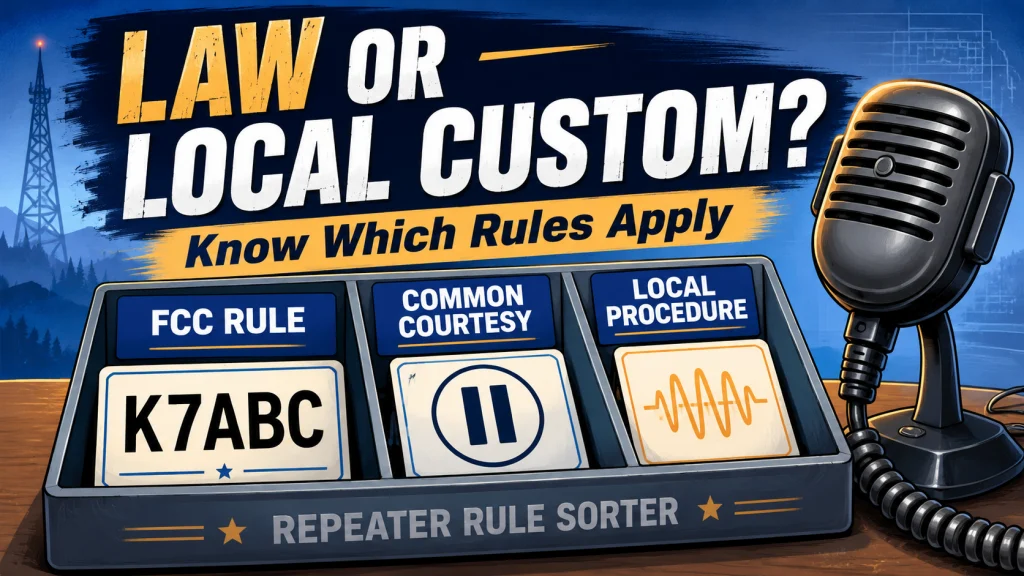
The fastest way to become comfortable on a repeater is to sort every instruction into one of three categories: an FCC requirement, a widely used operating convention, or a rule specific to that repeater. Those categories overlap in purpose, but they do not carry the same weight. A missed call sign can be a legal problem, while calling CQ on a local repeater is normally a custom issue, not a separate FCC offense.
I recommend making this distinction before memorizing scripts. New operators often become so worried about saying the wrong phrase that they stop listening to what is happening on the channel. Repeater operating procedure is easier when the operator first protects the legal requirements, then adapts to the machine and the local group using it.
| Type of instruction | Typical example | How to treat it |
|---|---|---|
| FCC requirement | Transmit your assigned call sign at the required interval and at the end of the communication | Follow it on every repeater |
| Common convention | Use your call sign plus “monitoring” instead of calling CQ | Use it unless the local system has a different established practice |
| Repeater-specific procedure | Wait for a particular courtesy tone, follow a linked-system pause, or obey net control | Verify it from the repeater owner, sponsoring group, announcement, or observed operation |
This article covers normal analog repeater use. It does not teach HF procedure, full first-contact scripts, or directed-net operations. Those activities use some of the same courtesy principles, but the words, timing, and control structure can be different.
Listen Long Enough to Understand the Repeater
Listening first means more than checking whether someone is speaking at the exact second you reach for the push-to-talk button. Monitor long enough to learn whether two stations are in conversation, a directed net is running, emergency or priority traffic is being handled, or the repeater is connected to another system. A quiet gap can be part of an active exchange rather than an invitation to transmit.
Pay attention to the machine as well as the voices. A courtesy tone may indicate that a transmission ended or that a timeout timer reset, while the repeater tail is the carrier that remains briefly after a user releases the microphone. On a linked network, audio and control signals may take longer to settle, so a pause that works on one local machine may clip audio or double with another user elsewhere on the network.
A useful listening check is:
- Can I tell whether the channel is free or merely between transmissions?
- Is a net control station directing who may speak?
- Has anyone announced emergency, priority, weather, or public-service traffic?
- Does the system have a courtesy tone, long tail, voice announcement, or linked delay?
- Are local users leaving a consistent opening for other stations?
If those answers are unclear, another minute of listening usually costs less than interrupting a conversation and then trying to repair it. Operators who are still learning the complete path from programming to transmitting can use the guide to getting on ham radio step by step before treating the repeater as ready for use.

The BTECH BL-5RHL is a 5200mAh lithium-ion battery pack with USB-C charging. It fits the BF-F8HP PRO, UV-5RM, UV-5G Plus, GM-5RH, and other radios using the BL-5RH battery standard. It gives compatible handhelds a high-capacity power option for longer monitoring sessions without changing repeater operating procedure.
Check On AmazonIf you click this link and buy, we earn a commission at no additional cost to you.
Start a Call With One Clear Purpose
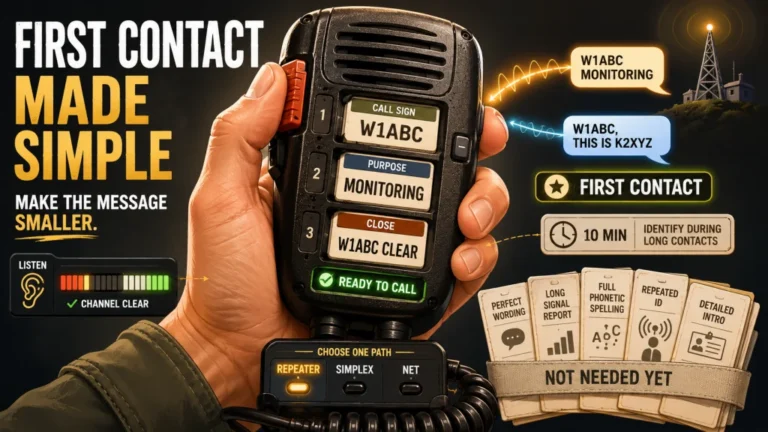
If the repeater is quiet and you are available for a contact, a common call is simply “[your call sign] monitoring” or “[your call sign] listening.” If you want a specific station, say that station’s call sign followed by your own. Keep the first transmission short so another operator can answer without competing with a long explanation.
Calling CQ on a repeater is generally unnecessary because listeners are already monitoring a known channel rather than tuning across a wide band looking for activity. Many local groups discourage CQ for that reason. That makes it a convention issue, not a special rule that turns the phrase itself into illegal operation.
The practical test is whether your opening tells listeners what response you want. Compare these approaches:
After one or two reasonable attempts, stop and listen again. No answer may mean the repeater is quiet, your signal is not reaching it, or listeners are unavailable. It does not mean you need to fill the channel with repeated calls. For wording beyond the opening line, see the separate guide to making your first ham radio contact.

The BTECH UV-5X3 is a tri-band amateur handheld covering VHF, 1.25-meter, and UHF operation. It provides 128 memory channels and two output levels of 5 watts and 0.5 watt. The included USB-C rechargeable battery and dual-band plus 220 MHz antennas support a ready handheld setup for clear, purpose-driven repeater calls.
Check On AmazonIf you click this link and buy, we earn a commission at no additional cost to you.
Use Pauses for Access, Not a Memorized Countdown
There are two different pauses in repeater operation. First, pause briefly after pressing push-to-talk before speaking so the radio, repeater, and any linked path can open. Second, leave space after the other station finishes so the system can reset and another station can enter.
No single number works for every repeater. A simple local machine may pass audio almost immediately, while a linked network, remote receiver, Internet bridge, or voting system may need more time. Waiting for a courtesy tone can help where one exists, but not every system uses the same tone or gives it the same meaning.
Use the first exchange as a diagnostic. If the beginning of your call sign is clipped, lengthen the pause after keying. If you repeatedly double with distant users, leave more space after the courtesy tone or tail. If the repeater drops during long transmissions, shorten your turns rather than trying to guess or defeat its timeout behavior.
Key point: The purpose of the pause is to preserve the communication path and create an entry point for other stations. Copying an exact timing rule from another repeater can defeat both purposes.

The BTECH QHM22 is an IP54 speaker microphone for radios using the Kenwood K1 two-pin connector. Its reinforced cable, impact-resistant housing, and rotating spring clip are designed for regular field use. A built-in 3.5mm listen-only jack supports an earpiece, while the remote PTT gives the operator a practical control point for deliberate key-and-pause timing.
Check On AmazonIf you click this link and buy, we earn a commission at no additional cost to you.
Join an Active Conversation Without Taking It Over
To join a normal conversation, wait for a natural pause and transmit only your call sign. Then release the microphone and wait to be acknowledged. This gives the stations already talking a clear choice to bring you in without forcing your comment over the current speaker.
Do not use break as a casual substitute for your call sign. ARRL beginner guidance treats that word as a signal for urgent or emergency interruption, so using it for an ordinary comment creates unnecessary uncertainty. If you have an actual emergency, say emergency clearly, give your call sign, and state what help or channel access is needed.
A short call to another station during a long conversation is a separate case. Give your call sign during a pause, wait for acknowledgment, ask to make a quick call, and keep it quick. If the other station answers, move the extended one-to-one conversation to simplex or another available channel when practical.
Once invited into the conversation, match its pace and subject before changing direction. A repeater is shared, so joining successfully means adding something useful, not proving that you found the opening first.

The BTECH QHM22D is an IP54 dual push-to-talk speaker microphone for compatible K1 two-pin radios. Amazon lists compatibility with models including the BTECH UV-5X3 and BaoFeng UV-5R and BF-F8HP families. Its two PTT buttons and shoulder-mic format provide a direct way to make the brief call-sign entry described when joining an active repeater conversation.
Check On AmazonIf you click this link and buy, we earn a commission at no additional cost to you.
Know What Part 97 Actually Requires
For normal voice operation, transmit your assigned call sign at the end of each communication and at least every ten minutes during a communication. The FCC rule does not require you to repeat both stations’ call signs at every handoff, nor does it create a mandatory script for saying “monitoring.” Giving your call sign at the beginning is useful operating practice because it tells listeners who entered the channel, but the legal timing rule must still be met during and at the end of the communication.
Part 97 also requires operators to cooperate in selecting channels, use amateur frequencies effectively, give priority to stations providing emergency communications, and avoid willful or malicious interference. Those requirements are broader than politeness. Talking over emergency traffic or deliberately blocking another station is not merely unfriendly repeater behavior.
The prohibited-transmission rules matter when the conversation itself drifts. Amateur stations may not transmit music by phone except for narrow rule-based exceptions, obscene or indecent language, messages encoded to obscure their meaning, false or deceptive messages or identification, or communications intended to facilitate a criminal act. This is not a complete Part 97 summary, but it marks the line where “local etiquette” stops being the whole issue.
Field Note: I have spoken with new licensees who stayed silent on repeaters because they were worried about using the wrong phrase. The useful correction is to ask, “Is this an FCC requirement, a common courtesy, or this repeater’s local procedure?” That question gives them a reliable way to transmit without treating every local variation as a legal trap.
Keep a Busy Repeater Available to More Than One Conversation
Concise does not mean robotic. It means one transmission should carry one useful thought without turning the shared channel into a private telephone line. During commute periods, weather events, public-service activity, or any time several stations are waiting, shorter turns make it easier for priority traffic and new callers to be heard.
An extended conversation can remain on the repeater when the system is quiet and local practice allows it. The answer changes when activity increases. If two stations can communicate directly, moving to simplex frees the repeater for users who need its wider coverage. Another open repeater or agreed channel may serve the same purpose when simplex is not workable.
During a directed net, the net control station determines the order of transmissions. Do not join as though the channel were an open roundtable, and do not answer traffic that was directed to another station unless the net’s procedure calls for it. The separate guide to joining ham radio nets as a beginner covers that controlled format without confusing it with ordinary repeater conversation.
If emergency or priority traffic appears, stop transmitting and listen. Offer assistance only when requested or when you can provide something directly useful. Filling the channel with offers, questions, or speculation can make a real communication problem harder.

The Nagoya NA-771 is a 15.6-inch VHF/UHF whip antenna for 144/430 MHz operation. This variant uses an SMA-Female connector for compatible BTECH and BaoFeng handheld radios. It is a relevant antenna option when an operator may move from repeater use to simplex, where the handheld antenna becomes part of the direct radio path.
Check On AmazonIf you click this link and buy, we earn a commission at no additional cost to you.
Test With Identification and a Defined Question
Repeatedly pressing push-to-talk without speaking is commonly called kerchunking. It tells listeners almost nothing, creates unidentified signals, and can keep linked equipment active for no useful reason. A purposeful on-air test should include your call sign and the question you are testing, such as whether your audio is readable or whether the repeater is receiving you from a particular location.
A clean test can be as short as “[your call sign] testing” or “[your call sign], radio check.” If someone answers, ask for the specific information you need rather than a vague “How does it sound?” Signal strength, audio level, clipping, noise, or intermittent access point to different problems.
Not every bench test belongs on the air. When the goal is checking transmitter power, microphone wiring, deviation, or another equipment condition that does not require a live repeater path, use a dummy load or service monitor where appropriate. Radiate only the part of the test that needs a real antenna and real path.
Research-based: Brief adjustment transmissions are allowed within Part 97, but the station identification and interference rules still matter. A technical purpose does not turn repeated unidentified keying into good procedure.
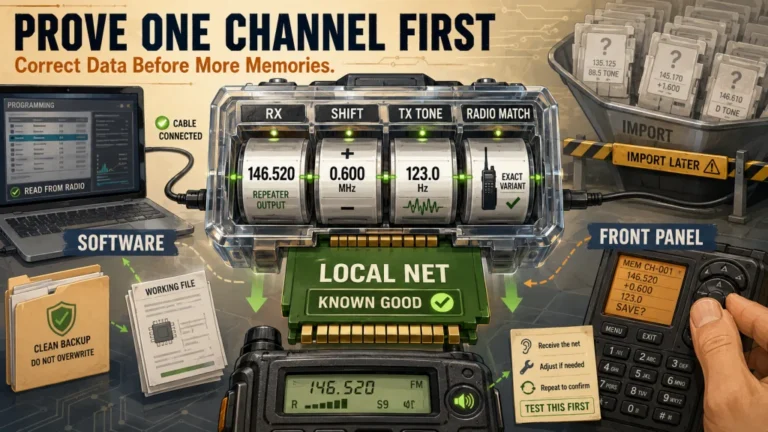
If the repeater does not respond, check programming, offset direction, access tone, receive frequency, antenna connection, location, and whether the machine is active before transmitting more often. The ham radio troubleshooting decision guide helps separate a programming problem from a coverage or equipment problem.

The Mcbazel Surecom SW-33 Plus is a digital power and SWR meter for 125-525 MHz VHF/UHF systems. It connects inline between a handheld or mobile transceiver and the antenna and is rated for measurements up to 100 watts. It provides a defined bench measurement path when checking transmitter, feed-line, or antenna behavior instead of repeatedly keying a live repeater.
Check On AmazonIf you click this link and buy, we earn a commission at no additional cost to you.
Expect Local Variations Without Turning Them Into Federal Rules
Repeater owners and sponsoring groups may establish procedures for normal use as long as operation remains consistent with FCC rules. One system may ask users to wait for a specific tone. Another may have an autopatch sequence, a linked-network delay, a digital bridge, scheduled control announcements, or restrictions during emergency nets and public-service events.
Local rules should be verified, not guessed. Check the sponsoring group’s published information, listen to the machine’s announcements, and observe how net control or regular users handle access. A habit heard on one repeater should not be carried across town and presented as the only correct amateur radio rule of conduct.
Autopatch and control functions deserve extra caution because incorrect touch-tone commands can affect the system rather than only your own transmission. Linked systems deserve longer listening because a local silence may hide activity arriving from another site. Digital bridges may also add delay or identification behavior that is not obvious from the analog audio alone.
The safest general rule is narrow: obey Part 97 everywhere, follow the active net or control operator, and adapt the remaining conventions after verifying how that repeater works. Local knowledge should make operation smoother, not become a reason to shame a visitor who followed a different but lawful convention.
Correct Mistakes Without Creating a Second Disruption
New operators will clip a call sign, miss a courtesy tone, call CQ, or enter at the wrong moment. Most of those errors can be corrected with one calm sentence after the immediate communication is complete. A public lecture that occupies the repeater longer than the original mistake does not improve channel discipline.
When correcting someone, name the category and the practical reason. Say that FCC identification is required, that the local system needs a longer pause because it is linked, or that the group normally reserves break for urgent traffic. This is more useful than saying, “That is not how we do radio,” which gives the operator no reliable rule to apply next time.
When receiving a correction, ask for the local source if the instruction sounds unfamiliar. The other operator may be describing a real repeater-specific procedure, a common convention, or a personal preference. Confirming which one it is lets you change the right behavior without collecting another piece of radio folklore.
Courtesy works in both directions. Experienced users protect the repeater by teaching clearly, and new users protect it by listening, identifying, and adjusting when the system genuinely requires something different.
Final Thoughts: Protect the Channel Before Perfecting the Script
Good ham radio etiquette is not a performance of special phrases. It is a repeatable operating habit: listen for the full situation, identify as required, make the purpose of the transmission clear, leave room for others, and yield immediately to emergency or directed traffic. The exact wording and timing can change from one repeater to another, but that operating logic remains useful.
Before your next transmission, decide which part of the procedure is law, which part is common courtesy, and which part belongs to the local machine. That distinction keeps you legal without turning every variation into an argument, and it makes the repeater easier for the next new operator to use.
FAQs
📻 Should I call CQ on a ham radio repeater?
Usually not. A call sign followed by “monitoring” or “listening” is the common repeater convention, while calling CQ is generally unnecessary and locally discouraged rather than a separate FCC violation.
⏱️ How long should I pause between repeater transmissions?
Long enough for the system to reset and another station to enter. Use the courtesy tone and observed system behavior as guides, but allow more time on linked or delayed systems instead of relying on one universal number.
🗣️ How do I join a repeater conversation?
Wait for a natural pause, transmit your call sign, and release the microphone. Continue only after one of the current stations acknowledges you.
🚨 Can I say “break” to enter a conversation?
Do not use it for an ordinary comment. ARRL beginner guidance associates the word with urgent or emergency interruption, so use your call sign for a normal entry and state “emergency” clearly when that is the actual situation.
🪪 When must I identify on a repeater?
Transmit your assigned call sign at the end of the communication and at least every ten minutes while it continues. Identifying at the beginning is also useful courtesy because it tells listeners who entered the channel.
🔧 Is it acceptable to kerchunk a repeater for a test?
Avoid repeated unmodulated keying. Give your call sign and a brief test purpose so the transmission is identified and listeners can provide the information you need.
📡 Should a long conversation move off the repeater?
Move when the repeater is busy, when both stations can use simplex, or when another channel is more practical. A longer conversation may be acceptable on a quiet system if local policy allows it and space remains for priority traffic.
🏘️ Can a local group create its own repeater rules?
A repeater owner or sponsoring group may establish operating procedures consistent with FCC rules. Verify those procedures from the group or the system itself, and do not present a local preference as a nationwide federal requirement.