Phonetics are a clarity tool, not a performance ritual. Use the standard alphabet when a call sign, name, location, or other critical detail could be misheard, then return to normal speech once both operators are copying comfortably. The FCC encourages a phonetic alphabet as an aid to clear station identification, but it does not require every letter of every identification to be spoken phonetically. This reference gives you the complete alphabet, practical call-sign drills, number guidance, and a clean correction method for noisy or uncertain contacts.
The Ham Radio Phonetic Alphabet Is a Tool, Not a Script
The ham radio phonetic alphabet replaces each letter with a distinctive word, such as Kilo for K or Sierra for S. Its job is to separate letters that can sound almost identical through noise, weak audio, accents, clipping, or a hurried transmission. It is especially useful for call signs because one incorrect character can send the other operator toward the wrong station record or leave a net control operator unsure whom to acknowledge.
The legal rule and the operating habit are not the same thing. FCC rules require an amateur station to transmit its assigned call sign at the required times, and they encourage phonetics as an aid to correct identification. They do not say that every voice identification must use the full alphabet, so a clear plain-language call sign can still be a proper identification.
I tell new operators to make one decision before keying the microphone: will the other person probably copy this correctly the first time? If the answer is uncertain, use phonetics. That same clarity-first approach applies to the larger process of getting on ham radio confidently, where correct setup and a usable local path matter more than sounding polished.
Key point: Use phonetics to repair or prevent ambiguity. Do not add them merely because you think a radio contact must sound formal.
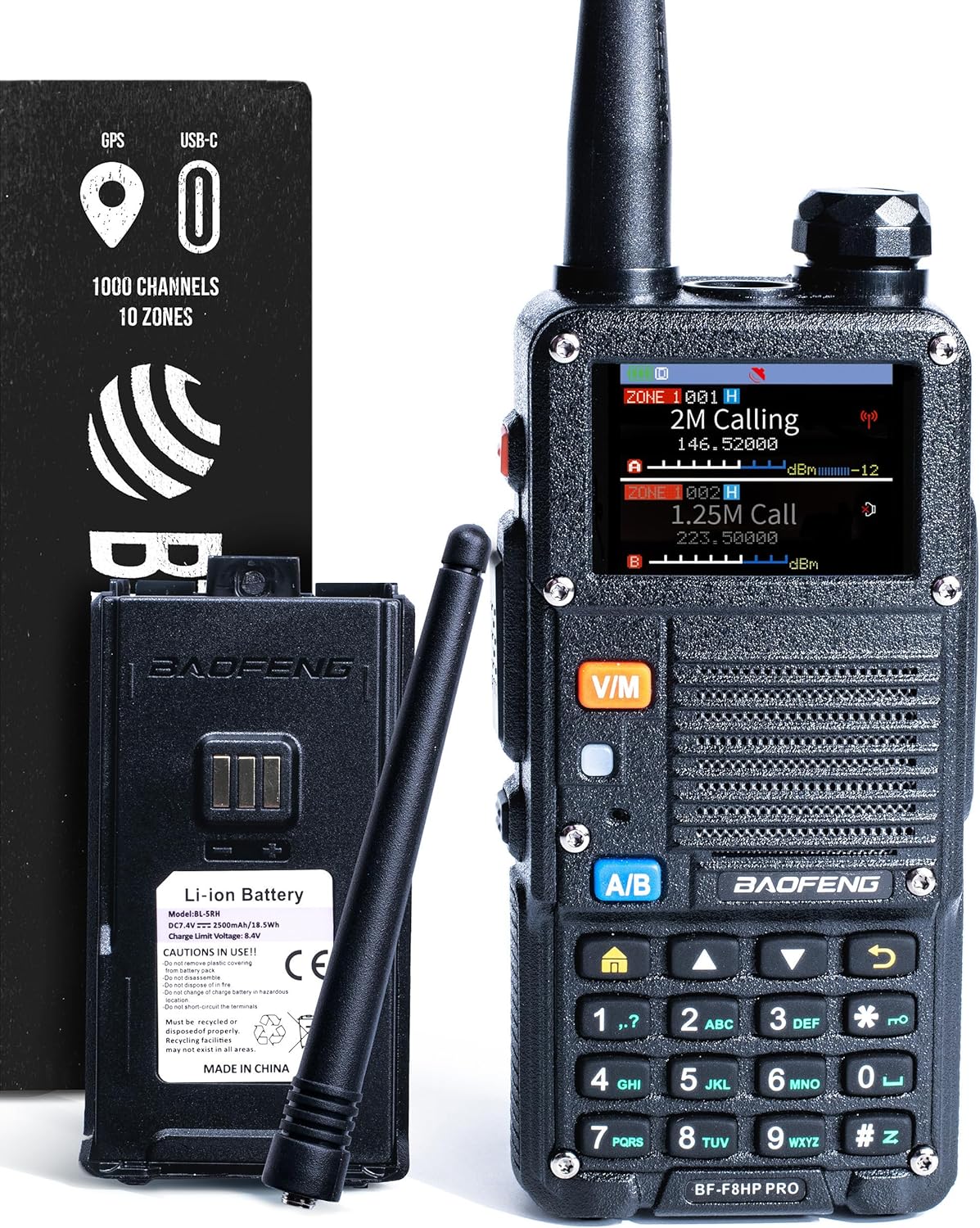
The BAOFENG BF-F8HP PRO is a 10W tri-band ham radio with 1,000 programmable channels organized into 10 zones. It can monitor Airband AM, NOAA weather, FM broadcast, and additional VHF and UHF frequencies in receive mode. Built-in GPS supports coordinate display and radio-to-radio location sharing with another BF-F8HP PRO on the same channel.
Check On AmazonIf you click this link and buy, we earn a commission at no additional cost to you.
Complete Standard Phonetic Alphabet Reference
The standard used by radio amateurs is the international radiotelephony spelling alphabet, commonly called the NATO phonetic alphabet. Three spellings often surprise beginners: Alfa uses an f, Juliett ends with two t’s, and X-ray includes a hyphen. Those spellings are intentional, not typographical errors.
The pronunciation cues below are practical approximations. An accent does not make a phonetic invalid, but each word should remain recognizable and separated from the next one. Speak at a measured pace, leave a small gap between words, and avoid stretching every syllable until the call sign becomes harder to follow.
| Letter | Code word | Simple pronunciation cue |
|---|---|---|
| A | Alfa | AL-fah |
| B | Bravo | BRAH-voh |
| C | Charlie | CHAR-lee |
| D | Delta | DELL-tah |
| E | Echo | ECK-oh |
| F | Foxtrot | FOKS-trot |
| G | Golf | GOLF |
| H | Hotel | HOH-tell |
| I | India | IN-dee-ah |
| J | Juliett | JEW-lee-ett |
| K | Kilo | KEY-loh |
| L | Lima | LEE-mah |
| M | Mike | MIKE |
| N | November | NO-vem-ber |
| O | Oscar | OSS-cah |
| P | Papa | PAH-pah |
| Q | Quebec | KEH-beck |
| R | Romeo | ROW-me-oh |
| S | Sierra | SEE-air-ah |
| T | Tango | TANG-go |
| U | Uniform | YOUN-ee-form |
| V | Victor | VIKT-ah |
| W | Whiskey | WISS-key |
| X | X-ray | ECKS-ray |
| Y | Yankee | YANG-key |
| Z | Zulu | ZOO-loo |
Accuracy matters more than imitating a particular accent. If your “Quebec” or “Victor” remains distinct and the receiving operator copies it, the alphabet is doing its job. The standard words give both sides a shared expectation before the signal even reaches the speaker.

This four-card PVC set puts the phonetic alphabet and core ham radio reference material into a pocket guide. The set covers ham band plans, Q codes, FT8 information, and other operating references for quick lookup. Its water-resistant construction makes it suitable for keeping beside a radio or carrying during portable operating.
Check On AmazonIf you click this link and buy, we earn a commission at no additional cost to you.
Learn Your Own Call Sign Before Random Letter Groups
Your first drill should be the information you will say most often: your assigned call sign. Break it into prefix, numeral, and suffix, then say the plain call sign followed by the phonetic version. Using a made-up example shaped like KJ4MP, the sequence would be “KJ4MP, Kilo Juliett Four Mike Papa.”
Practice until you can say it without looking down, but do not chase speed. A call sign delivered rapidly from memory can be less useful than one read slowly from a card. The goal is automatic recall with clear word boundaries, not a single breath that turns Juliett Four into an unrecognizable blur.
- Say the plain call sign once, then the complete phonetic version.
- Start the call sign from the middle so you are not relying only on a memorized rhythm.
- Ask someone to write what they hear without seeing the call sign.
- Record yourself and check whether each word has a clean beginning and ending.
- Practice receiving other call signs by writing the letters before looking them up.
Field Note: The first-contact hesitation I see is often not a lack of knowledge. A new licensee may know every word on the chart and still freeze when another operator repeats one character incorrectly. That is why I practice the correction step along with the alphabet itself.
Once your own call sign is automatic, random groups become useful because they prevent you from predicting the next letter. Five-character groups such as QMTBZ or RAKDX train the ear and mouth without turning the exercise into an exam. Stop when pronunciation starts getting sloppy; repeated mistakes are not productive practice.
When Phonetics Improve a Contact
Use phonetics when the cost of one wrong letter is higher than the cost of a few extra words. That usually means the beginning of an unfamiliar contact, a weak signal, a net check-in, a correction, or any exchange where names and locations need to be recorded accurately. You do not need to wait for the other station to ask if the path already sounds marginal.
- First identification: The other operator has no established context for your call sign.
- Weak or noisy audio: Similar-sounding letters can disappear into static or clipping.
- Net check-ins: Net control may be writing several call signs in quick succession.
- Public-service traffic: Names, street references, and other details may need an exact read-back.
- Corrections: A single uncertain character can be isolated and repaired.
- Accents or unfamiliar voices: Standard words give both operators a common reference.
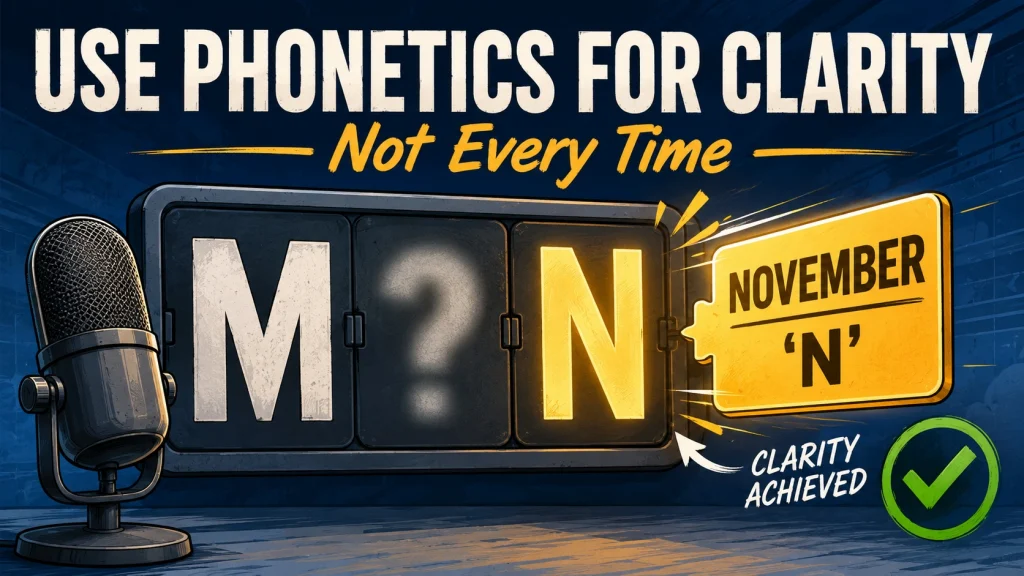
For example, “N” and “M” may sound close on a noisy repeater, while “November” and “Mike” are much harder to confuse. During your first local repeater contact, giving the call sign plainly and then phonetically can reduce the chance that the responding operator has to ask for it again.
The same principle applies when checking into a ham radio net. Say only what the net requests, but give the call sign clearly enough that net control can log it without guessing. More words are not automatically clearer; the useful words are the ones that remove uncertainty.
When Plain Letters Are Enough
A strong local repeater signal and an established conversation may not need a full phonetic call sign every time you identify. Once both operators have confirmed the call signs and the audio is clean, plain letters can keep the exchange natural. The identification still has to be clear, but clarity can come from good pacing and familiar context rather than twenty-six-word formality.
Suppose another station has already addressed you correctly twice and your audio is full quieting. Saying the plain call sign at the required identification point may be entirely sufficient. If the operator comes back with the wrong suffix, that is the signal to switch back to phonetics for the repair.
This is also an etiquette judgment. A busy repeater or directed net rewards concise transmissions, while a weak simplex path may justify slower and fuller phonetics. The broader rules in practical repeater etiquette for beginners help you fit the wording to the channel instead of treating one style as correct everywhere.
How to Say Numbers in a Call Sign
Speak the numeral in a call sign as a separate digit. A 4 is “four,” not “four hundred,” and a 0 is normally “zero,” not the letter O. Keep the digit between the prefix and suffix rather than running it into the surrounding phonetic words.
Aviation radiotelephony uses modified pronunciations for several digits, including “tree,” “fower,” “fife,” and “niner.” Amateur operators may use those forms for added clarity, but amateur radio rules do not make the aviation pronunciation mandatory. On a clean local signal, ordinary “three,” “four,” “five,” and “nine” are usually understood.
| Digit | Clear everyday form | Radiotelephony clarity form | Practical note |
|---|---|---|---|
| 0 | Zero | ZE-RO | Avoid “oh” when it could be mistaken for the letter O |
| 1 | One | WUN | Say it as a separate digit |
| 2 | Two | TOO | Keep it distinct from surrounding words |
| 3 | Three | TREE | The modified form can help through noise |
| 4 | Four | FOW-ER | Two syllables can improve separation |
| 5 | Five | FIFE | Either form may be heard in amateur operation |
| 6 | Six | SIX | No special amateur requirement applies |
| 7 | Seven | SEV-EN | Do not shorten it when the path is weak |
| 8 | Eight | AIT | Separate it cleanly from the suffix |
| 9 | Nine | NIN-ER | “Niner” is a clarity form, not an FCC requirement |
If someone miscopies the numeral, repeat the whole call sign once with the digit emphasized, then return to a normal pace. Shouting only the number can distort the audio and make the second attempt worse than the first.
Correct One Character, Then Confirm the Full Call Sign
A clean correction is shorter than restarting the entire conversation. Identify the uncertain part, give the corrected character in standard phonetics, then repeat the complete call sign so the other operator can confirm the repaired version in context. This prevents a fix to one letter from creating a new mistake elsewhere.
Imagine the other station reads your suffix as “Mike Tango,” but it is “Mike Papa.” A useful response is: “Correction, the final letter is Papa. Full call sign Kilo Juliett Four Mike Papa.” The word “correction” prepares the listener for a change, and the full repeat closes the loop.
If you are the receiving operator, ask for the smallest useful piece: “Please repeat the suffix phonetically,” or “Was the first letter Sierra?” After receiving the answer, read back the complete call sign. A read-back is more reliable than assuming silence means you copied it correctly.
I prefer this repair pattern because it keeps the contact moving without turning uncertainty into embarrassment. Every operator misses a letter occasionally. The professional response is not to pretend; it is to isolate the problem and confirm the result.
Nonstandard Phonetics Can Help or Hurt
Radio amateurs sometimes substitute words such as America, Germany, Radio, or Sugar for the standard alphabet. A familiar local group may understand those immediately, and a second word can occasionally rescue a stubborn character that is not getting through. The trade-off is that the receiving operator has to recognize your private choice before interpreting the letter.
Use the standard word first when accuracy matters. If “Sierra” is repeatedly lost in the noise, you can try a clearly introduced alternative, such as “Sierra, S as in Sugar,” then confirm the complete call sign. That is different from using an unpredictable set of humorous words on the first attempt.
Nonstandard words are a poor choice for net control, public-service traffic, weak-signal work, or an operator who may not share your local habits. Standardization reduces the receiver’s mental workload. The other person hears “Whiskey” and knows immediately that the target is W; “Washington” may also work, but it asks for an extra interpretation step.
Warning: Do not turn a casual alternate word into a claim that there is a separate official amateur alphabet. The internationally recognized spelling alphabet remains the most predictable starting point.
A Practical Way to Learn Amateur Radio Phonetics
Memorizing the chart is only the first layer. On the air, you must retrieve words while transmitting and translate words back into letters while listening. Train both directions, because an operator who can say “Foxtrot” may still hesitate when hearing it inside a fast call sign.
Use a progression rather than a time promise. Some operators already know the alphabet from aviation, military service, dispatch work, or another radio service; others are learning all twenty-six words for the first time. Practice until the skill is reliable under mild pressure, not until a calendar says you should be finished.
- Read the chart aloud: Focus on correct words and clean syllable separation.
- Drill your own call sign: Say it plain, then phonetically, at a steady pace.
- Decode random groups: Hear five letters and write them without looking at the chart.
- Practice corrections: Deliberately change one character, repair it, and repeat the full group.
- Listen to real contacts: Copy call signs before checking a database or screen.
- Keep a printed reference nearby: Use it during early contacts rather than guessing under pressure.
A printed card is not a sign that you failed to memorize the alphabet. It is a backup that keeps a first transmission accurate while recall becomes automatic. Over time, the card should become less necessary because the words are attached to real contacts rather than isolated study.

This Ready Radio pocket guide covers amateur radio, GMRS, FRS, MURS, NOAA weather, radio settings, and communication procedures. It includes the NATO phonetic alphabet and provides quick reference without requiring a phone or internet connection. The credit-card-sized cards use waterproof synthetic material for everyday carry in radio kits, vehicles, and field gear.
Check On AmazonIf you click this link and buy, we earn a commission at no additional cost to you.
Final Thoughts: Use the Fewest Words That Remove Uncertainty
The best phonetic habit is not “always use every word” or “never use phonetics on a repeater.” It is to recognize when the receiving operator lacks enough context to copy a letter confidently. Use the standard alphabet at that moment, speak the digit separately, and correct only the uncertain part before confirming the whole call sign.
I would rather hear a new operator pause and read a correct call sign from a card than rush through a polished but ambiguous identification. Clarity is the skill. The alphabet is simply the shared tool that makes clarity easier when the signal or situation is working against you.
FAQs
📻 Do I have to use phonetics every time I identify?
No. FCC rules encourage phonetics as an aid to correct identification, but they do not require every voice identification to be fully phonetic. Use them when plain letters may be misheard.
🔤 Is the NATO phonetic alphabet used in ham radio?
Yes. Radio amateurs commonly use the international radiotelephony spelling alphabet that is also known as the NATO or ICAO alphabet. Its standard words give unfamiliar operators a shared reference.
🪪 Should I say my call sign normally before using phonetics?
That is often a clear approach: give the plain call sign, then the phonetic version when the listener has no context or the path is noisy. On an established, strong contact, the plain version may be enough.
9️⃣ Do I need to say “niner” instead of “nine”?
No. “Niner” is an international radiotelephony clarity pronunciation, not a special FCC requirement for amateur operators. Use it when it improves copy, but an intelligible “nine” is acceptable.
🛠️ What should I do when someone copies one letter incorrectly?
State that you are making a correction, give the uncertain character phonetically, then repeat the full call sign. Ask the other operator to confirm if the path remains noisy.
🎙️ Are funny or custom phonetic words allowed?
They may be understood in casual contacts, but they reduce predictability. Start with standard phonetics when accuracy matters, and use an alternate only as a clearly explained second attempt if needed.