Ham Radio Antenna Setup: Home VHF/UHF, First HF Wire, Restricted Housing, and Mobile Installation

Ham Radio Antenna Setup

A useful antenna setup starts with the operating job, the property, and a safe feedline path, not with the largest gain number in a listing. Home VHF/UHF, a first HF wire, restricted housing, and a vehicle each create a different installation problem. This guide helps you choose the correct path, recognize the limits that change … Read more
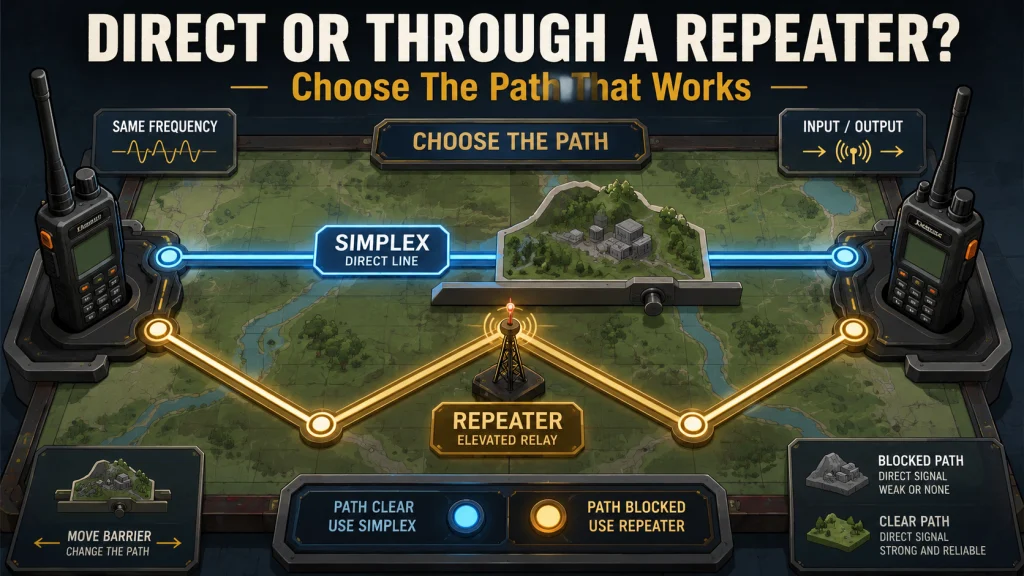
Ham Radio Simplex vs Repeater: When to Use Each and How to Make a Direct Contact

Ham Radio Simplex Vs Repeater

A repeater relays your signal through a well-positioned station, while simplex lets two amateur stations communicate directly on one frequency. Use a repeater when its coverage, activity, or elevation solves a path problem; use simplex when the stations can already hear each other, need a direct local channel, or want to move an extended conversation … Read more

What Do You Need to Start Ham Radio? The Minimum Gear List for a New Technician

What Do You Need To Start Ham Radio

A new Technician needs four connected pieces to make a first local contact: a VHF/UHF handheld, a workable programming method, an antenna, and one verified local repeater. The included antenna is usually enough for the first coverage test, while a programming cable or supported wireless method may be the missing item that turns an unopened … Read more

Mobile Ham Radio Power Output: What 25W, 50W, and 65W Actually Change in Practice

Mobile Ham Radio Power Output

Moving from 25W to 50W doubles transmitter power, but it adds only about 3 dB to the outgoing signal, not twice the range. A 65W setting adds about 4.15 dB over 25W and only about 1.14 dB over 50W, so the practical difference depends on the antenna system, terrain, feedline loss, supply voltage, receiver conditions, … Read more