Shortwave and ham radio overlap on parts of the HF spectrum, but they solve different problems. A shortwave receiver is the simpler choice when the goal is to listen to distant broadcasts and other supported signals without transmitting. Ham radio is the better path when the goal is two-way contact, nets, technical experimentation, or digital operation under the privileges of a US amateur license. The right decision depends less on which device covers more frequencies and more on whether you want information coming in, communication going both ways, or two separate tools for both jobs.

The Real Choice Is Listening or Participating
The ham radio vs shortwave radio decision becomes much easier once you stop treating the two labels as competing versions of the same device. Shortwave commonly refers to the 3 to 30 MHz HF range and to the listening hobby built around signals found there. Amateur radio is a licensed radio service that uses parts of HF as well as bands above and below it for two-way communication, self-training, and technical investigation.
That distinction matters because a wide tuning range does not tell you what a radio is designed to do. A receiver may tune across international broadcasts, amateur conversations, time signals, and other transmissions yet have no legal transmit capability. An amateur transceiver may transmit on authorized amateur frequencies but still be less convenient for broadcast listening because its audio, filters, tuning steps, or controls were designed around amateur operation.
Field Note: At exam sessions, I often hear the buying question before the operating question. Someone asks which radio to buy, but the useful answer only appears after we establish whether that person wants to hear distant programming, talk with licensed operators, or do both as separate activities.
If you are also comparing local monitoring tools, the broader explanation of how scanners, shortwave, and ham radio differ helps separate three jobs that are often bundled together. For this comparison, the boundary is narrower: receive-focused shortwave listening versus licensed amateur HF operation.

The PL330 receives FM, LW, MW, and shortwave and includes USB and LSB single-sideband reception. Direct frequency entry, ATS, ETM+, and 850 station memories support structured listening across different signal types. Its external FM/SW antenna jack also gives the listener a documented path to improve reception beyond the built-in antenna.
Check On AmazonIf you click this link and buy, we earn a commission at no additional cost to you.
What a Shortwave Receiver Can and Cannot Do
A shortwave receiver converts supported radio signals into audio or data you can monitor. Depending on its documented coverage and modes, it may receive conventional AM broadcasts, single sideband voice, CW signals, or certain digital transmissions. Those capabilities are not automatic, so the word “shortwave” on a box should never be treated as proof that every frequency, mode, or signal type is supported.
The practical dividing line is transmission. A receive-only set does not become a two-way emergency radio because it can hear an amateur operator, and it does not gain legal transmit authority through a menu setting or connector. It is an information tool: you tune, identify a signal, adjust the filter or antenna, and listen to whatever is being transmitted and successfully reaches your location.
For example, a listener focused on spoken international programming may care most about AM audio, easy direct frequency entry, memories, and a usable speaker. Someone who wants to hear amateur SSB conversations needs sideband reception, fine tuning resolution, and filters narrow enough to separate nearby signals. Those are different buying requirements even though both users may describe the activity as shortwave listening.

The D-808 covers FM, MW, LW, shortwave, SSB, and air band reception. It supports direct frequency entry, automatic tuning storage, and up to 500 stored frequencies, making it useful for scheduled or repeat listening. A shortwave external antenna jack and included 18650 lithium battery support portable monitoring without adding any transmit capability.
Check On AmazonIf you click this link and buy, we earn a commission at no additional cost to you.
What an HF Amateur Transceiver Adds
An HF amateur transceiver combines reception with the ability to transmit inside amateur allocations allowed by the operator’s license class. That opens activities a shortwave receiver cannot provide: calling another station, joining a net, exchanging signal reports, using permitted digital modes, practicing CW, testing antennas, and learning how propagation changes an actual two-way path.
Transmission is not the only difference. Amateur equipment is normally organized around amateur bands, operating modes, frequency control, filters, meters, and station accessories. General-coverage reception may be included, but its extent and broadcast-listening quality vary. A transceiver that is excellent for weak SSB contacts is not automatically the most pleasant device for listening to an hour of wide AM programming through a small communications speaker.
The same distinction applies when comparing a shortwave receiver vs amateur radio equipment for long-distance signals. A receiver only has to recover a usable signal from another station. A two-way contact requires both stations, both antennas, current propagation, compatible modes, correct frequency privileges, and enough skill to complete the exchange. That is why how ham radio handles long-distance communication is a system question rather than a promise attached to one radio.
When the decision has already moved toward transmitting, use case should narrow the equipment class before features do. The guides to choosing a ham radio by use case and choosing an HF ham radio address that next step without assuming every new operator needs the same station.

The G90 is a 20-watt HF amateur transceiver with an SDR architecture and a built-in automatic antenna tuner. It covers 0.5 to 30 MHz on receive and supports amateur-band transmission from 1.8 to 30 MHz. SSB, CW, and AM operation plus a detachable front panel make it a compact example of equipment built around two-way amateur use.
Check On AmazonIf you click this link and buy, we earn a commission at no additional cost to you.
The Dial Contains Signals, Not a Guaranteed Program List
Shortwave is not one station or one radio service. Depending on frequency, time, location, and receiver capability, you may encounter international broadcasters, standard time and frequency stations, amateur conversations, beacons, utility transmissions, digital signals, and long stretches that sound empty. Some signals are intended for the public, while others may be difficult to identify or unsuitable for casual listening.
Availability is the part basic comparisons often skip. A broadcaster can change frequency, language service, target region, or schedule. A signal listed for a certain UTC time may still be weak at your location because propagation does not support the path that day. An amateur conversation may appear briefly and disappear as the operators finish, change bands, or lose the opening.
A useful way to plan is to start with one signal goal rather than scanning randomly. Write down the service or activity, expected mode, published frequency, UTC schedule when relevant, and the time window you can actually listen. Then confirm that the receiver supports the required mode and tuning resolution before judging reception.
- International programming: prioritize current schedules, AM reception, readable tuning, memories, and comfortable audio.
- Amateur voice: require SSB reception, fine tuning, suitable filters, and enough antenna performance for the target band.
- Time and frequency signals: check the active frequencies and try more than one because propagation changes by hour and location.
- Digital signals: confirm the radio supplies the required mode, bandwidth, audio path, and tuning stability before assuming a decoder will work.
This signal-first method prevents a common disappointment: buying broad coverage, hearing mostly noise, and concluding that shortwave is dead. The better diagnosis is to check whether a real signal was scheduled, whether the mode was correct, and whether propagation and the antenna supported reception at that time.

The PL368 receives FM, LW, MW, and shortwave and includes USB and LSB single-sideband reception. It provides direct frequency entry, ATS, ETM+, and 850 station memories for organizing repeated listening targets. The slim receiver also includes an external antenna jack for MW/LW and a BL-5C lithium battery power system.
Check On AmazonIf you click this link and buy, we earn a commission at no additional cost to you.
Receiving and Transmitting Have Different Legal Boundaries
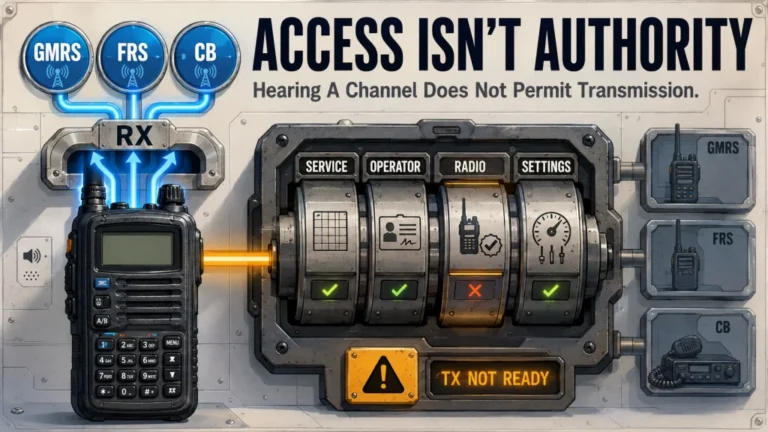
In the United States, receiving ordinary radio broadcasts generally does not require an amateur license. Transmitting on amateur frequencies is different: the station must operate under the control of a properly licensed amateur operator, and the frequencies and modes available depend on that operator’s license privileges. Technical capability does not create legal authority.
This is where a radio capable of both receiving and transmitting can confuse a new buyer. A frequency appearing on the display only proves that the radio can tune there. It does not prove that the operator may transmit there, that the selected emission is permitted, or that the frequency belongs to the amateur service.
License limit: A US Technician has limited HF privileges. Technician RTTY and data privileges, including FT8, are limited to 28.000 through 28.300 MHz on the 10-meter band. A Technician license does not provide general FT8 or data privileges on 20, 40, 80, or 15 meters.
The clean rule is to separate listening permission from transmitting permission before touching the push-to-talk control. This article addresses ordinary US broadcast and amateur reception, not every possible intercepted communication or every state and local rule that may apply to specialized monitoring. Outside the United States, receiving and equipment rules may differ, so do not generalize the US answer to travel abroad.
The Antenna and Noise Floor Often Matter More Than the Receiver Label
Two receivers can produce very different results in the same house because the radio is only one part of the receiving path. Indoor switching power supplies, chargers, lighting, computers, solar equipment, and network hardware can raise the noise floor until a distant signal disappears. Moving the receiver a few feet, running it from a quiet power source, or turning off a noisy device can reveal more than changing a menu setting.
The antenna must also fit the location and the frequency. A compact telescoping whip is convenient for travel and strong signals, but it has limited capture area and may sit directly inside household noise. An outdoor wire can improve reception, although too much signal can overload some portable receivers. A tuned loop can help reject noise or separate stations by direction, but it is not automatically best for every band or room.
For a transmitting amateur station, the antenna has another job: it must accept power safely and radiate efficiently on the intended band. Feed line, common-mode current, grounding choices, and nearby objects can change both transmitted and received performance. The practical starting point is to understand beginner HF wire antenna choices, then match the antenna to available space, supported bands, and local restrictions.
Propagation completes the path. Lower and higher HF bands behave differently across daylight, darkness, seasons, solar conditions, and distance. If a station is absent at noon, that does not prove the receiver is defective. Try the published schedule on another suitable frequency, compare day and evening reception, and reduce local noise before buying a replacement.
The solar cycle changes how strongly the upper atmosphere can bend or return HF signals over long paths. During periods of stronger solar activity, higher HF frequencies are more likely to support distant reception and amateur contacts; during quieter periods, those same bands may open less often or for shorter windows. This is not a reason to chase a different radio every time conditions change. It is a reason to compare several bands and times before deciding that a receiver, transceiver, or antenna has failed.

The AN-48X is an indoor active loop antenna designed for LW, MW, and shortwave reception. Its documented coverage spans 120 to 400 kHz, 520 to 1700 kHz, and 3500 to 20000 kHz across those bands. Three connector cables and a ferrite coupler help adapt it to different radios and support antenna-position experiments away from local noise sources.
Check On AmazonIf you click this link and buy, we earn a commission at no additional cost to you.
A Shortwave Receiver Is Not Guaranteed Emergency Communication
A shortwave receiver may provide useful information during an outage or disruption when a relevant station is transmitting, the schedule is known, and the signal reaches your location. It may also run from batteries and receive stations far beyond the coverage of a local broadcast outlet. Those are useful qualities, but they do not guarantee timely local instructions.
The missing capability is a return path. You cannot use a receive-only radio to report your condition, ask a question, confirm that someone heard you, or request help. Even a licensed amateur station is not a guaranteed rescue system because success still depends on an available operator, a workable frequency, propagation, power, antennas, and an established communication plan.
| Emergency need | What shortwave may provide | What it cannot guarantee |
|---|---|---|
| Broad regional information | Reception of a relevant distant broadcast when receivable | Coverage of your exact town or incident |
| Updates during a local outage | Battery-powered listening if the station and path remain available | A continuous schedule or a usable signal indoors |
| Requesting assistance | No two-way capability from a receive-only set | Contact with responders, family, or another operator |
Power planning also separates the two buying paths. A receive-only radio usually needs far less energy than an HF transceiver under transmit, so a modest battery supply may support listening much longer than it can support two-way operation. Check whether the radio can run from replaceable cells, an internal rechargeable battery, a documented DC input, or a supported USB source, and confirm whether it can operate while charging rather than assuming every charging port is a continuous power input.
Power check: A wall adapter is not an outage plan, and a power bank is useful only when its voltage, connector, and operating behavior match the radio. For an amateur transceiver, include the current demand of transmission, the external battery or power supply, cable protection, and realistic duty cycle in the decision rather than comparing receive runtime alone.
Treat shortwave as one possible information layer, not the entire plan. Local broadcast radio, official alerts, stored contacts, charged phones, weather information, and any licensed two-way service you are trained to use each solve different parts of the problem.
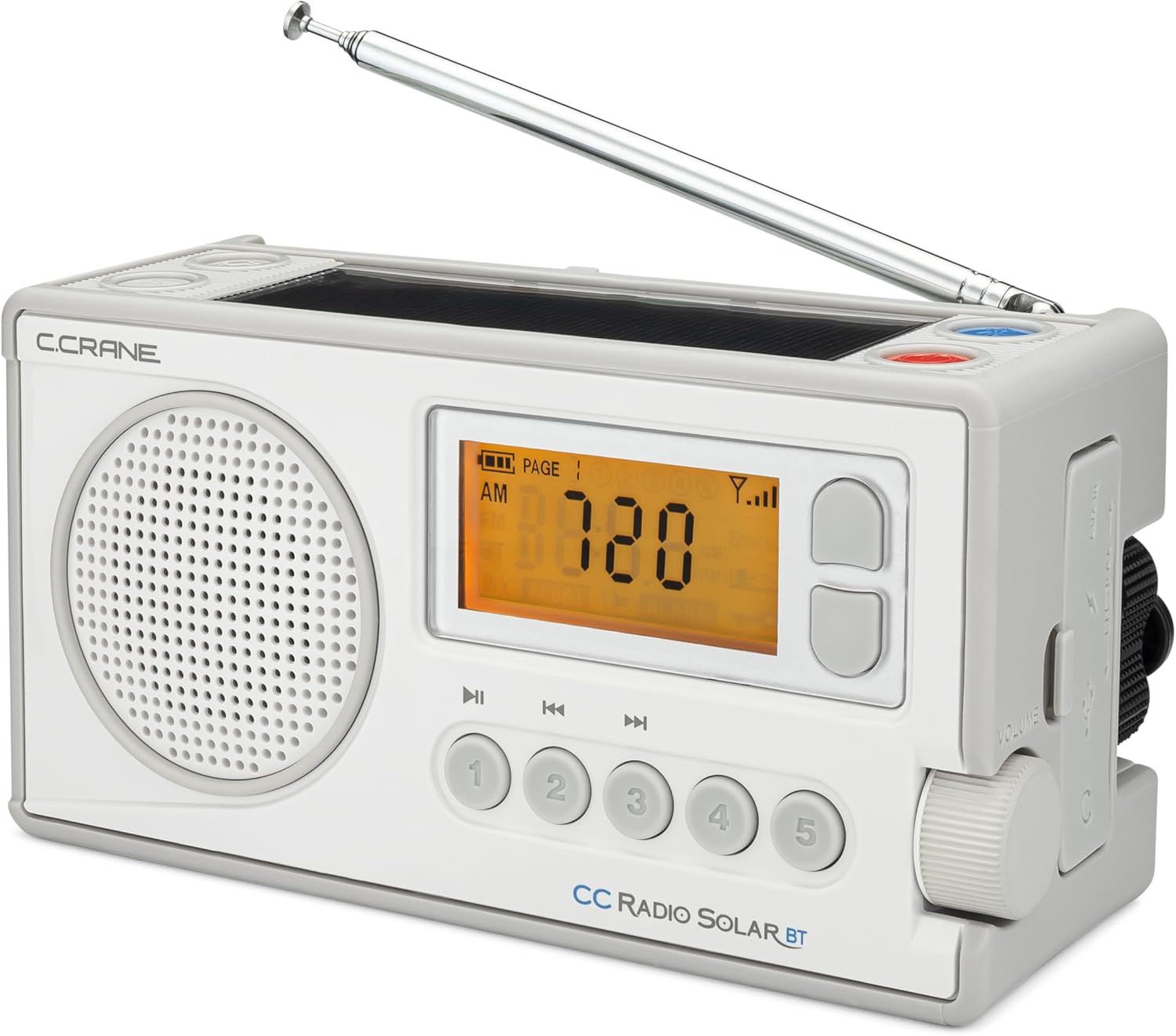
The CCRadio Solar receives AM, FM, and the seven NOAA weather channels for local information during outages. It can run from its internal 18650 rechargeable battery, AA alkaline batteries, solar panel, dynamo crank, or 5-volt Micro USB input. The radio therefore adds a battery-backed local information layer to an emergency plan without pretending to provide two-way communication.
Check On AmazonIf you click this link and buy, we earn a commission at no additional cost to you.
Choose Shortwave, Ham Radio, or Both by Assigning Separate Jobs
When someone asks whether to buy ham radio or shortwave radio, I reduce the choice to the action they expect to take after turning the equipment on. Listening and transmitting can coexist in one station, but combining them should be a deliberate choice rather than an assumption that one expensive device must be best at everything.
Use the table as a job assignment, not a winner chart. More than one row may describe you, but each checked goal should have a clear reason behind it.
| Your real goal | Better starting path | Reason |
|---|---|---|
| Listen to international broadcasts and explore HF at low commitment | Shortwave receiver | Receive-focused controls, no amateur transmitting goal, and a lower learning barrier |
| Hear amateur SSB conversations without transmitting | Shortwave receiver with SSB | You need the correct receive mode, not an amateur transmitter |
| Make contacts, join nets, or exchange messages with licensed operators | Amateur license and transceiver | The goal requires legal two-way operation |
| Experiment with antennas, digital modes, propagation, and station setup | Amateur radio | The activity extends beyond passive listening into operating and technical investigation |
| Maintain a simple listening tool and a separate two-way station | Both, with distinct roles | Each device can be chosen around its own job instead of forcing one compromise |
Choosing both makes sense only when both roles are real. A compact receiver may remain available for casual listening or travel while an amateur station stays configured for operating. Buying both because the categories sound different, without a schedule to hear or a contact goal to pursue, only creates two unused radios.

The DX-286 is a portable FM, LW, MW, and shortwave receiver built around the TEF6686 DSP chip. It supports external antennas across its bands and provides antenna attenuation plus selectable antenna paths for LW and MW reception. That receive-focused design gives readers a concrete shortwave option when they assign listening and transmitting to separate jobs.
Check On AmazonIf you click this link and buy, we earn a commission at no additional cost to you.
Buyer Checklist: Confirm the Signal Path Before the Feature List
A useful checklist should stop a bad purchase, not repeat every specification printed by the seller. Begin with the signal you intend to receive or the amateur activity you intend to perform. Then reject any option that cannot document the required coverage, mode, control, antenna connection, or power arrangement.
- Coverage: Does the documented tuning range include the exact broadcast or amateur bands you plan to use?
- Modes: Do you need AM only, or also SSB, CW reception, or a usable path for digital audio?
- Filter bandwidth: Can the radio widen for intelligible broadcast audio and narrow enough for crowded voice or CW signals?
- Tuning resolution: Can you tune SSB and narrow signals precisely rather than jumping past them in large steps?
- Memory and direct entry: Can you return to scheduled frequencies without slowly spinning through the dial?
- Recording: Is recording genuinely useful for language study, schedule comparison, or later signal identification?
- Antenna connector: Can you connect the antenna you need without an awkward or fragile adapter chain?
- Power: Will the radio work from the power sources available at home, during travel, or during an outage?
- Current schedules: Have you confirmed that the broadcasts you want still operate at times and frequencies practical for your region?
- Transmit purpose: If you are considering an amateur transceiver, can you name the contacts, nets, modes, or experiments that justify the license and station?
There is no universal winner because the final constraint changes by reader. The shortwave listener may need simple controls and quiet audio more than advanced station integration. The future amateur operator may accept more complexity because two-way operation, filters, data connections, and antenna control support a larger technical hobby.

The PL-380 covers FM, MW, LW, and shortwave and provides 550 station memories. Its ETM function provides a separate way to scan and revisit available stations while comparing active signals. It runs from three AA batteries or 5-volt USB DC and includes a 3.5 mm stereo earphone jack.
Check On AmazonIf you click this link and buy, we earn a commission at no additional cost to you.
Final Thoughts: Buy the Capability You Will Actually Use
Choose a shortwave receiver when listening is the complete goal. Choose amateur radio when you want to participate, obtain the appropriate license, and build a station around real contacts or experiments. Choose both only when you can assign each one a separate job.
The mistake to avoid is buying by frequency coverage alone. A long number on a specification sheet does not guarantee the right mode, a quiet antenna location, a current broadcast schedule, legal transmit privileges, or another station ready to answer. Define the action first, verify the complete signal path, and the equipment choice becomes much clearer.

The T-1 is a portable shortwave reel antenna that extends to 23 feet and rewinds into its compact case. It uses a 3.5 mm mini plug for receivers with a matching external antenna jack. An included adapter plug lets it connect to a radio whip when a 3.5 mm antenna jack is not available.
Check On AmazonIf you click this link and buy, we earn a commission at no additional cost to you.
FAQs
📻 Can a shortwave receiver listen to ham radio?
Yes, when its frequency coverage includes the amateur band and it supports the mode being used. For HF voice, that commonly means SSB reception and fine enough tuning to clarify the signal.
🪪 Do I need a ham license to own or listen to an amateur transceiver?
In the United States, the amateur license is required for transmitting on amateur frequencies, not merely owning the equipment or listening. Keep the transmit function unused until a properly licensed control operator and valid operating privileges are in place.
🌍 Will a shortwave radio receive every international station?
No. Reception depends on the station’s current schedule, target region, frequency, propagation, local noise, antenna, and the receiver’s supported modes. Confirm a current schedule and try the correct time window before blaming the radio.
🆘 Is shortwave reliable for emergency information?
It can add an information source when a relevant station is transmitting and receivable, but it does not guarantee local instructions or two-way help. Use it as one layer alongside local alerts and other communication methods.
🎙️ Can an HF ham transceiver also receive shortwave broadcasts?
Some can receive outside amateur bands, but coverage, AM audio, filtering, and operating convenience vary. Check the documented receive range and modes rather than assuming every HF transceiver is a complete broadcast receiver.
🧭 Should a beginner buy shortwave or ham radio first?
Start with shortwave when you only want to listen and explore signals. Start the amateur licensing path when your real goal is making contacts, joining nets, or experimenting with a two-way station.