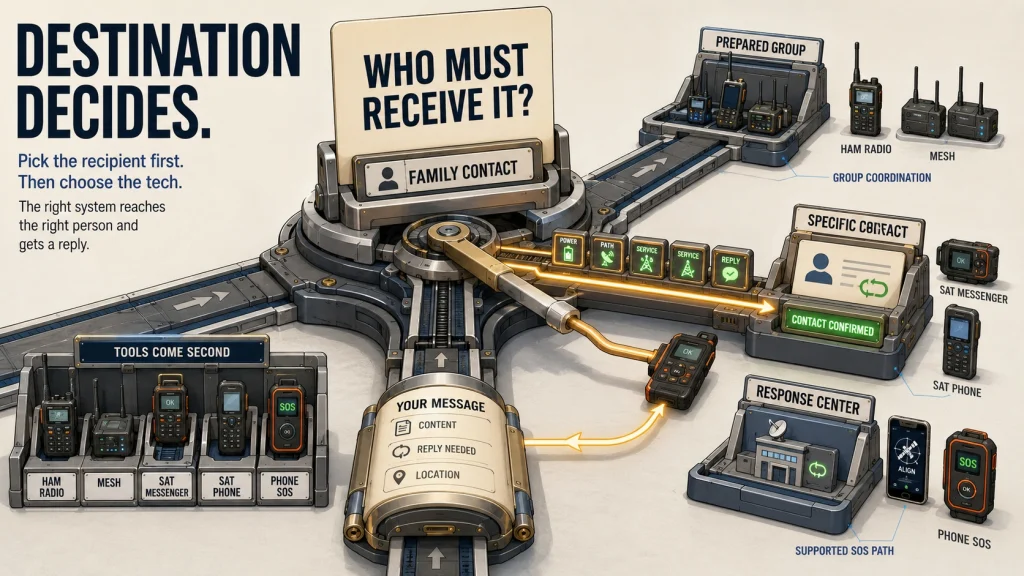
Ham radio, local mesh, satellite messaging, satellite phones, and phone-based satellite SOS do not solve the same contact problem. The right choice depends first on who must receive your message, then on the infrastructure, power, sky view, subscription, and operating skill that the path requires. Ham radio is strongest when you need flexible communication with licensed operators and organized radio networks, while commercial satellite systems are usually better at reaching a specific person, a response center, or a normal phone number. A dependable plan may use one system, two complementary systems, or no dedicated off-grid system at all, but it should never rely on a capability that has not been tested in the exact place and workflow where it will be needed.
Ham Radio vs Modern Alternatives Starts With the Receiver
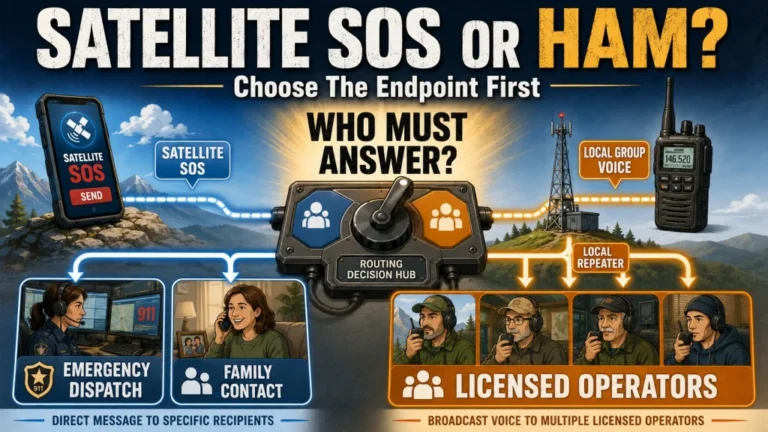
A useful comparison starts by asking who must receive the message, not which technology sounds most capable. A nearby group, an amateur operator monitoring a repeater, a family member at home, an emergency coordination center, and a normal telephone number are five different destinations. A system can perform well and still be the wrong choice because it cannot reach the person who matters.
At exam sessions, I often hear emergency communication reduced to a buying question: which radio should someone get? I would reverse that order. Write down the recipient, the message, and the expected reply before choosing the path, because a radio that can reach unknown operators is not a substitute for a service that can text your spouse, and an SOS button is not a substitute for routine group coordination.
| Who must receive the message? | Path that usually fits best | Condition that can break the plan |
|---|---|---|
| A nearby prepared group | Local mesh or licensed local radio | The group lacks compatible equipment, shared settings, coverage, or monitoring discipline |
| Licensed operators or an organized radio net | Ham radio through simplex, repeaters, or HF | No one is monitoring, the path is blocked, or the operator has not practiced |
| A specific family contact | Two-way satellite messaging or supported phone messaging | The recipient does not recognize the message, app, number, or reply procedure |
| An emergency coordination center | Interactive satellite SOS where service is active | The feature is unavailable, unactivated, obstructed, or used without a clear follow-up exchange |
| A normal phone number | Satellite phone service | The account, dialing format, airtime, sky view, or jurisdiction does not support the call |
This receiver-first test also prevents an unfair comparison. Ham radio is not a commercial dispatch service, a satellite messenger is not an open community channel, and a phone SOS feature is not a complete replacement for ordinary off-grid communication. The destination defines the job.
Scope: This comparison covers ham radio, Meshtastic-style local mesh, dedicated satellite messengers, satellite phones, and smartphone satellite features. It does not compare GMRS, CB, FRS, scanners, or shortwave; readers making the first of those decisions can use how ham radio compares with GMRS.
Every Path Depends on Infrastructure, Even When It Feels Off-Grid
“Works without cell service” is useful, but it is not the same as “works without dependencies.” Ham radio may depend on a local repeater, a suitable antenna path, another listening operator, or HF conditions. A mesh depends on enough compatible nodes in useful positions. Satellite systems depend on a commercial network, a clear view of the sky, current service status, regional permission, and an activated device or account.
The hidden dependency is often the control device. Some mesh and satellite equipment can perform basic functions by itself, while other workflows become far easier, or only practical, with a paired phone. That phone must be charged, paired, updated, and usable under stress. A system stored in a vehicle for six months can look ready while its app login, firmware, contact list, or subscription has quietly become the real point of failure.
- Local radio path: antenna placement, terrain, repeater status, frequency settings, licensing, and someone listening.
- User-built mesh: correct regional configuration, compatible channels, enough nodes, useful elevation, and a working route between sender and recipient.
- Commercial satellite path: active service, supported region, current account, sky view, sufficient battery, and a network that accepts the device.
- Recipient workflow: a known number, app, email, response center, radio frequency, or check-in procedure that the other person understands.
A practical plan names those dependencies instead of hiding them under the word “off-grid.” Once the dependencies are visible, the choice becomes less emotional and much easier to test.
Cost follows the same dependency pattern. Ham radio and local mesh usually place more of the expense and work at the beginning through equipment, antennas or nodes, setup, and learning, while commercial satellite paths commonly add an ongoing service relationship. A satellite phone may also make airtime part of the operating decision, and smartphone satellite features can change with the model, region, carrier, software, and current service terms. Compare the cost of keeping the complete path usable for several years, not only the price of the device in your hand.
The learning burden differs too. A narrow SOS workflow may be quicker to rehearse than programming a radio or maintaining a mesh, but even a simple system can fail when the user has never practiced aiming, composing, sending, receiving, and replying. Time spent learning belongs in the comparison because a cheaper path that nobody can operate under stress is not the cheaper path in practice.
Ham Radio vs Meshtastic: Community Radio or Private Low-Data Mesh
Meshtastic is a local, low-data mesh built around low-power unlicensed radios. It can move short messages and location information between compatible nodes without a cell tower or internet connection, and its channels can use encryption. That makes it attractive for a prepared group that wants private text-style communication and is willing to build, place, configure, and maintain its own local network.
The word “mesh” creates an easy misunderstanding. A message does not travel merely because several devices exist somewhere in town. The nodes must be close enough, high enough, correctly configured, and positioned so a route actually connects the sender to the intended recipient. Hills, buildings, indoor placement, poor antennas, and sparse participation can turn a promising map into an isolated node.
Ham radio solves a different problem. A licensed operator may call on simplex, use an established repeater, join a net, or use HF when the license privileges, equipment, conditions, and skill support it. That flexibility can connect the operator with people outside a prearranged private group, but it does not provide the privacy or automatic person-to-person delivery that many people expect from messaging.
A prepared local group that values brief private updates may get more from a tested mesh than from an open voice channel. The balance shifts toward ham radio when voice, wider operator participation, organized amateur networks, or more technical flexibility matters. The detailed comparison of ham radio and Meshtastic is most useful after the group has identified its actual locations and who will maintain the nodes.

The SenseCAP T1000-E is a compact Meshtastic tracker with LoRa, Bluetooth, and integrated GNSS positioning. It supports the 863 to 928 MHz range, including the US Meshtastic region, and uses an internal antenna in a card-size enclosure. The device also includes a rechargeable battery, IP65 enclosure rating, LED, buzzer, and a physical control button.
Check On AmazonIf you click this link and buy, we earn a commission at no additional cost to you.
Ham Radio vs Satellite Messenger: Open Radio Contact or Specific Two-Way Messaging
A dedicated satellite messenger is designed around specific contacts, compact text exchanges, location sharing, tracking, and interactive SOS. It generally needs an active service relationship for communication features, and it needs enough open sky to reach the network. Depending on the unit and task, a paired phone may be part of normal message composition and contact management.
Its strength is not unlimited communication. Its strength is a defined delivery workflow. You can tell a family member which address, number, app, or tracking page to watch, and an interactive SOS can support a back-and-forth exchange with a response center. Messages may still be delayed by sky obstruction, network conditions, device orientation, or the time needed for the recipient to notice and respond.
Ham radio is stronger when you want live voice coordination, contact with available licensed operators, local nets, repeaters, simplex, or an HF path that you control without a commercial satellite subscription. The trade-off is that it does not guarantee a path to one named person. Your family member cannot receive the message unless they are licensed where required, equipped, monitoring the correct path, and within reach of the station or network you are using.
Delivery is the dividing line in the comparison between ham radio and satellite messaging. A short update addressed to one person, tracking link, or interactive SOS exchange favors the satellite workflow. Live coordination with available operators or a prepared radio group favors the amateur path.

The Garmin inReach Mini 2 is a compact satellite communicator that sends and receives text messages through the Iridium satellite network. It supports messaging, tracking, weather information, and interactive SOS functions with an active satellite subscription. The device can pair with the Garmin Explore app for contacts, maps, messaging, and other connected functions.
Check On AmazonIf you click this link and buy, we earn a commission at no additional cost to you.
Ham Radio vs Satellite Phone: Radio Networks or Voice Calls to Normal Numbers
A satellite phone is the closest option here to an ordinary telephone. With compatible service, an active account or airtime arrangement, and a usable satellite view, it can place and receive voice calls and often send messages through a commercial network. That matters when the person you need is reachable only through a normal telephone number and has no special radio or messaging equipment.
The familiar handset shape can hide unfamiliar operating conditions. The phone may need to be outdoors, with its antenna deployed and a broad view of the sky. Buildings, canyon walls, heavy foliage, terrain, and poor orientation can interrupt registration or a call. Dialing may use international-style formats, incoming calls may involve an unfamiliar number, and service or device possession may be restricted in some jurisdictions.
Ham radio does not imitate that telephone workflow. It can support one-to-one or group voice, but both ends need suitable amateur stations and operating authority, and the frequency path must work at that moment. In exchange, the operator gains local and long-distance radio options without paying a satellite voice provider for every active service period or airtime arrangement.
When the job is a live voice call to an ordinary number, the telephone workflow has the clearer fit. An intended network of licensed operators, repeaters, nets, or prepared stations points in the other direction. A closer look at ham radio and satellite phones should begin with the actual numbers you may need to call and the places from which you expect to call them.

The Iridium Extreme 9575 is a handheld satellite phone designed for voice and messaging through the Iridium network. It integrates GPS and location-based functions and includes a dedicated two-way emergency SOS button. The handset is built for satellite communication where ordinary cellular coverage is unavailable, with service and airtime required for network use.
Check On AmazonIf you click this link and buy, we earn a commission at no additional cost to you.
Ham Radio vs Satellite SOS: A Phone Feature Is Conditional, Not Universal
Modern smartphones can include satellite functions such as emergency texting, location sharing, roadside contact, or limited messaging outside cellular and Wi-Fi coverage. The exact function depends on the phone model, operating system, country, carrier support, active SIM or account status, service terms, and regulatory availability. Two phones that look similar can have very different off-grid capabilities.
Phone-based satellite contact also behaves differently from normal cellular messaging. The user may need to stand outside, follow an aiming prompt, keep a clear view of the sky and horizon, wait for transmission, and remain in position for replies. Trees, buildings, terrain, weather-related conditions, battery level, and regional service status can affect the attempt. A feature shown in a launch presentation is not a field plan until it appears on the exact phone, in the exact region, with the exact account that will be carried.
An SOS function has an intentionally narrow job: reach emergency help when ordinary networks are unavailable and the supported conditions are met. It should not be assumed to provide open voice communication, routine group coordination, unrestricted family messaging, or the flexible local and HF paths available to a licensed amateur station. Likewise, ham radio should not be presented as a guaranteed replacement for a direct emergency-service workflow.
Research-based: Satellite phone features, supported regions, software requirements, carrier conditions, and service terms were checked against current provider information in July 2026. Recheck the exact phone and destination before every significant trip because these details can change without making older instructions visibly wrong.
The practical choice between ham radio and smartphone satellite SOS depends on whether you need a narrow emergency path, ordinary off-grid messaging, or broader radio communication. Do not treat those three jobs as interchangeable.
What Ham Radio Adds, and What It Cannot Promise
Ham radio adds operating flexibility. A licensed station can use local simplex, repeaters, scheduled nets, digital modes, and HF within the operator’s privileges and equipment limits. It can support spontaneous contact with available amateurs, planned communication among licensed group members, and technical adaptation when one path fails.
That flexibility is earned rather than automatic. The operator must obtain the appropriate license, learn the equipment, program or tune the station correctly, manage the antenna and power system, and practice the contact procedure. A handheld stored in a drawer is not an emergency network, and access to many frequencies does not mean that a useful person will be listening on the one selected.
Ham radio also lacks the delivery guarantees people import from phones. There is no promise that a specific relative, dispatcher, or emergency center will hear a call. Repeaters may be unreachable or offline, simplex may be blocked by terrain, HF may require more equipment and skill, and a local channel may be quiet when the operator first tries it.
I treat ham radio as a flexible human network, not a replacement for every commercial service. It becomes valuable when the operator knows who monitors locally, which repeater or simplex path works, what net procedures are used, and which backup path is available. That distinction is central to using ham radio for emergency preparedness.

The Yaesu FT-65R is a VHF/UHF 2-meter and 70-centimeter FM amateur handheld transceiver. It provides selectable 5W, 2.5W, and 0.5W output levels and comes with a 1950mAh lithium-ion battery pack and rapid charger. It also supports programmable scanning, weather alert scanning, CTCSS and DCS operation, quick-recall keys, and PC programming.
Check On AmazonIf you click this link and buy, we earn a commission at no additional cost to you.
A Reliability Test That Exposes Weak Plans Before an Emergency
Marketing coverage, a repeater directory entry, a node map, and a satellite icon are all leads. None proves that your complete path works. Reliability has to be tested from the actual parking area, trail, home, shelter, or vehicle location, using the exact device, power source, antenna, account, contacts, and response procedure intended for the real event.
The test should follow the message all the way to the recipient and back. A successful transmit indicator is not enough. You need confirmation that the other person received the content, understood what to do, and could reply through the same or an agreed alternate path.
- Location: test indoors and outdoors where relevant, not from an easier open area several miles away.
- Power: run the device from its stored batteries or backup supply and confirm the charging method.
- Sky and antenna: identify the exact place and orientation that creates a usable radio or satellite path.
- Network status: verify the repeater, mesh route, commercial account, subscription, firmware, and regional availability.
- Latency: record how long a routine message and reply take under realistic conditions.
- Recipient behavior: confirm the number, app, address, frequency, call sign, or response-center process the recipient will use.
- Written backup: carry frequencies, contact details, dialing format, check-in times, and fallback steps outside the primary device.
Field Note: The gap I see after exam sessions is that passing the test does not prove a complete communication path. A new licensee may have a call sign and a powered radio but still not know which local repeater to use, who is listening, or how to confirm that a message reached anyone.
Testing also needs a schedule. Recheck the full path before every significant trip or event, at least quarterly for equipment stored as an emergency backup, after any software, account, contact, antenna, battery, or device change, and when a new season changes foliage, weather, access, or operating locations. A successful test from last year does not verify today’s subscription, repeater, mesh route, phone feature, or recipient procedure.
Record the date, location, message delay, reply result, and any failure that required a fallback. That simple log shows whether the path is becoming more dependable or merely familiar. Readers still deciding what kind of station supports the tested path can use choosing a radio around the emergency path without starting from a model name.
Choose One System, Two Complementary Systems, or Neither
More equipment is not automatically more reliable. Two systems can share the same weak point, such as dead batteries, an untrained user, poor sky view, or a recipient who does not know how to answer. The decision should follow the number of distinct contact jobs, not an identity built around being prepared.
| Decision | When it makes sense | What must be proved |
|---|---|---|
| One system | You have one primary recipient type and one tested operating environment | The complete send, receive, reply, power, and backup workflow works |
| Two complementary systems | You have two different jobs, such as group voice plus family messaging, or local coordination plus interactive SOS | The systems fail differently and users can operate both without confusion |
| Neither dedicated system | Your activities remain inside verified ordinary coverage and the consequence of a missed check-in is low | The normal phone path, travel plan, emergency contacts, and location-sharing routine are current |
A common strong pairing is one path for open or group coordination and another for a specific contact or emergency center. That does not mean every reader needs both. Someone staying inside reliable cellular coverage may gain more from a written check-in schedule and charged backup power than from equipment they will never practice with.
The final test is simple: name the recipient, send the message, receive a reply, and repeat the process from the hardest realistic location. Keep only the systems that pass that test and that the people involved are willing to maintain.
Final Thoughts: Build Around the Contact, Not the Technology
Ham radio is the better fit when you want adaptable voice and digital communication with licensed operators, local radio networks, or prepared stations. Mesh is useful for a maintained local group, satellite messaging is useful for specific contacts and tracking, a satellite phone is useful when a normal voice number must be reached, and phone-based satellite SOS is useful for the supported emergency task it was designed to perform.
I would not call any of them a universal winner. The best path is the one that reaches the required person from the required location, survives its own dependencies, and has been practiced by both ends. Once that requirement is written clearly, buying less, using two systems, or deciding that ordinary cellular service is enough can all be reasonable conclusions.
Compare Each Off-Grid Path in Detail
The broad decision becomes easier when each alternative is tested against one contact job at a time. These focused comparisons separate local mesh, dedicated satellite messaging, satellite voice, and smartphone SOS so changing service features do not blur the underlying choice.
| Comparison | What it helps you decide |
|---|---|
| Ham Radio vs Meshtastic | Whether a prepared low-data local mesh or licensed radio network better fits your group. |
| Ham Radio vs Satellite Messenger | Whether you need flexible radio contact or direct two-way text, tracking, and interactive SOS. |
| Ham Radio vs Satellite Phone | Whether the requirement is an amateur radio network or a voice call to an ordinary number. |
| Ham Radio vs Smartphone Satellite SOS | Whether a supported emergency phone feature is enough or broader communication is required. |
Start with the comparison that matches the recipient you cannot afford to miss, then test that complete path before adding another system.
FAQs
📡 Is ham radio more reliable than satellite communication?
Not universally. Ham radio depends on the frequency, antenna, terrain, equipment, skill, and available operators, while satellite systems depend on sky view, service status, regional availability, power, and account conditions. Test the exact path instead of choosing by technology name.
🧭 Can Meshtastic replace ham radio for a local group?
It can fit a prepared group that needs short messages or locations inside a tested mesh. It does not provide the same voice options, amateur community access, repeater use, or HF flexibility, and it needs compatible nodes and a working route.
💬 Is a satellite messenger better for contacting family?
Often, because it is built to deliver messages to specific contacts rather than whoever may be monitoring a radio frequency. Confirm the recipient’s app, number, reply method, service plan, and expected message delay before relying on it.
☎️ Do I need a satellite phone to call a normal number?
A satellite phone is the direct option among the systems compared here when voice contact with an ordinary telephone number is required. The account, airtime, dialing format, sky view, network coverage, and local rules still have to support the call.
🆘 Can smartphone satellite SOS replace an emergency radio?
It can provide a valuable emergency path on supported phones and in supported regions, but it is not a general radio network. It may not provide routine group voice, open contact, or all family messaging functions, so match it to the exact emergency job.
🔋 Should I carry both ham radio and a satellite device?
Carry both only when they solve different tested jobs, such as local group coordination and direct family or SOS contact. Two unpracticed systems with the same power or user failure are not meaningful redundancy.