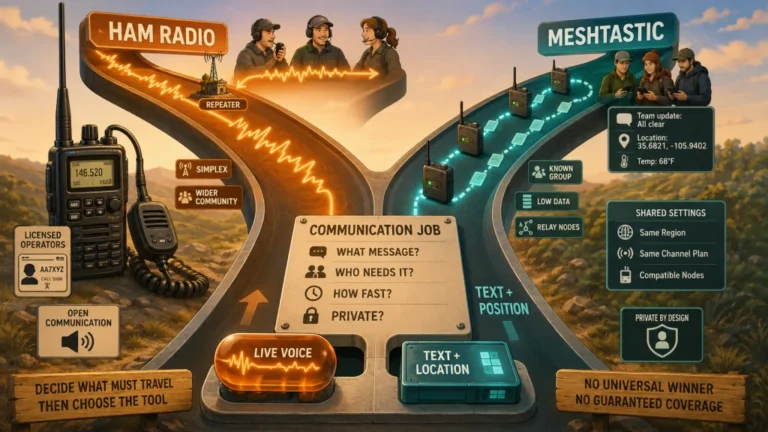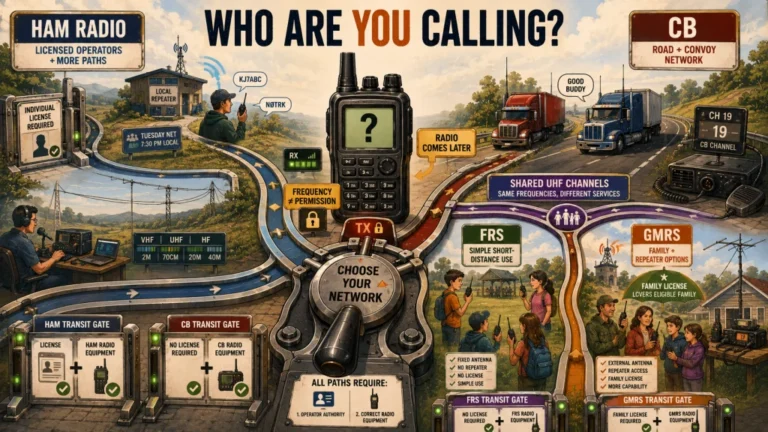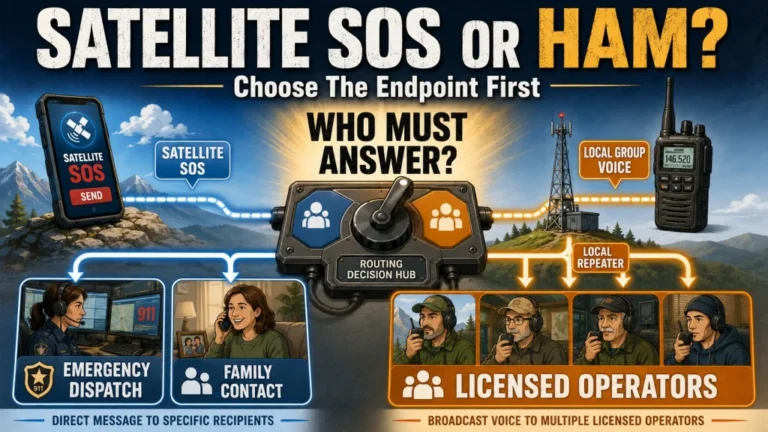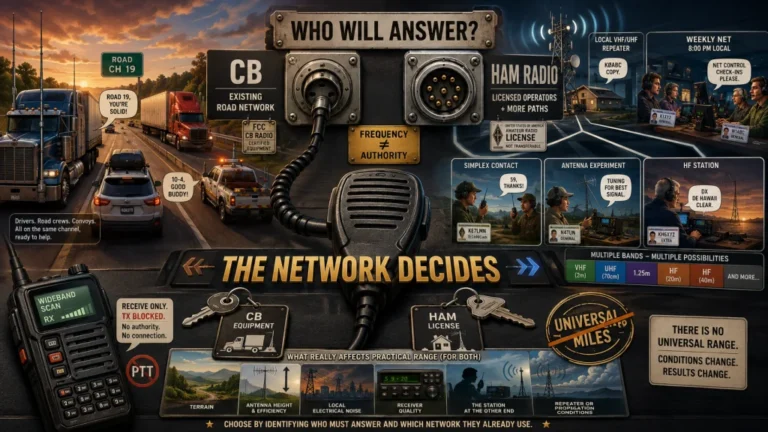
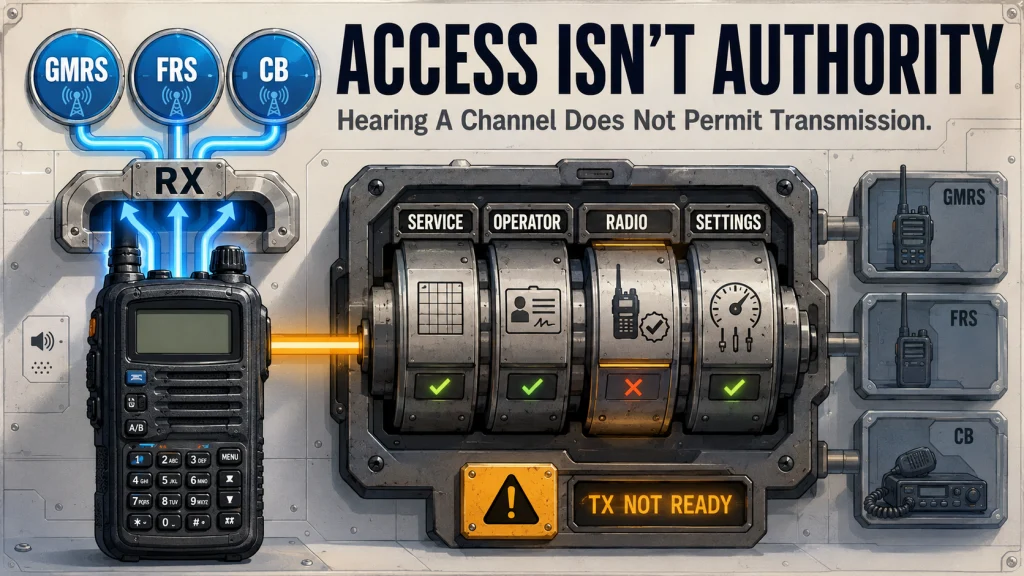
A ham radio may be able to receive GMRS, FRS, or CB signals, but hearing a signal and being authorized to answer are separate questions. To transmit, the operator must be authorized for the intended service, the transmitter must be permitted for that service, and the channel, mode, power, bandwidth, and identification rules must all be followed. A ham license does not authorize GMRS or FRS transmission, and an unlocked amateur radio is not a lawful substitute for certified Part 95 equipment. The practical solution is to use separate compliant radios or choose one legal service for everyone in the group.
Can Ham Radio Talk to GMRS, FRS, or CB Radios?
The honest answer is usually no when the question means transmitting directly from an amateur radio into another service. A display that accepts a frequency, a receiver that hears a signal, a programming application that writes a channel, and a legal transmitter are four different things. Treating them as interchangeable is how a technical capability becomes an operating violation.
The four-question test below checks whether one radio can lawfully cover a particular service. It examines the complete transmission, not merely the frequency shown on the screen:
- Is the chosen frequency or channel assigned to the service being used?
- Is the operator authorized to transmit in that service?
- Is the exact transmitter authorized or otherwise permitted for that service?
- Are the mode, power, bandwidth, antenna, channel, and identification settings compliant?
A no at any step means the planned transmission is not ready. Holding an amateur license answers only the amateur-service authorization question. It does not convert GMRS, FRS, or CB channels into amateur frequencies and does not change the equipment rules attached to those services.
Research-based: I do not judge cross-service operation by what the keypad accepts. I start with the service, then the operator authority, then the FCC authorization for the exact transmitter. That order prevents a wideband specification from being mistaken for permission.
The scope here is the legal and practical boundary between amateur radio and three personal radio services. It does not teach out-of-band modification, programming tricks, or a full service comparison. For the broader choice among communication systems, use the comparing radio communication services.
The Four-Question Test Before Any Transmission
The first question is about spectrum. Amateur stations transmit only within frequencies authorized to the control operator’s license class under Part 97. GMRS, FRS, and CB operate under Part 95, with their own channels and technical limits. A frequency that appears inside a receiver’s tuning range does not move it into the amateur service.
The second question is about the person operating. GMRS requires an individual license for ordinary operation, while FRS and CB are generally operated by eligible users without individual licenses under their service rules. None of that changes the separate requirement for an amateur license when transmitting as an amateur station.
The third question is about the transmitter itself. Personal Radio Service transmitters generally require FCC certification under Part 95 and Part 2 unless a specific rule says otherwise. Amateur equipment follows a different framework, so a transmitter marketed for amateur use does not become GMRS, FRS, or CB equipment because software exposes those frequencies.
The fourth question is the complete operating configuration. A compliant radio can still be used incorrectly through the wrong channel, excess power, wrong bandwidth, prohibited antenna arrangement, missing identification, or an unauthorized mode. Legal operation requires all four answers to line up at the same time.
| Question | What it proves | What it does not prove |
|---|---|---|
| The radio can tune the frequency | The synthesizer or receiver may cover it | That transmission is authorized |
| The operator has a ham license | The operator may use assigned amateur privileges | Authority to transmit in GMRS, FRS, or CB |
| The radio has an FCC ID | The exact device may have one or more equipment grants | Approval for every frequency exposed by software |
| The channel works technically | Another radio may hear the signal | Compliance with service, power, mode, or equipment rules |
This framework also explains why two radios can communicate legally on one channel but not another. The answer can change with the exact service, equipment grant, operating mode, and user authority. There is no single brand-wide or frequency-wide shortcut.
Ham Radio and GMRS Interoperability
A ham license does not authorize transmission on GMRS frequencies. GMRS transmitting requires authority under the GMRS rules and a transmitter certified for GMRS under Part 95E. Using an amateur transceiver does not become lawful merely because the operator also holds a GMRS license.
The person and the radio must both fit the service. Someone who holds both licenses can operate an amateur station on amateur frequencies and a compliant GMRS station on GMRS channels. The licenses do not merge the two systems, and they do not turn one unlocked amateur handheld into a lawful dual-service transmitter.
Current GMRS certification rules draw this boundary directly. A GMRS transmitter cannot receive GMRS certification if it includes transmit capability in a service that does not require equipment certification, such as the Amateur Radio Service. A device may have certification for another service that also requires certification, but the exact grants and operating restrictions still control what it may do.
Required disclosure: GMRS transmission requires equipment certified for GMRS under Part 95E. Holding a ham license, holding a GMRS license, or programming GMRS frequencies into an amateur transceiver does not make that amateur transceiver legal for GMRS transmission.
A useful planning rule is to label equipment by service, not by frequency coverage. If a group chooses GMRS, each transmitting station should use equipment and operator authority appropriate to GMRS. The ham radio and GMRS comparison explains which service is the better fit without pretending the equipment is interchangeable.

The Midland GXT1000VP4 is a GMRS handheld pair with 50 channels and 142 privacy codes. It includes NOAA Weather Alert with Weather Scan plus an SOS siren. The package includes rechargeable battery packs, a desktop charger, AC and DC adapters, belt clips, and boom microphone headsets.
Check On AmazonIf you click this link and buy, we earn a commission at no additional cost to you.
Can Ham Radio Talk to FRS?
An amateur transmitter should not be used as an FRS radio. FRS is designed around compliant handheld units operating on its assigned channels and technical limits. An amateur license supplies no additional FRS authority, and an operator does not gain permission by lowering power or matching the channel bandwidth manually.
FRS and GMRS are easy to confuse because all 22 FRS channels are shared with GMRS. That overlap allows a compliant GMRS station to communicate with an FRS unit on the shared channels under the rules that apply to each station. It does not bring the Amateur Radio Service into the conversation.
Consider a family outing where one person carries an FRS unit and another carries a compliant GMRS radio under a valid GMRS license. They may be able to talk on a shared channel. Replacing the GMRS radio with an unlocked amateur handheld breaks the equipment side of the four-question test even when the frequency and audio appear identical.
The distinction matters because technical adjustments cannot recreate an equipment authorization. Power, antenna, channel spacing, occupied bandwidth, controls, and certification conditions work together. Matching one or two settings is not equivalent to using a transmitter approved for FRS or GMRS.

The Midland LXT600VP3 is an FRS two-radio set with 22 channels plus 14 extra channels and 121 privacy codes. It includes NOAA Weather Alert and Weather Scan along with high and low power settings and eVOX operation. Rechargeable battery packs, a desktop charger, belt clips, and an AC adapter are included.
Check On AmazonIf you click this link and buy, we earn a commission at no additional cost to you.
Can Ham Radio Talk to CB?
CB is a separate Part 95 service using 40 channels from 26.965 through 27.405 MHz. A typical dual-band VHF/UHF amateur handheld operates in a very different frequency range, so it cannot communicate with CB merely because both devices provide two-way voice. Even an amateur radio that can receive part of the CB band does not gain CB transmit authority.
CB transmitting equipment must comply with CB equipment rules. Ordinary CB operation does not require an individual operator license, but that does not mean any transmitter may be placed on a CB channel. License-by-rule operation still depends on using the service as authorized.
Modulation can create another barrier. A receiver might cover the frequency but not the mode used by the signal, producing silence or unintelligible audio. Conversely, hearing CB traffic through a wideband receiver proves only that reception works. It says nothing about whether the transmitter is permitted to respond.
For a group that needs CB communication, the compliant solution is a CB station used under CB rules. For amateur communication, use amateur stations on amateur frequencies. Trying to bridge the gap by changing a programmed frequency creates more uncertainty than carrying the correct radio for each service.

The Cobra 29 LTD Classic provides all 40 CB channels with selectable AM and FM operation and 4 watts of output. It includes adjustable RF gain and squelch controls. The radio also provides SWR calibration, an antenna warning indicator, and instant access to Channel 9.
Check On AmazonIf you click this link and buy, we earn a commission at no additional cost to you.
Receiving Another Service Is Not Permission to Transmit
Many amateur radios include receive coverage outside amateur bands. That feature can be useful for monitoring weather, public broadcasts, personal radio channels, or other signals supported by the receiver. It remains a receive feature, not a service authorization.
Coverage numbers also do not guarantee useful reception. The receiver may lack the correct modulation, filtering, step size, bandwidth, or sensitivity for the signal. A frequency can appear on the display while the audio remains distorted or silent.
Federal service rules governing transmission are only part of the receiving question. State or local law may restrict scanner use in vehicles, during the commission of an offense, or in other specific circumstances. Do not turn the general ability to receive into a blanket claim that every monitoring use is lawful everywhere.
Key point: Receive capability is a technical property. Transmit authority comes from the service rules, the operator’s status, the exact equipment authorization, and the complete operating configuration.
If a saved out-of-band channel behaves unexpectedly, diagnose whether the issue is receive coverage, modulation, filtering, programming, or an intentional transmit lock. The ham radio troubleshooting process helps separate a receiver problem from a programming or hardware assumption.
The Emergency Exception Is Not a Routine Plan
Part 97 includes narrow provisions for immediate safety of human life, immediate protection of property when normal communication systems are unavailable, and a station in distress. The language is intentionally tied to immediate or exceptional circumstances. It is not a standing authorization to use any convenient frequency during ordinary travel, training, testing, or preparedness activity.
Another Part 97 rule permits communications with a station in another FCC-regulated service while providing emergency communications. That does not mean a ham operator may build routine GMRS, FRS, or CB interoperability and label it an emergency system. The circumstances and necessity matter.
Research-based: I would not design a family or community communication plan around needing to defend an emergency exception later. A reliable plan uses equipment and authority that are lawful during practice, routine check-ins, minor disruptions, and real emergencies. People need to know the controls before the stressful day arrives.
Practical boundary: An immediate threat to life with normal systems unavailable is not the same as poor cellular coverage, a scheduled drill, a convenience call, or a desire to carry one radio instead of two.
Emergency provisions should be read from the current rule language and applied to the facts, not treated as a shopping feature or programming option. For ordinary operation, stay inside the normal service and equipment rules.
Can Baofeng Transmit on GMRS? Check the Exact Model and FCC ID
A brand name cannot answer this question. Different radios sold under the same brand may have different hardware, firmware, labels, frequency limits, and FCC equipment grants. A claim about one model or one production version must not be transferred to every radio carrying the same logo.
Start with the exact model designation and FCC ID printed on the radio, battery compartment, packaging, or manual. Search the FCC equipment authorization record and inspect the rule parts, frequency ranges, grant notes, and exhibits for that exact identifier. Then compare the grant with the service in which you intend to transmit.
Do not rely on a retailer description, an online programming file, a keypad unlock video, or the fact that the radio accepts a GMRS frequency. Those sources may describe technical behavior without establishing lawful operation. An FCC ID is also not a universal approval badge; it identifies specific grants with defined conditions.
- Match the exact model and hardware version.
- Locate the complete FCC ID, not only the brand name.
- Confirm the rule part listed on the equipment grant.
- Check the authorized frequency range and grant notes.
- Compare the intended mode and configuration with the grant.
- Reject brand-wide claims based on one radio or one firmware version.
The same discipline applies to any manufacturer. If the exact radio is an amateur transmitter, treat it as amateur equipment unless an applicable authorization clearly establishes another certified use. Do not assume an unlocked variant is the lawful version of a restricted model.
Practical Ways to Communicate Legally
The simplest solution is to choose one service for the whole group. This reduces channel mistakes, equipment confusion, and assumptions about who can answer whom. The best service depends on licensing tolerance, communication purpose, local infrastructure, terrain, and how much training the group will actually complete.
When one service cannot cover every situation, carry separate compliant radios. That may feel less elegant than an all-in-one device, but it makes the operating boundary obvious. The radio selected for each call already matches the service being used.
| Situation | Compliant approach | Approach to avoid |
|---|---|---|
| Licensed hams talking with each other | Use amateur stations on authorized amateur frequencies | Move the conversation to GMRS using amateur transmitters |
| GMRS licensee talking with FRS users | Use compliant GMRS and FRS equipment on shared channels | Substitute an unlocked amateur handheld |
| Family wants no individual operator exams | Choose a Personal Radio Service that fits the group and follow its rules | Assume one person’s ham license covers everyone |
| Driver wants CB communication | Use compliant CB equipment on CB channels | Program a VHF/UHF amateur handheld for a different band |
| One person participates in several services | Hold the required authority and use appropriate equipment for each service | Treat multiple licenses as approval for one universal transmitter |
Where a product has more than one equipment authorization, use only the functions and modes covered by the applicable grants. Do not assume that multi-service certification includes amateur transmitting capability, because current GMRS rules specifically reject that combination for GMRS certification.
Before choosing a service, make sure everyone understands who may operate, what equipment is required, and whether the group will practice. The US ham radio licensing requirements explains amateur authority, while the service-specific rules control GMRS, FRS, and CB operation.

The Yaesu FT-65R is a VHF/UHF 2-meter and 70-centimeter FM amateur handheld with selectable 5W, 2.5W, and 0.5W output. It comes with a 1950mAh lithium-ion battery pack and rapid charger. The radio also provides programmable scanning, CTCSS and DCS operation, weather alert scanning, quick-recall keys, and PC programming support.
Check On AmazonIf you click this link and buy, we earn a commission at no additional cost to you.
Final Thoughts: Frequency Capability Is Not Legal Authority
A radio can hear a signal, display a frequency, or accept a programmed channel without being lawful to transmit there. The correct decision comes from four aligned answers: the channel belongs to the intended service, the operator has the required authority, the exact transmitter is permitted for that service, and the complete configuration follows its rules.
For routine communication, do not rely on an emergency exception, a software unlock, or a brand-wide claim. Choose one legal service for the group or carry separate compliant radios. That approach may be less impressive than a supposed universal radio, but it is easier to practice, easier to verify, and far less likely to fail when communication actually matters.
FAQs
📻 Can a ham radio legally transmit on GMRS?
Not merely because it can tune the frequency. GMRS transmission requires GMRS authority and a transmitter certified for GMRS under Part 95E.
👨👩👧 Can a GMRS radio talk to an FRS radio?
Yes, compliant GMRS and FRS stations may communicate on the shared channels under the rules that apply to each station. This does not authorize an amateur transmitter on those channels.
🎧 Is it legal to listen to GMRS or FRS on a ham radio?
Receive coverage does not create transmit authority, and useful reception depends on the radio’s supported modes and bandwidths. State or local scanner restrictions may also apply in certain locations or uses.
🚚 Can a VHF or UHF ham handheld talk to CB?
Normally no. CB uses channels around 27 MHz and compliant CB equipment, while a typical VHF/UHF amateur handheld operates in different frequency ranges.
🪪 Does holding both licenses make one radio legal for both services?
No. Multiple licenses authorize the operator, but the transmitter must still be permitted for the service used. Current GMRS certification rules do not allow GMRS certification for a transmitter with amateur-service transmit capability.
⚠️ Can I transmit anywhere during an emergency?
Part 97 contains narrow provisions for immediate safety, property protection when normal systems are unavailable, and stations in distress. They do not create routine cross-service permission for drills, convenience, or ordinary preparedness plans.
🔓 Does unlocking a radio make out-of-band transmission legal?
No. Unlocking changes technical access, not the operator’s authority or the radio’s equipment authorization.
🔍 How do I check whether a radio is certified for GMRS?
Find the exact model and FCC ID, then inspect the equipment authorization record for the applicable rule part, frequency range, and grant conditions. Do not rely on the brand name alone.