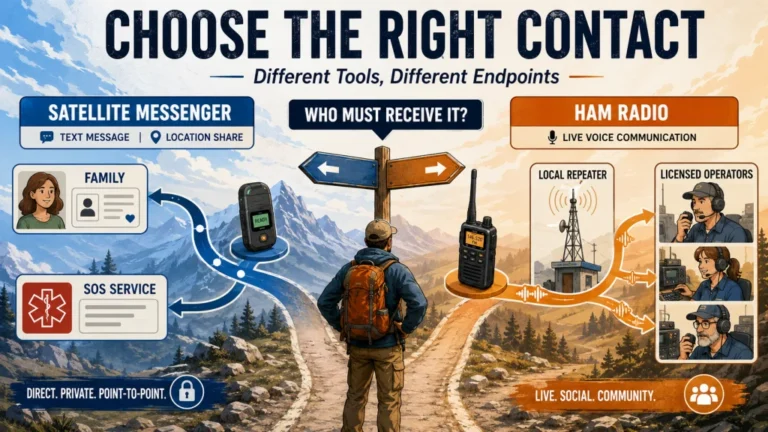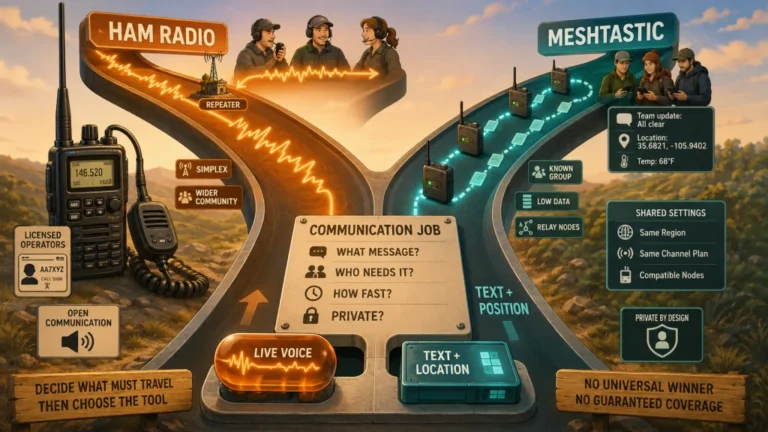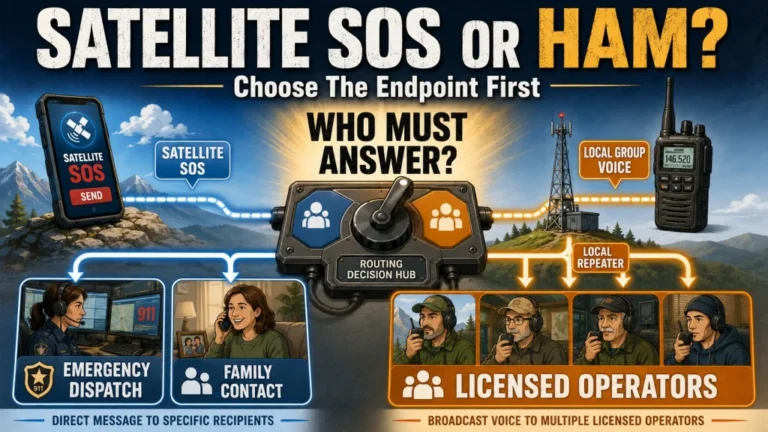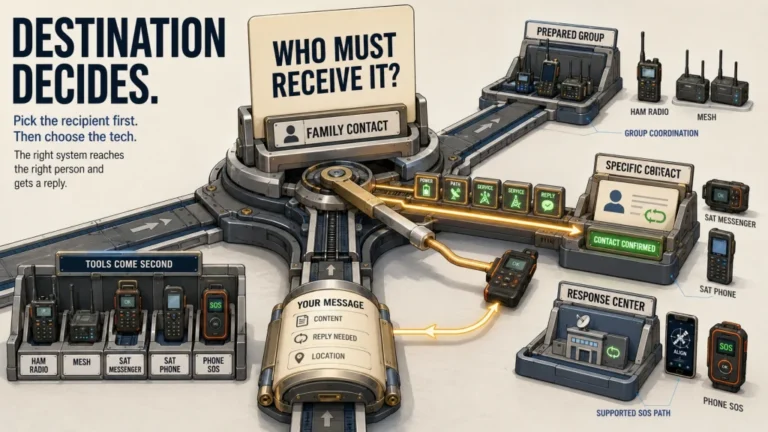
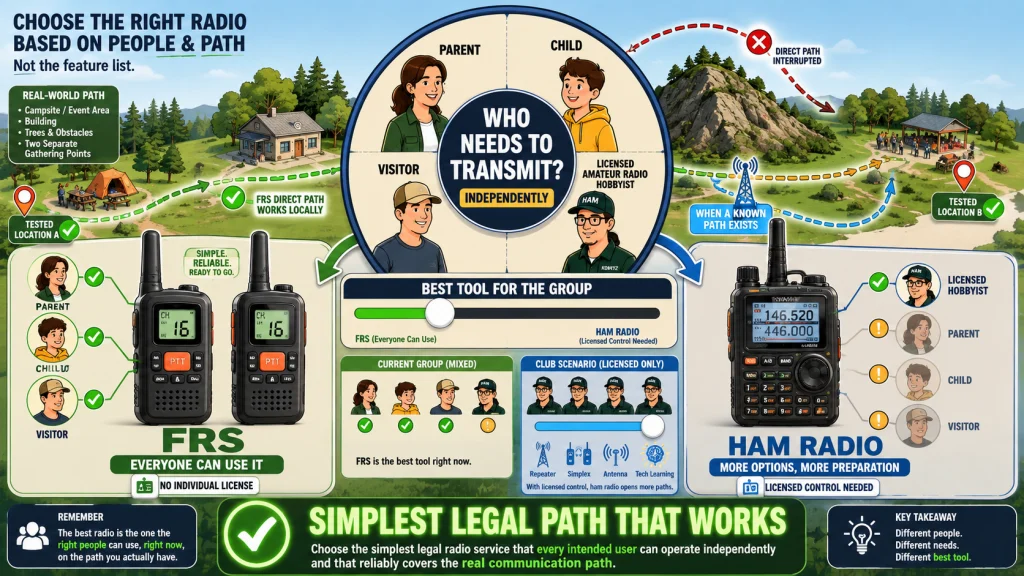
A pair of ordinary FRS walkie-talkies is often the better choice when children, visitors, or family members need immediate legal communication across a small, tested area. Ham radio adds repeaters, more bands, broader operating options, and room to build technical skill, but independent users must be licensed and the setup usually demands more preparation. The right comparison starts by identifying the radio service, the people who must transmit, and the path the signal must cross. Choose the least complicated legal option that reliably serves the real job.
Ham Radio vs Walkie Talkie Starts with the People Using It
A pair of FRS radios may be exactly right when everyone needs to press a button and talk without studying for an exam. That is the practical answer behind most searches for ham radio vs walkie talkie: ham is not automatically better because it offers more capability. Extra capability only helps when the intended users can legally operate it, understand the setup, and reach the path they expect to use.
I start this comparison with one question: who needs to transmit? A licensed hobbyist contacting a local repeater has a different problem from a parent handing radios to two children at a campground. The first person may benefit from amateur privileges and technical flexibility, while the second needs simple, legal communication that works without supervision or programming.
This article treats the ordinary consumer walkie-talkie as an FRS radio unless the device is clearly identified as something else. It covers legal equipment, realistic local coverage, participant requirements, and the point at which amateur radio adds useful capability. For a wider view of the choices around FRS, GMRS, CB, and amateur operation, see how to compare common personal radio services.
A Walkie Talkie Is a Shape, Not a Radio Service
The phrase walkie-talkie describes a handheld two-way radio, not the rules under which it operates. Two radios can look nearly identical while belonging to completely different services. One may be an FRS unit that anyone may operate by rule, another may be a GMRS radio that requires a license, and another may be amateur equipment that can only transmit under amateur authority.
This distinction matters because a radio’s technical ability does not create legal permission. A handheld that can be programmed to a frequency is not automatically authorized for that service, and a ham license does not turn every handheld into legal FRS or GMRS equipment. Start with the service identification and equipment authorization, not the keypad, frequency display, or marketing description.
- Read the model label and manual for the radio service it was designed and authorized to use.
- Locate the FCC ID, often printed on the case, label, or inside the battery compartment, then verify that identifier in the FCC Equipment Authorization database when the service is unclear.
- Check whether the antenna is permanently attached. That supports an FRS identification, but it does not prove by itself that the radio is an authorized FRS unit.
- Do not assume a radio marked as dual band, programmable, or multi-service is legal on every frequency it can reach.
If the label, manual, and FCC authorization do not point to the same service, stop before transmitting and resolve the mismatch. This quick check is more reliable than judging the radio by its shape or menu. The radio, operating authority, and intended users must all belong to the same legal communication plan.
How the FRS Model Keeps Communication Simple
FRS is built for short-distance communication between low-power handheld radios. It uses 22 shared channels, and no individual FCC license is required for ordinary operation. Certified FRS radios are designed around fixed limits, including an integral non-removable antenna and power limits that depend on the channel.
Channels 8 through 14 are limited to 0.5 watt effective radiated power. Channels 1 through 7 and 15 through 22 may use up to 2 watts effective radiated power. Those numbers are useful for understanding the service, but they do not convert into a guaranteed number of miles because terrain and obstructions usually control the result.
| FRS feature | Practical meaning |
|---|---|
| No individual license | Children, visitors, and temporary users can operate certified FRS radios without each completing an exam or application. |
| 22 shared channels | You may hear other users, and channel availability can vary at busy events or campgrounds. |
| Fixed antenna | The user cannot solve a weak path by attaching a larger external antenna. |
| Channel-based power limits | Some channels permit more power than others, but power alone does not overcome hills, concrete, or poor radio position. |
FRS gives up expansion options in exchange for predictable legal simplicity. That trade is often favorable when the job is keeping a family together at an event, coordinating vehicles at close range, or talking across a property that has already been tested.

The Midland LXT600VP3 is a license-free FRS two-radio set with 22 channels plus 14 extra channels and 121 privacy codes. It includes NOAA weather alert and weather scan functions along with selectable high and low power settings. The package includes rechargeable battery packs, a desktop charger, an AC adapter, and belt clips.
Check On AmazonIf you click this link and buy, we earn a commission at no additional cost to you.
What Changes When You Move to Ham Radio
Amateur radio is a licensed service intended for communication, self-training, and technical investigation. Every transmitting amateur station must have a licensed control operator, and the operator’s license class determines the privileges available. A ham license is not a household license that automatically covers every family member carrying a separate handheld.
If several people will operate separate radios independently, each amateur station needs an appropriately licensed control operator. An unlicensed person may speak under the control of a licensed operator at an amateur station, but that is not the same as handing out amateur handhelds to visitors and letting them use the radios on their own. For a group that needs independent, immediate operation, this difference can decide the comparison before range or features enter the discussion.
What ham adds is flexibility. A licensed operator may use allocated amateur bands within the privileges of the license class, communicate directly by simplex, use available repeaters, experiment with station configuration, and move beyond handheld-only operation. Those options require learning how frequencies, offsets, access tones, antennas, and local operating practices fit together.
The added capability is valuable for someone who wants radio to become a skill, not merely a temporary coordination tool. It also explains why how ham radio compares with GMRS is a separate decision from comparing ham with ordinary FRS radios.

The Yaesu FT-65R is a VHF/UHF dual-band FM amateur handheld with selectable 5W, 2.5W, and 0.5W output settings. It comes with a 1950mAh lithium-ion battery pack and a rapid charger. The radio also supports programmable scanning, CTCSS and DCS operation, weather alert scanning, quick-recall keys, and PC programming.
Check On AmazonIf you click this link and buy, we earn a commission at no additional cost to you.
Use the Participant Test Before Comparing Features
The easiest legal service for every intended user can be more useful than the service with the longest feature list. A family communication plan fails if only one person is allowed or prepared to transmit. An event plan also fails if radios require programming changes that temporary volunteers cannot understand under pressure.
Research-based: My decision rule is to list every person who must carry a radio before comparing power, antennas, or repeaters. If one unlicensed visitor or child must use a radio independently, that requirement immediately changes which services are practical.
| Participant | Usually easier starting point | Reason |
|---|---|---|
| Children and family members | FRS | No individual exam or license is required, and the controls can be kept simple. |
| Visitors or temporary event users | FRS | Loaner simplicity is usually more important than technical flexibility. |
| Unlicensed hiking companions | FRS or another suitable backup | Every person can legally transmit without depending on a licensed control operator. |
| Licensed amateur club members | Ham radio | The group can use shared operating knowledge, repeaters, simplex plans, and organized activities. |
| One person pursuing a technical hobby | Ham radio | The license opens a broader learning path than a fixed consumer radio service. |
The table is a starting filter, not a universal answer. A licensed parent may still keep FRS radios for family outings because the rest of the group needs effortless access. A technically interested family may decide to study together, but the amateur option only becomes a shared solution after the intended operators are licensed and practiced.
Coverage Depends on the Path, Not the Package Mileage
Retail range claims usually describe favorable conditions that do not resemble a neighborhood, campground, office building, or wooded trail. Radio signals weaken when they pass through hills, reinforced walls, vehicles, dense foliage, and the human body. Holding a handheld at waist level can produce a different result from holding it upright near the head in the same location. Two radios with similar transmit power may also perform differently because antenna efficiency and receiver design affect what each unit can hear.
FRS can work well across an open field and disappoint across a concrete building. A ham handheld may reach a well-positioned local repeater from a location where direct handheld-to-handheld communication is poor, but only if the operator can access that repeater and knows how to program it. Ham can also outperform FRS through better station choices without using a repeater, so repeaters are one possible path, not the only advantage.
- Mark the exact places from which people must communicate.
- Test indoors, outdoors, inside vehicles, and behind the main obstructions.
- Use the same body position and carrying method expected during real use.
- Repeat the test when the area is busy if channel congestion is likely.
- Define a fallback point or method for every location that fails.
That field check tells you more than a printed mileage number. Outdoor users should also account for elevation, route separation, and the fact that a repeater shown on a map may not be reachable from a valley. The guide to using ham radio while hiking and camping goes deeper into matching the communication plan to the route.
When FRS Is Enough
FRS wins when the communication area is small, the path has been tested, and the users need instant operation. Typical examples include keeping family members together at a fair, coordinating parking at a community event, talking between nearby campsites, or checking in across a property where coverage is already known.
It is also the stronger loaner option. A radio that a visitor can legally use after a thirty-second explanation may solve the job better than an amateur handheld with more menus, more programming choices, and a license requirement. The right tool is the one the whole group can use correctly, not the one with the most impressive specification sheet.
FRS stops being enough when the tested area contains persistent dead zones, shared channels are too congested, or the users need a communication path beyond direct local handheld coverage. Even then, the answer is not automatically ham. The next step depends on whether the problem is equipment flexibility, licensing structure, a repeater path, or the need for contact outside the local group.

The Motorola Talkabout T802 is a two-radio FRS set with 22 channels and 121 privacy codes for direct local communication. It adds IP54 weather resistance, dual-power operation, NOAA weather radio and alerts, and rechargeable batteries for outdoor and family use. Bluetooth connectivity works with the Talkabout app and compatible audio accessories, while the two-pack includes two radios, belt clips, batteries, USB-C to USB-A charging cables, and personalization stickers.
Check On AmazonIf you click this link and buy, we earn a commission at no additional cost to you.
When a Ham License Adds Real Value
Ham becomes the stronger choice when the operator wants to learn radio, use local amateur infrastructure, experiment with direct communication, join nets, or participate in club and public-service activity. A license creates room to move beyond a fixed pair of consumer handhelds and build a station around a specific goal.
The upgrade is especially meaningful when a local repeater provides a useful path that FRS cannot match from the same area. It can also matter when simplex operation with a better antenna position or a mobile or home station is the real solution. The practical difference between those paths is explained in choosing between simplex and repeater use.
Ham is a poor upgrade when nobody wants to study, practice, program radios, or learn local procedures. Passing an exam does not make an unreliable path reliable, and buying a more capable handheld does not replace an antenna or repeater plan. The license adds options, but the operator still has to assemble those options into a working communication system.
Emergency Communication Needs More Than One Radio Choice
FRS can be a useful part of a family emergency plan when the goal is local coordination between people who are already near one another. It can help family members communicate around a neighborhood, property, shelter area, or vehicle group within tested coverage. It cannot guarantee contact with emergency services or anyone outside that local radio group.
Ham radio can provide access to repeaters, nets, and trained operators, but those paths also have conditions. The repeater must be reachable and operating, the user must know the correct settings and procedures, and the radio must have power. A net that exists on paper is not a backup until the operator has checked into it and confirmed the station works from the intended location.
Do not build a routine plan around the idea that an emergency will erase the need for training or normal legal operation. Immediate safety provisions exist for exceptional circumstances, but they are not a substitute for choosing a service the group can practice with before an emergency. A realistic plan may combine local radios with cellular service and a satellite communication method when outside contact matters.
The most useful preparation work is testing the whole path, keeping a written communication plan, and giving every participant a legal tool they can operate. The guide to building a practical emergency radio setup explains how the radio fits into that larger system without treating one device as a guaranteed rescue link.
Choose Between FRS, GMRS, Ham, and an Outside Backup
The final decision should follow the people and the path. Keep FRS when every participant needs simple independent operation and testing shows that direct local coverage is adequate. I would not move a family away from FRS until I could name the specific limitation the next service must fix.
| Choice | Best fit | Do not expect it to solve |
|---|---|---|
| Keep FRS | Short-range family, event, campground, or property coordination with unlicensed users | Guaranteed long-distance contact or external emergency assistance |
| Add GMRS | A family group that wants a licensed personal-radio option with additional equipment and repeater possibilities | Amateur bands, amateur modes, or authority to use amateur equipment on GMRS |
| Pursue ham radio | Individuals willing to study, become licensed, practice, and use amateur frequencies or local amateur infrastructure | Instant legal operation for every visitor or family member |
| Add phone or satellite backup | Plans that require contact beyond the local radio group when terrestrial coverage may be absent | Guaranteed service without a clear view, power, subscription, network, or device readiness |
GMRS equipment rule: Transmitting on GMRS requires equipment certified for GMRS under Part 95E. Holding a ham license or owning an amateur transceiver does not make it legal to transmit on GMRS frequencies with that equipment.
A person choosing between the licensed services should compare the family licensing structure, repeaters, equipment rules, and operating goals rather than treating GMRS as a more powerful version of FRS or ham as a more powerful version of both. Use the dedicated comparison of ham radio and GMRS differences before moving from a simple FRS plan to a licensed service.

The Midland GXT1000VP4 is a GMRS handheld pair with 50 channels and 142 privacy codes. It has JIS4 water resistance and includes NOAA weather alert and weather scan functions. The package includes rechargeable battery packs, a desktop charger, AC and DC adapters, belt clips, and a pair of boom microphone headsets.
Check On AmazonIf you click this link and buy, we earn a commission at no additional cost to you.
Final Thoughts: Pick the Simplest Legal Path That Works
Make the decision in the right order: identify the service, list everyone who must transmit, and test the actual route. Features only matter after those three questions have a workable answer.
That sequence avoids both common mistakes, dismissing FRS when it already does the job and pursuing ham without a licensed group or usable signal path. Choose the service that the intended people can operate legally and reliably, then add complexity only to solve a limitation you have actually confirmed.
FAQs
📻 Are ham radios better than walkie-talkies?
Ham radios offer more operating options, but they are only better when licensed users need those options and have a workable signal path. FRS walkie-talkies are often better for unlicensed family members, children, visitors, and temporary event users.
👨👩👧 Can my family use my ham license?
No. A ham license is not a family license. Each independently operated amateur station needs a licensed control operator, so handing separate amateur handhelds to unlicensed family members is not the same as supervising a guest at your own station.
🗺️ How far will an FRS walkie-talkie work?
There is no dependable universal range. Hills, buildings, foliage, radio position, and channel congestion can reduce coverage sharply, so test the exact locations where the radios will be used.
📡 Does ham radio always have more range than FRS?
No. Ham can provide better paths through repeaters, antenna choices, and different station types, but a poorly placed ham handheld can still fail. Range depends on the complete station and signal path, not the service name alone.
🏕️ Should I use FRS or ham radio for camping?
Use FRS when unlicensed companions need simple local communication and testing confirms coverage around the campsite or route. Ham is more useful when licensed operators have a known simplex or repeater plan and want broader operating options.
🆘 Can I rely on either service in an emergency?
Neither service guarantees outside contact. FRS is useful for nearby group coordination, while ham may reach repeaters or nets when the infrastructure and trained operators are available. Use a tested radio plan and another backup when reaching someone outside the group is essential.