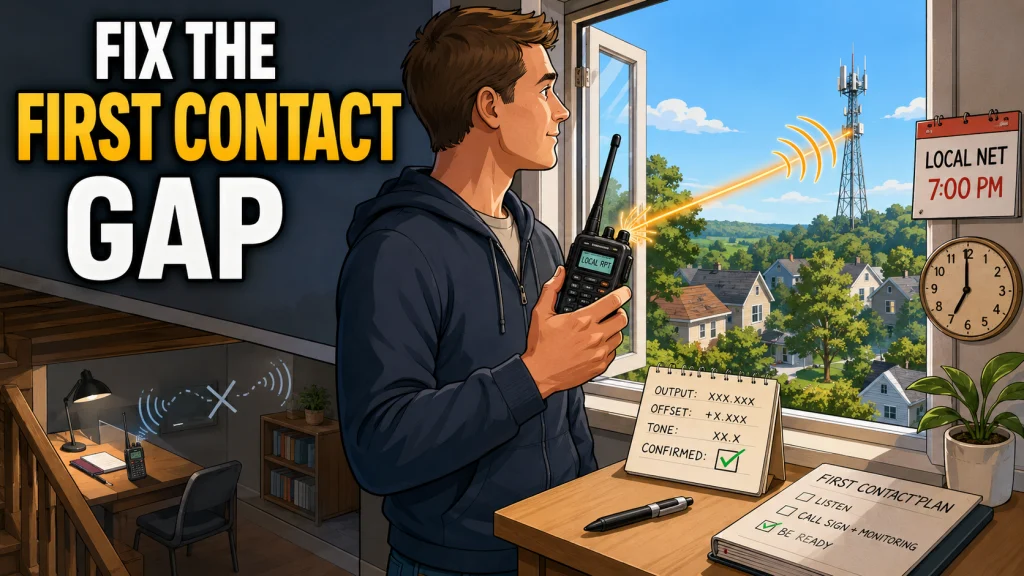
Some new hams never make their first contact because passing the exam solves the licensing problem, not the radio path, repeater setup, or fear of sounding wrong. I have seen candidates leave with a Technician pass, buy a handheld, and still never program a usable local repeater into it. The usual barriers are unrealistic expectations about handheld range, incomplete repeater information, and confusion between FCC rules and local operating etiquette. Once those three problems are separated, an unused license looks less like failure and more like a setup and confidence problem that can be fixed.
Passing the Exam Does Not Remove the Next Three Barriers
I have seen candidates pass the Technician exam and then stall before making a single contact. That pattern explains why new hams never make first contact even when they were motivated enough to study, register, sit for the exam, and buy a radio. The missing piece is rarely another chapter of license theory; it is the practical bridge between knowing what a repeater is and having one working memory channel, one realistic signal path, and enough confidence to press the push-to-talk button.
This is not a step-by-step script for making a first contact, and it is not a buying guide. The focus here is the gap between licensing and operating: why the radio stays quiet, why a new operator assumes that silence means failure, and why anxiety grows when the technical setup has never been confirmed. Readers who need the actual operating sequence should move next to the practical ham radio setup guides, where programming and first-use tasks belong.
| Barrier | What the new operator sees | What is usually missing |
|---|---|---|
| Antenna and path expectations | The handheld hears little or reaches nobody | A usable path to an active repeater from the actual operating location |
| Repeater configuration | The frequency is saved, but the repeater does not respond | The correct output frequency, offset, access tone, and current activity information |
| Fear of operating incorrectly | The operator listens for days but never transmits | A clear distinction between FCC requirements and local customs |
These barriers often overlap. A person may think they are afraid of talking when the radio is not configured correctly, or blame a low-cost handheld when the real problem is operating from inside a building with poor access to the repeater. Treating every case as a confidence issue misses the technical half of the problem, while treating every case as an equipment problem can send a beginner shopping when the radio has never been given a fair test.
Barrier One: A Handheld Is Not a Fixed-Range Device
The first disappointment often arrives before the first conversation. A new operator turns on a handheld, scans for activity, hears little, and concludes that the radio cannot reach anyone. That conclusion feels reasonable because consumer devices are sold with simple coverage claims, but VHF and UHF handheld performance depends heavily on terrain, building loss, antenna position, the operator’s elevation, and the height and location of the repeater.
ARRL guidance on VHF handheld use emphasizes that gaining height can change the path dramatically, while a compact stock antenna and a low indoor position can limit what the same radio can do. A handheld used beside an upstairs window may reach a repeater that remains inaccessible from a basement desk. The radio did not become more powerful between those two locations; the path became less obstructed. That is why a universal promise such as “this handheld reaches two miles” is not useful for deciding whether a first-contact attempt should work.
The practical mistake is testing the hobby and the equipment at the same time. When the first attempt fails, the operator cannot tell whether the problem is the radio, antenna, programming, repeater, location, or timing. A better interpretation is narrower: silence only proves that the current combination did not produce a contact. It does not prove the license was a mistake, the radio is defective, or nobody nearby uses amateur radio.
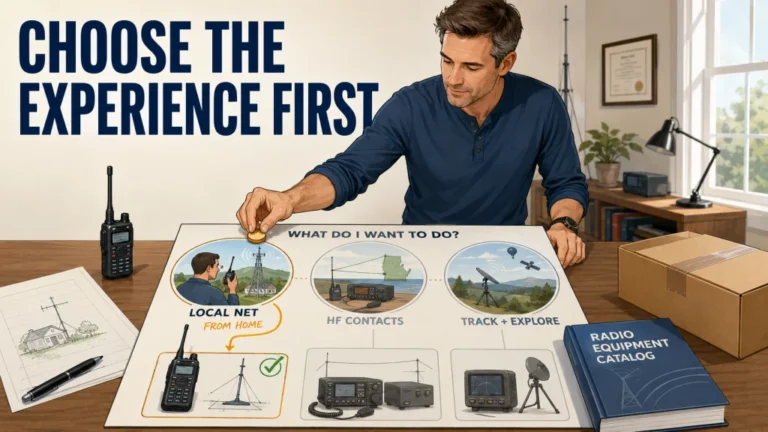
This is also why buying another handheld is usually a poor first response. A different radio may be justified when the original one does not fit the intended band, operating style, or programming needs, but a purchase cannot remove a blocked path or make an inactive repeater busy. The decision framework in choosing the right ham radio matters when the use case is wrong, not when the current setup has never been verified.
Barrier Two: A Repeater Is More Than One Frequency
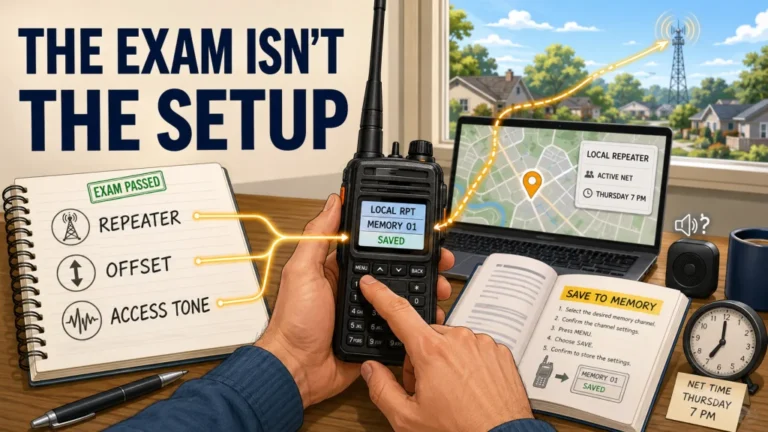
The Technician exam teaches the concept of repeater operation, but the exam does not hand a new licensee a working local channel. To use a typical analog repeater, the radio may need the repeater’s output frequency, the correct transmit offset or input frequency, and an access tone such as CTCSS. The operator also needs a repeater that is currently active and reachable from the location where the radio will be used.
This is where many first attempts fail quietly. Saving the published output frequency may be enough to listen, yet transmitting with the wrong offset or no required tone can produce no response from the repeater. ARRL’s first-contact guidance tells new operators to find a repeater, listen, and become familiar with its operating procedures, while ARRL’s repeater material explains that repeaters transmit and receive on different channels and commonly use access tones.
A directory entry is a starting point, not proof that the machine is active at this moment. Repeater status, tones, linking, schedules, and local use can change. ARRL’s 2026 Repeater Directory is powered by RepeaterBook data, but even a current directory should be checked against a local club page, the repeater trustee’s information, or actual monitored activity before a beginner builds the entire first-contact plan around it.
The useful distinction is between “programmed” and “confirmed.” A programmed channel contains values. A confirmed channel has been checked for the correct parameters, heard carrying identifiable activity or a scheduled net, and matched to the operator’s location. New hams often assume the radio memory is the finish line, when it is only the point where the real-world test begins.
Barrier Three: FCC Rules and Local Etiquette Get Blended Together
The third barrier is the one that keeps a correctly programmed radio silent. A new operator hears experienced voices using call signs, pauses, shorthand, net procedures, and local habits, then assumes every detail is a legal requirement. The fear is not just “I do not know what to say.” It is “I might break a rule in front of people who will immediately know I am new.”
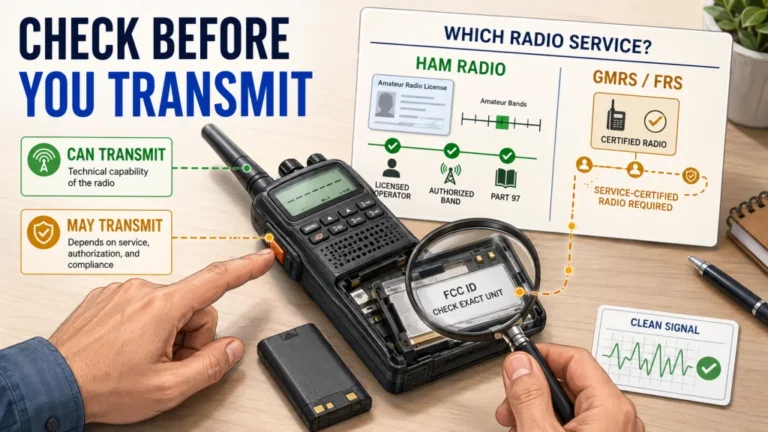
The federal identification rule is much narrower than the folklore surrounding a first call. Under 47 CFR 97.119, an amateur station must transmit its assigned call sign at the end of a communication and at least every 10 minutes during a communication. Part 97 also contains specific content restrictions, but it does not require a polished radio voice, a perfect conversational opening, or knowledge of every local habit before an operator can participate.
Local etiquette still matters because it keeps repeaters and nets orderly. Waiting for a pause, listening before transmitting, following a net control operator’s instructions, and using the local check-in format are good operating practices. The mistake is treating an unfamiliar custom as evidence that the operator is legally unprepared. Etiquette can be learned by listening and asking; the core FCC rules should be learned directly rather than guessed from how confident someone sounds on the air.
A scheduled net or an arranged contact with a local club member lowers the social risk because the operator knows when activity will occur and that someone is expecting a new voice. ARRL maintains a searchable Net Directory, although local club calendars and repeater pages may provide more current detail for a specific area. The value of a net is not that it eliminates nervousness. It replaces the uncertainty of calling into an empty repeater with a known time, known procedure, and a reason for someone to answer.
What Helps Before the First Contact Attempt
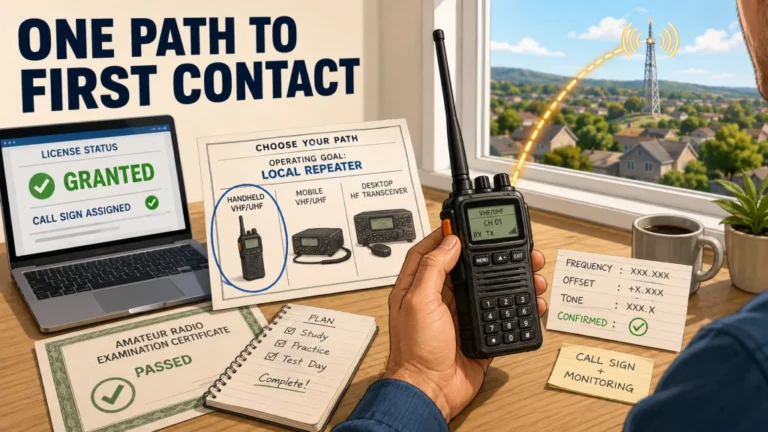
The operators who move past this stage do not necessarily have better radios or more technical confidence. They reduce the number of unknowns before transmitting. Instead of scanning dozens of saved channels and hoping one works, they prepare one realistic path and one low-pressure opportunity to use it.
- Choose one nearby repeater that appears current and active, rather than loading every listing in the region.
- Confirm the output frequency, offset, access tone, and any local operating notes from more than one current source when possible.
- Program and monitor the channel before transmitting, especially while waiting for a new license grant to appear.
- Find a scheduled net or arrange a contact with a local operator so someone is likely to answer.
- Separate the FCC identification rule from optional local phrasing and habits.
A person waiting for a brand-new license grant may listen and prepare the radio, but should not independently transmit as the new licensee yet. Under 47 CFR 97.5, the station must be under the physical control of a person named in an amateur station license grant in the FCC database before it transmits. Passing the exam is not the same event as the new license appearing in that database.
This preparation does not guarantee a contact. The repeater may be quiet, the path may still be weak, or the scheduled activity may have changed. It does, however, turn a vague failure into a diagnosable result. If the operator hears the repeater clearly but cannot access it, configuration or path is the likely next question. If the repeater works and other stations are active but the microphone never gets pressed, confidence and a planned contact deserve attention.
An Unused License Is Usually a Sequence Problem
The question I hear most often after an exam session is what radio to buy. That question arrives before many candidates know which local repeater they intend to use, whether it is active from home, or how they will create a low-pressure first opportunity to transmit. Buying feels concrete, while choosing a path and arranging a first contact feels uncertain, so the equipment decision gets finished and the operating decision gets postponed.
That order matters. When a new ham buys first, programs later, tests from a poor location, and then waits for a random stranger to answer, four uncertain steps have been stacked on top of each other. The first-contact anxiety is real, but it is often the final symptom of a sequence that was fragile from the beginning.
Field Note: I do not assume a silent license means the person lost interest. When someone has already studied and passed, I look first for the missing bridge between the license, the local radio path, and a specific opportunity to use it.
The important shift is to stop treating the first contact as a performance. It is a small test of whether the license, radio, programming, location, and local activity have finally been connected. Once that test is framed correctly, a failed attempt becomes information instead of a verdict on whether the person belongs in amateur radio.
Final Thoughts: The First Contact Problem Is Solvable
Some new hams never make their first contact because three manageable problems arrive together: the handheld does not behave like a fixed-range device, the repeater channel is incomplete or unconfirmed, and local operating habits look more like law than they really are. None of those problems is solved by passing another practice test, and not all of them are solved by buying a better radio.
I would not call an unused Technician license proof that someone failed at the hobby. I would call it a sign that the operating sequence stopped too early. One confirmed repeater, one realistic signal path, and one expected contact can do more for a hesitant new operator than another month of waiting to feel completely ready.
FAQs
😟 Is it normal to feel nervous about a first ham radio contact?
Yes. New-ham first-contact fear usually comes from not knowing whether the radio is configured correctly and not knowing which local habits matter. Confirming the technical setup and arranging a known contact reduces both uncertainties.
📡 Does hearing nothing mean my handheld radio is defective?
No. Terrain, buildings, antenna position, repeater location, programming, and local activity can all produce silence. Test one confirmed repeater from more than one practical location before blaming the radio.
🪪 Can I transmit as soon as I pass the Technician exam?
A brand-new licensee must wait until the FCC license grant appears in the database before independently transmitting under that new license. The radio can be programmed and used for listening while the grant is pending.
🔧 Why can I hear a repeater but not talk through it?
The receive frequency may be correct while the transmit offset, input frequency, or access tone is wrong. A weak path can create the same symptom, so verify both the channel settings and the operating location.
🗓️ Is a scheduled net a good place for a first contact?
It can be, especially when the net welcomes new operators and publishes a clear check-in procedure. Listen first, confirm the schedule is current, and follow the net control operator’s instructions.
Sources and References
- eCFR, 47 CFR 97.119 Station Identification: FCC identification timing and authorized methods of transmitting a call sign.
- eCFR, 47 CFR 97.5 Station License Required: requirement for a station to be controlled by a person named in an FCC license grant before transmitting.
- eCFR, 47 CFR 97.113 Prohibited Transmissions: prohibited content and communications under the amateur service rules.
- ARRL, Making Your First Contact: finding a repeater, listening before transmitting, and becoming familiar with local operating procedures.
- ARRL, Find a High Spot for VHF: practical explanation of how elevation and radio horizon affect handheld VHF performance.
- ARRL Net Directory: searchable directory of registered amateur radio nets.
- ARRL, 2026 Repeater Directory Announcement: current context for repeater listings powered by RepeaterBook data.