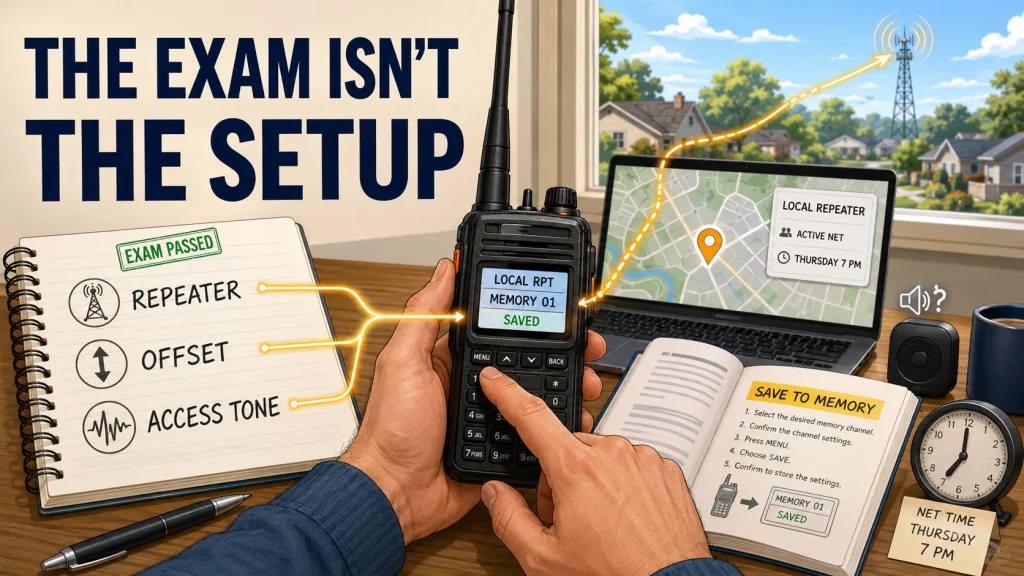
The Technician exam proves that you understand the basic rules, operating practices, radio theory, and safety needed to begin using amateur radio legally. It does not teach you how to find an active local repeater, program your own radio, recognize when a quiet frequency is normal, or plan a complete first station. Those gaps do not make the exam defective, but they do explain why a person can pass comfortably and still feel unprepared the first time the radio is switched on. The useful next step is to treat the license as permission to begin learning on the air, not as proof that every practical skill has already been learned.
Passing the Technician Exam Is Only the Licensing Threshold
The Technician exam contains 35 questions, and 26 correct answers are required to pass. As an accredited Volunteer Examiner who has worked with new operators for more than a decade, I have seen how quickly the conversation changes after a candidate earns a passing score. The next questions are rarely about Ohm’s law or frequency allocations. They are about finding a repeater, programming a radio, hearing actual activity, and understanding what a complete first setup requires.
As of July 1, 2026, exams use the 2026 through 2030 Technician question pool. That active pool contains 409 questions covering licensing rules, operating procedures, radio wave behavior, electrical principles, equipment, antennas, and safety. It gives a new operator a necessary foundation, but a national licensing exam cannot walk each person through local repeater activity, a particular radio menu, or the antenna limitations at a specific house. That difference between national knowledge and local action is where most ham radio Technician license gaps appear.
This article stays focused on those gaps. It is not a study guide, a radio-buying guide, or a step-by-step programming tutorial. Readers who are still deciding whether the hobby fits their goals should begin with practical ham radio guidance for beginners, while licensed operators who need task-by-task help can use the section on setting up and using ham radio.
The Exam Explains Repeaters, but Not How to Find Yours
A Technician candidate learns why a repeater uses separate input and output frequencies, what an offset is, and why an access tone may be required. Those are the right concepts to test. The missing step is turning that knowledge into one working local memory channel on a real radio. A national exam cannot tell you which machine covers your neighborhood, whether it is active in the evening, or whether its published information has changed.
One of the questions I hear most often after a session is some version of, “How do I find repeaters near me?” The practical answer begins with a community repeater directory, followed by confirmation from a local club or operator when possible. A directory entry can provide the output frequency, offset direction, tone, mode, location, and sometimes operating notes, but it cannot promise that the repeater is active or reachable from your exact position.
| The exam can establish | The operator still has to determine |
|---|---|
| What a repeater does | Which nearby repeater serves the intended area |
| Why an offset is used | The correct input and output settings for that machine |
| What an access tone is | Whether the listed tone is current and entered correctly |
| How to identify legally | When the repeater is active and how local users normally check in |
The decision rule is simple: do not judge the radio until one known local channel has been verified. If the radio receives nothing, the cause might be a quiet repeater, the wrong tone, a location blocked by terrain, an incorrect memory entry, or a receiver setting. Testing one variable at a time prevents a new operator from replacing equipment when the real problem is only incomplete local information.
The Exam Tests Concepts, Not the Menu in Your Hand
The question pool includes equipment controls, frequency use, operating modes, and repeater concepts. It does not teach the button sequence for every handheld or mobile radio, because those interfaces are not standardized. Two radios that perform the same basic job may use different menu names, different abbreviations, and different procedures for saving a memory. Passing the exam therefore does not mean a new operator should be able to program an unfamiliar radio without its manual.
This is where a lot of unnecessary frustration starts. VFO mode normally lets the operator enter or tune a frequency directly, while Memory mode recalls channels that have already been saved. A person may set the frequency, offset, and tone correctly in VFO mode, then assume the radio is defective when those settings disappear because the channel was never written to memory. The exact labels and save sequence vary, so the model manual matters more than a generic video made for a similar-looking radio.
Computer programming software such as CHIRP can make repeated memory entry easier, but only when the exact radio and current software build support each other. The programming cable’s USB chipset and driver must also communicate correctly with the computer. Reading the radio first, saving an untouched backup, and then writing a small test file is safer than loading a large borrowed channel list and hoping every setting matches.
Field Note: When someone tells me that a newly purchased radio “cannot reach anything,” I do not begin by discussing transmit power. I ask which repeater was programmed, whether the frequency and tone were verified, and whether the radio can hear that repeater before transmitting. That short sequence separates a programming problem from a coverage problem much faster than changing random settings.
A first-time operator should program one local repeater and test reception before building a long channel list. Once that single memory works, the same process can be repeated with confidence. The exam gives you the vocabulary needed to understand the settings, while practical setup teaches you how your particular radio stores them.
The Exam Does Not Prepare You for a Quiet Speaker
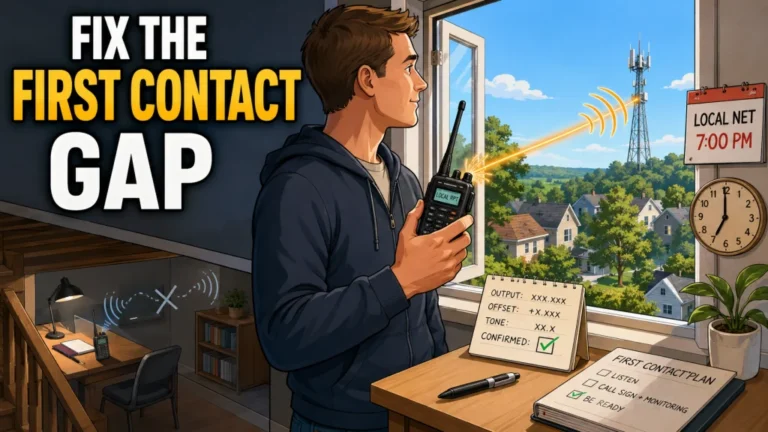
Frequency privileges look busy on a band chart. A new Technician may reasonably expect that turning on a radio and scanning will reveal continuous conversation, but local VHF and UHF activity often comes in short bursts. Some repeaters are busiest during commuting hours, scheduled nets, public-service events, or club activities. At other times, a correctly programmed radio may remain silent for long periods.
Silence is therefore not enough evidence to diagnose a problem. The radio might be outside the repeater’s coverage area, the squelch may be set too high, the wrong channels may be scanned, or the area may simply be quiet at that hour. The fastest way to distinguish those cases is to find a scheduled local net, listen from a location with a clearer path, and confirm that the radio receives a known signal before attempting a contact.
- Find the time and frequency of one scheduled local net.
- Confirm that the frequency, offset, and tone match the current repeater listing.
- Listen through one complete net before deciding the band is inactive.
- Move outdoors or to a higher, clearer location if reception is weak.
- Ask a local club whether the repeater has a known coverage limitation or temporary outage.
This checklist matters because “I hear nothing” describes a symptom, not a cause. A better diagnosis starts with a known event at a known time. Once the operator hears real traffic, the question changes from “Does any of this work?” to the much smaller and more manageable question of how to join the conversation.
The Exam Fee Is Not the Cost of a Working Setup
The current FCC application fee for a new amateur license is $35. An exam session charge is separate and depends on the Volunteer Examiner Coordinator, with the ARRL VEC exam fee set at $15 for 2026. The $35 FCC fee also applies to renewals, rule-waiver requests, and vanity call sign applications, but ordinary operator-class upgrades and requests for a sequentially issued call sign are exempt. Those distinctions matter because the cost of passing Technician is not the same as the cost of upgrading later.
A useful setup may require more than a radio. For a budget-focused analog handheld setup intended for local repeater use, a realistic current total is often roughly $60 to $150 when the radio, programming method, and any basic antenna accessory are counted. That is an estimate, not a required spending target: a radio that already includes the needed cable or works well from the intended location may cost less, while established-brand or digital equipment can cost considerably more. A fixed home station or vehicle installation can also add a power supply, feed line, mounting hardware, adapters, or weather protection.
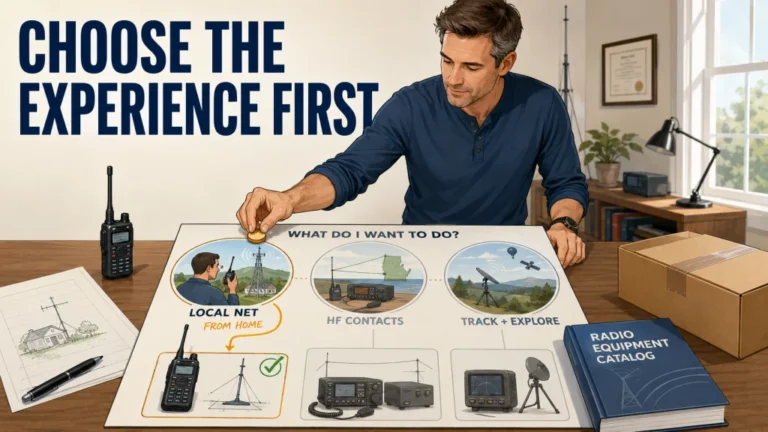
Not every beginner needs all of those items, and buying them before identifying the first operating goal is usually the wrong approach. The equipment list should follow the activity and location, not a generic shopping checklist. The price range becomes useful only after the reader decides whether the first goal is a local repeater contact, a vehicle station, a home base station, or a future HF setup.
For local repeater use, the first complete setup may be modest. For a fixed home station, a vehicle installation, or HF operation after upgrading the license, the support equipment and installation demands change. This is why a Technician license is not enough by itself to determine what someone should buy: license privileges, terrain, repeater coverage, operating goal, and installation limits all matter.
What the Technician Exam Gets Right
The practical gaps should not be confused with a failure of the exam. Its job is to establish that a new operator understands the rules and basic technical ideas needed to use amateur spectrum responsibly. The active 409-question pool covers identification, frequency privileges, interference avoidance, electrical and RF safety, operating procedures, equipment, antennas, propagation, and enough radio theory to recognize common risks and controls. Each candidate receives a 35-question exam drawn from that broader pool and must answer 26 correctly.
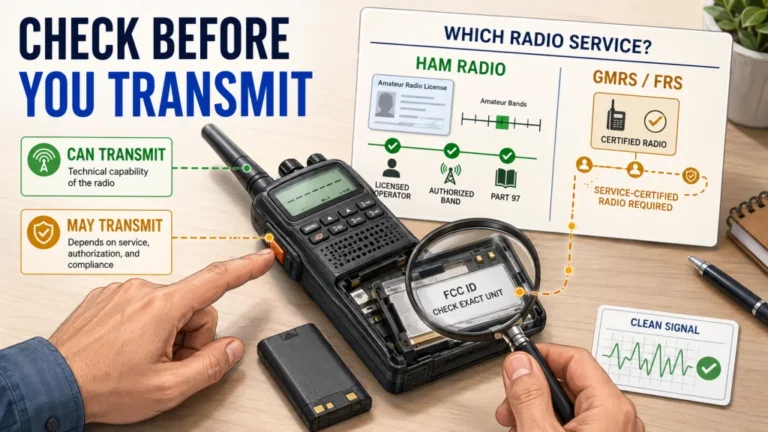
That is exactly what a licensing exam should prioritize. A candidate must know not to transmit outside authorized privileges, not to interfere with emergency traffic, and not to create avoidable electrical or RF hazards. Those responsibilities cannot be replaced by a helpful club member or a well-written equipment manual. Local activity, menu navigation, and station planning can be learned afterward because mistakes in those areas can usually be corrected without putting other spectrum users or people at risk.
The better conclusion is not that the test teaches the wrong things. It teaches the minimum shared knowledge that every new Technician needs, while leaving local and equipment-specific skills for hands-on learning. Once that boundary is clear, the question of what to do after passing Technician becomes easier to answer: choose one realistic activity and learn only the next few skills required to do it.
Build a Small Bridge From Passing to Operating
New licensees often try to close every knowledge gap at once. They collect frequencies, watch programming videos, compare antennas, read about digital modes, and plan future upgrades before making one contact. The volume of information makes the hobby feel larger than it needs to be. A narrower sequence works better because each step produces evidence that the previous one was completed correctly.
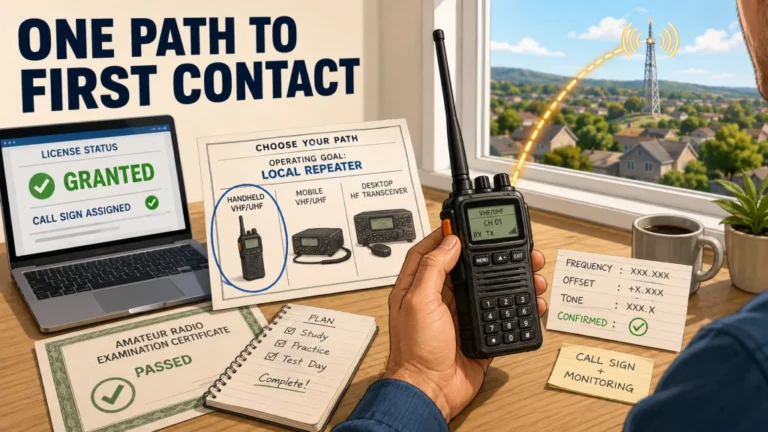
Use the following path as a practical bridge rather than another study syllabus:
- Wait until the FCC database shows an active call sign before transmitting.
- Choose one first activity, such as listening to and checking into a local repeater net.
- Verify one repeater entry from more than one current source when possible.
- Program and test one memory channel before adding a full list.
- Ask a local mentor or club member to check the channel if the result is unclear.
- Listen to normal local operating style, then make a short first contact.
- Change equipment only after identifying a specific limitation.
This sequence does not require a perfect station or complete confidence. It only requires one reachable signal, one correctly configured channel, and enough operating knowledge to identify properly. That is a much smaller problem than “learn all of ham radio,” and it is the point where the license begins to become useful.
Final Thoughts: The Hobby Starts After the Score
The Technician exam is not designed to make someone fully operational in 35 questions. It establishes a legal and safety baseline, then leaves the local, equipment-specific, and social parts of amateur radio to develop through setup, listening, mentoring, and practice. I have seen capable candidates pass and still hesitate because they expected the license to remove uncertainty. It does not, and that is normal.
The best response is not to keep studying indefinitely or buy a more complicated radio. Pick one practical goal, verify one local path to the air, and ask for help when a local operator can shorten the diagnosis. The exam gives you permission and a foundation. Operating comfort grows by using both with other people, not by trying to eliminate every unknown before transmitting.
FAQs
📝 What should I know about the ham radio Technician exam before taking it?
The exam has 35 questions, and you need 26 correct answers to pass. Study the current question pool for your test date, but understand that passing measures licensing knowledge, not your ability to program every radio or find local activity.
📻 Can I transmit as soon as I pass the Technician exam?
No. Wait until the FCC database shows your call sign and active license before transmitting. Passing the exam begins the application process, but it is not itself the operating authorization.
🗺️ How do I find a local repeater after I get licensed?
Start with a current repeater directory, then confirm the details through a local club or another operator when possible. Check the output frequency, offset, access tone, mode, and any notes before programming the channel.
💻 Do I need computer software to program a ham radio?
Not always. Many radios can be programmed from the front panel, while supported models may be easier to manage with software such as CHIRP. The right method depends on the exact radio, the number of channels, and how comfortable you are with its menu system.
🔇 Why do I hear nothing after programming a repeater?
The repeater may be quiet, out of range, temporarily unavailable, or programmed incorrectly. Test during a scheduled net, verify the settings, reduce excessive squelch, and try a clearer location before blaming the radio.
💰 Is the $35 FCC fee the full cost of getting started?
No. The FCC application fee is separate from any exam session charge, and a basic local repeater setup may still require a radio, programming method, or antenna accessory. Ordinary operator-class upgrades are exempt from the $35 FCC fee, although the exam session may still have its own charge.
Sources and References
- ARRL, Getting Your Technician License: Technician exam structure, licensing steps, and the role of the published question pool.
- NCVEC, 2026-2030 Technician Question Pool: Current Element 2 question pool and effective examination cycle beginning July 1, 2026.
- ARRL, FCC Application Fee: Current $35 FCC application fee and payment process for new amateur licenses.
- ARRL VEC Exam Fees: Current ARRL VEC examination fee and separate exam-session cost information.
- RepeaterBook Amateur Radio Repeater Database: Community-maintained repeater search information used to locate nearby systems and review operating details.
- CHIRP Radio Programming Documentation: Programming workflow, cable guidance, supported-radio information, and beginner documentation.
- CHIRP Supported Radios: Current model-support list and limitations that should be checked before using programming software.
- Ham Radio Outlet, Current Amateur Radio Listings: Retail pricing reviewed for the budget-focused equipment range described in the article.