The Baofeng legality question at a ham radio exam session needs a conditional answer, not a verdict based on the logo. I separate it into four checks: the exact unit, the radio service, the operator’s privileges, and the compliance of the transmitted signal. That framework explains why lawful Part 97 use does not automatically make the same handheld legal on GMRS or FRS, and it keeps the licensing answer separate from the buying decision.
The Baofeng Question at a Ham Radio Exam Session Is Really Four Questions
A candidate can arrive at a ham radio exam session with a low-cost handheld already in a bag and a simple concern: is this radio legal once the license is granted? As a Volunteer Examiner, I would not answer that with a bare yes or no. The useful answer has to separate the exact radio from the frequency, service, operator authority, and signal that will actually go on the air.
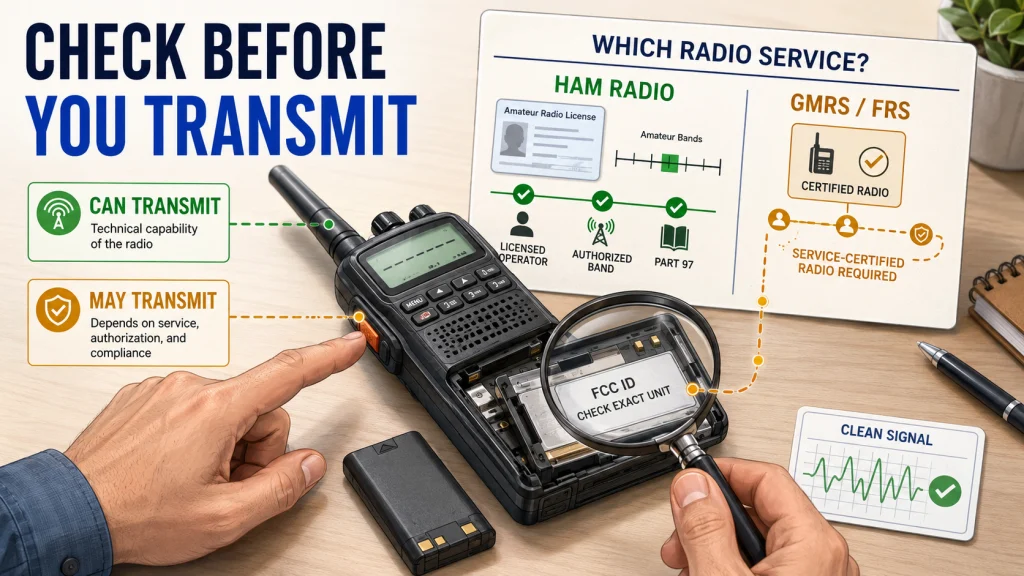
That distinction matters at the exam table because a passing result proves knowledge of the rules, not that every selectable channel on a radio is authorized. A display can show a frequency the hardware can reach, yet the operator may have no authority to transmit there or may need service-specific certified equipment. The first practical lesson is therefore to treat technical capability and legal permission as two different facts.
Key point: Ask four questions in order: what exact radio is this, what radio service is being used, is the operator authorized for that service and frequency, and does the transmitted signal comply with the applicable technical rules?
Field Note: My exam-session answer would end with a verification path, not a recommendation to buy or replace a radio. The new operator needs to know what must be checked before transmitting; product suitability belongs in a separate evidence-based guide.
This article stays within that legal boundary. It does not compare Baofeng radios with alternatives, decide whether one is sufficient for a particular use case, recommend an upgrade, or explain programming. Legality and product suitability are separate questions, and combining them usually produces a misleading answer to both.
Four Different Questions Get Compressed Into “Is It Legal?”
The framework I would put in front of a new licensee splits the broad question into four narrower ones. Ownership, technical capability, equipment authorization, and lawful operation are connected, but none automatically proves the others. A radio may be capable of transmitting on a frequency the operator is not authorized to use. A unit may also carry an FCC ID without that grant authorizing every frequency, service, or version discussed under the same product name.
| Question | What it addresses | What decides the answer |
|---|---|---|
| Can the radio tune or transmit there? | Technical capability | Hardware, firmware, and configuration |
| Can that exact unit be marketed for the stated capability? | Equipment authorization | FCC ID, grant, labeling, model version, and authorized scope |
| May this operator transmit there? | Operator authority | Radio service, license status, license class, and privileges |
| Is the transmission compliant? | On-air operation | Frequency, emission, bandwidth, power, identification, and unwanted emissions |
Online arguments often answer only one row. One person proves that the radio can reach a frequency and treats that capability as permission. Another finds an FCC grant and assumes it authorizes every possible use of the radio. A third focuses only on the operator’s license and ignores whether the radio is being used in the radio service for which that equipment is permitted.
The phrase “FCC approved” is therefore too vague to settle the question. An equipment grant applies under stated rules and parameters. It is not a universal permission slip for every channel that can be entered through the keypad or programming software. The exact identifier on the exact unit must be matched to the federal record before the grant can support a conclusion.
What Part 97 Requires for Amateur Radio Use
Part 97 governs the Amateur Radio Service in the United States. When I explain the legal boundary to a new operator, I use control-operator responsibility as the anchor: the license authorizes amateur operation, but the person controlling the station remains responsible for the transmission. In practical terms, the operator must use an amateur frequency available to that license class, select a permitted emission, identify the station correctly, avoid harmful interference, and keep the signal within the applicable technical standards.
Amateur radio does not use the same service-specific transmitter-certification model that Part 95 applies to GMRS and FRS. That flexibility allows amateur operators to use commercially manufactured, modified, or individually constructed equipment when the resulting station complies with Part 97. The flexibility is not a waiver of operating rules. A ham license does not make an out-of-band transmission legal, excuse harmful interference, or turn a radio with excessive unwanted emissions into a compliant station.
- Confirm that the selected frequency is inside an amateur allocation available at the operating location.
- Confirm that the license class permits the intended transmission on that band and segment.
- Use an emission, bandwidth, and power level allowed for the intended amateur operation.
- Identify the station as required and avoid transmitting on channels assigned to another radio service.
- Stop and verify the rules whenever the programmed transmit range extends beyond amateur allocations.
The checklist explains why “a ham license makes a Baofeng legal” is incomplete. The license authorizes the person to conduct amateur communications under Part 97. It does not certify an amateur handheld for GMRS, authorize public-safety or business frequencies, or guarantee that every individual unit produces a compliant signal. The legal answer appears only after the operator, frequency, service, and equipment behavior are matched correctly.
Why the Baofeng UV-5R Record Causes Confusion
The question “is a Baofeng UV-5R ham radio legal?” cannot be answered safely from the model name alone. In a 2018 Citation and Order, the FCC discussed UV-5R and UV-5R V2+ radios associated with FCC ID ZP5BF-5R, whose equipment authorization had been granted in 2012. The order addressed a marketed UV-5R V2+ version that the FCC found could operate outside the scope of that authorization and directed the distributor to stop marketing noncompliant units until the problem was corrected.
That record does not declare every Baofeng radio illegal. It also does not provide blanket approval for every radio sold with UV-5R in the name. The enforcement document concerns a particular marketing record, model version, operating capability, distributor, and equipment grant. Applying its conclusion to a different unit without checking the FCC ID skips the very distinction the order illustrates.
The practical check begins with the label on the radio, often beneath the battery. Match the FCC ID to the equipment authorization database, read the grant, and compare the authorized scope with the unit’s actual transmit capability. A seller’s statement that a radio is “FCC compliant” is not enough when it does not identify the applicable FCC ID, rule part, model version, and authorized range.
Warning: Do not verify an uncertain channel by making a brief test transmission. Identify the service, frequency, license privilege, equipment record, and permitted use before pressing push-to-talk.
The lesson is broader than one model. Similar product names can cover different production runs, hardware revisions, firmware behavior, and authorization records. The name printed in a listing is a starting point for verification, not the final legal answer.
A Distributor Case Does Not Remove the Operator’s Responsibility
The 2018 Baofeng order focused on marketing equipment outside the scope of its authorization. That is different from an enforcement case against an individual operator, but the distinction does not protect someone who transmits unlawfully. A distributor’s conduct answers whether a particular unit was marketed in compliance with equipment rules. The operator’s conduct answers whether a particular transmission was authorized and compliant.
For an individual, the practical risk begins with the transmission itself. Operating outside authorized amateur frequencies, using privileges the license does not provide, causing harmful interference, or transmitting with a noncompliant signal can create a separate rule violation regardless of where the radio was purchased. A valid receipt, an online listing, or a seller’s assurance does not transfer the control operator’s responsibility back to the retailer.
The FCC response to a violation depends on the facts, including what occurred, whether harmful interference was involved, whether the conduct was willful or repeated, and how the operator responds after being notified. The rules provide enforcement tools that can include notices or orders, monetary forfeitures, and administrative action affecting an FCC authorization. That does not mean every mistaken button press produces the same result. It means “the seller advertised it that way” is not a safe operating rule.
Practical distinction: The equipment record helps determine what the unit was authorized and marketed to do. The operating record determines what the person actually transmitted, where, and under which authority.
This distinction gives a new operator a useful next step. Do not try to predict enforcement from a forum argument. Prevent the problem by checking the service and frequency before transmitting, correcting questionable programming, and stopping immediately if a transmission causes interference or falls outside the operator’s privileges.
A Ham License Does Not Make the Same Radio Legal on GMRS or FRS
GMRS and FRS are Personal Radio Services governed by Part 95, not amateur bands governed by Part 97. Section 95.335 generally prohibits operating a non-certified transmitter in a Personal Radio Service unless a stated exception applies. Section 95.1761 requires each GMRS transmitter to be certified for GMRS. The ability to program a GMRS or FRS channel into an amateur handheld does not establish that the transmitter is certified for that service.
Holding both an amateur license and a GMRS license does not merge the two authorizations. The amateur license governs amateur operation. The GMRS license governs eligible GMRS operation using equipment permitted for GMRS. An amateur handheld does not become legal GMRS equipment merely because its owner holds both licenses or intends to use low power.
The order of the questions matters. Starting with the keypad encourages the user to treat every selectable frequency as an available option. Starting with the intended radio service immediately identifies which license and equipment rules control the transmission. Technical capability is considered only after the legal category is clear.
What a Responsible Exam-Session Answer Should Cover
At the exam table, I would provide a verification path rather than a verdict based on brand reputation. First identify the exact unit and FCC ID. Next identify the intended radio service and frequency. Then verify the operator’s authority and the technical rules that govern the transmission. When any one of those facts is unknown, the correct action is to verify it before transmitting.
I would also stop the answer before it becomes a disguised product recommendation. Receiver quality, durability, interface design, accessory support, and suitability for a local repeater are evidence-based buying questions. They do not determine whether a particular transmission is lawful. Readers making an equipment decision should use a ham radio selection guide organized by use case rather than treating legal status as a quality score.
Legal does not mean ideal, and inexpensive does not mean unlawful. A radio can be legally used for one amateur operation while remaining unsuitable for the operator’s actual goal. It can also be technically capable of another transmission that the operator is not permitted to make. Keeping those judgments separate prevents both needless fear and careless operation.
Final Thoughts: Match the Radio, Service, and Operator Before Transmitting
My answer at a ham radio exam session would be conditional: amateur use may be lawful when the exact radio may be used for that operation, the operator holds the required license, the frequency and emission fall within the operator’s privileges, and the transmitted signal complies with Part 97. The brand name alone proves none of those conditions.
The same radio’s ability to reach GMRS, FRS, public-safety, marine, aviation, or business frequencies does not authorize transmission there. Find the FCC ID, identify the intended service, verify the operator and equipment requirements, and confirm the transmit settings before using push-to-talk. Once those pieces match, the legal question becomes a practical checklist instead of an argument about a logo.
FAQs
📻 Is Baofeng legal for ham radio?
A Baofeng can be used legally for amateur operation when the exact radio may lawfully be used, the operator holds the appropriate amateur license, and every transmission stays within Part 97 privileges and technical requirements. The brand name by itself does not settle the question.
🔍 Is a Baofeng UV-5R ham radio legal in the United States?
Check the exact unit, model version, FCC ID, grant, and transmit capability rather than relying on the UV-5R name alone. FCC records involving one version or authorization should not be applied automatically to every similarly named unit.
🪪 Can you use Baofeng for ham radio before your call sign appears?
A first-time applicant must wait until the FCC license grant and call sign appear in the licensing database before transmitting under that authorization. Passing the exam alone does not authorize a new applicant to transmit.
📡 Can I use an amateur Baofeng on GMRS if I also have a GMRS license?
Only when the exact transmitter is certified and permitted for GMRS under Part 95E. Holding both licenses does not convert an uncertified amateur transmitter into compliant GMRS equipment.
⚠️ Can the operator be responsible if a seller advertised the radio as legal?
Yes. Seller claims do not remove the control operator’s responsibility for the actual transmission. Verify the frequency, service, privileges, equipment rules, and signal compliance instead of relying on a listing description.
🏷️ Where do I find the FCC ID on a handheld radio?
Check the radio’s label, often beneath the removable battery, or an approved electronic-labeling menu when applicable. Search that exact identifier in the FCC equipment authorization database and compare the grant with the unit in hand.
Sources and References
- Electronic Code of Federal Regulations, 47 CFR Part 97: Amateur Radio Service rules covering operator authority, station operation, frequency privileges, identification, interference, and technical standards.
- FCC Enforcement Advisory No. 2018-03: FCC guidance on equipment authorization requirements for two-way VHF/UHF radios and the limited amateur-radio exception.
- Electronic Code of Federal Regulations, 47 CFR Section 95.335: General restriction on operating non-certified transmitters in Personal Radio Services unless an exception applies.
- Electronic Code of Federal Regulations, 47 CFR Section 95.1761: GMRS transmitter certification requirements and limits involving multi-service capability.
- FCC Grant of Equipment Authorization for FCC ID ZP5BF-5R: Equipment grant associated with the UV-5R record discussed in the FCC’s 2018 action.
- FCC Citation and Order DA 18-801: Enforcement record concerning the marketing of a UV-5R V2+ version outside the scope of its equipment authorization.
- 47 U.S.C. Section 312: Administrative sanctions and cease-and-desist authority involving FCC station authorizations.
- 47 U.S.C. Section 503: Statutory authority for monetary forfeitures involving willful or repeated violations of the Communications Act or FCC rules.