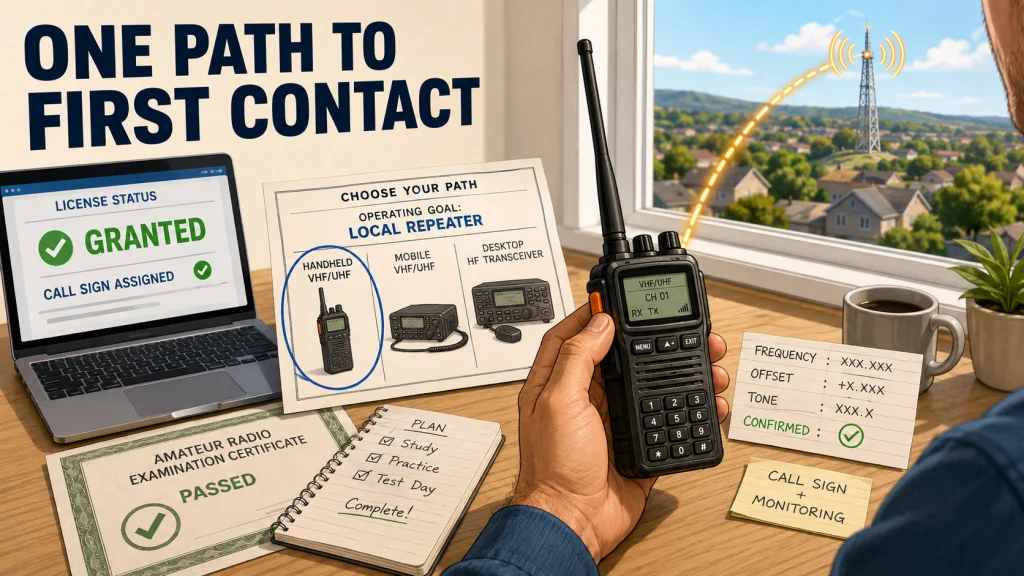
What people ask after passing a ham radio exam usually falls into three practical questions: when they may transmit, what kind of radio fits their goal, and what they should do first once the call sign appears. A first-time applicant must wait until the FCC license grant is visible in the Universal Licensing System before transmitting. The most useful next move is not buying the most capable radio available, but choosing one operating path, finding a local signal to listen to, and preparing one low-pressure first contact.
Passing the Exam Creates Three Immediate Questions
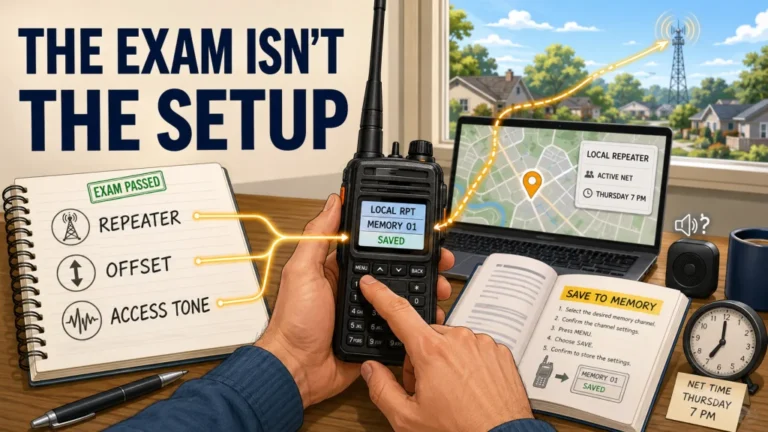
The question I get most often right after a successful exam session is what radio to buy, sometimes before the new applicant has asked when the call sign will appear. That moment says a lot about the gap between passing the Technician exam and becoming comfortable on the air. The exam verifies minimum knowledge, but it does not hand the candidate a local repeater, a programmed memory channel, or a first conversation.
That is why I separate the post-exam confusion into three questions instead of giving a new licensee a giant checklist. First, when does the authority to transmit begin? Second, what radio category matches the kind of operating the person can realistically do? Third, what small action turns a license record into an actual contact? This article stays with those questions. It is not a complete operating course, a detailed programming tutorial, or a list of radios to buy.
That boundary matters because the common advice to “get on the air” skips the part that usually stops a beginner. A person cannot act on that advice until the FCC grant exists, the equipment fits an available signal, and the operator knows where to listen. Solving those three dependencies in order is more useful than collecting accessories before the first call sign has even been issued.
Question One: When Can I Transmit?
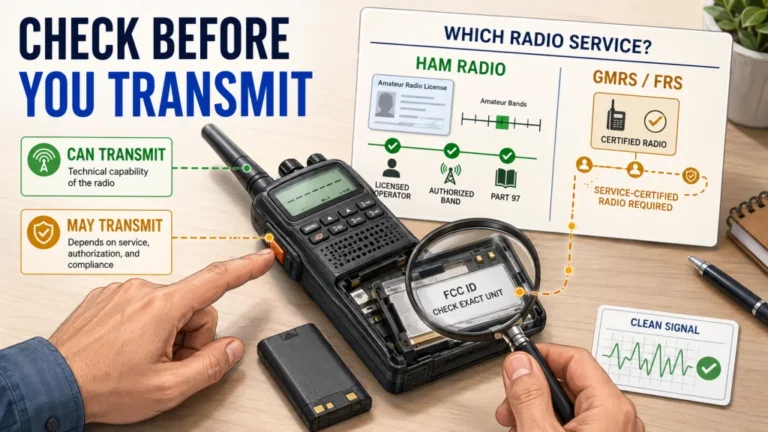
For a first-time applicant, passing the exam is not the same as holding an amateur station license grant. FCC rule 97.5 requires the transmitting apparatus to be under the control of a person named in a license grant in the ULS database. In practical terms, wait until your call sign and license grant appear in ULS before pressing the push-to-talk button. A passing result, a Certificate of Successful Completion of Examination (CSCE), and an FCC application that is still pending do not give a brand-new applicant authority to transmit.
The processing time is variable because the result must move from the exam team to its Volunteer Examiner Coordinator, then into the FCC system, through any required payment step, and finally to a granted license record. I do not promise candidates that this will always take one, two, or three business days. Electronic filing can move quickly, but weekends, payment timing, application issues, and processing delays can change the result. The dependable test is the ULS record, not someone else’s turnaround time.
Key point: A first-time Technician may listen, learn the controls, program receive frequencies, and prepare the station while the application is pending, but must not transmit until the FCC grant appears in ULS.
There is also a fee step that beginners sometimes confuse with the exam-session charge. The current FCC application fee for a new personal license is $35, paid to the FCC, while VE or VEC exam-session charges are separate and vary by organization. ARRL’s FCC fee instructions also distinguish new-license filings from ordinary operator-class upgrades and sequential call-sign requests, which are exempt from the FCC application fee. If the FCC requests payment for a new license application, completing the exam alone does not finish the licensing process.
A license upgrade is a different case and should not be mixed with a first license. Under FCC rule 97.9, an already licensed operator who passes the required upgrade examination and holds a valid CSCE may exercise the higher-class privileges while the application is pending, subject to the rule’s conditions. That temporary authority does not create a call sign for an unlicensed first-time applicant, so it does not change the answer for someone who just passed Technician with no existing amateur license.
Question Two: What Radio Should I Buy?
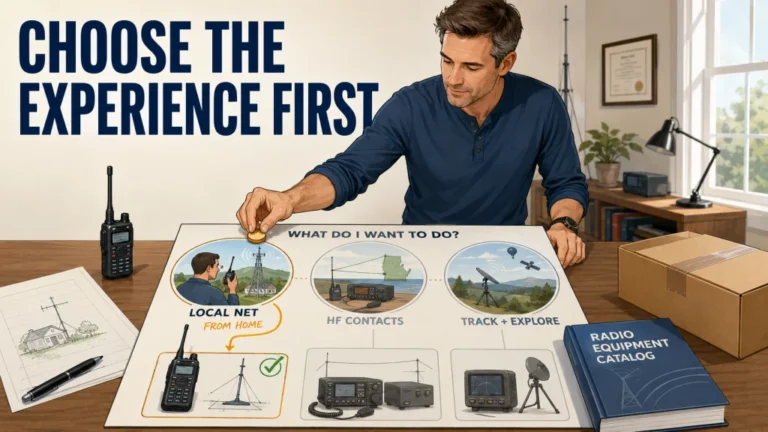
The useful answer begins with where the first contact is likely to happen, not with a brand name or the longest feature list. I usually ask whether the new licensee has found a local repeater before asking what radio they plan to buy. If nearby VHF or UHF activity is reachable from home, a handheld or mobile setup may make sense. If the real goal is regional or long-distance HF operating, the license privileges, antenna space, power supply, and budget become a different decision entirely.
This is where many new operators buy in the wrong order. A handheld may be affordable and portable, but it cannot create local repeater coverage where none exists, and a stock antenna used indoors may perform poorly even when a repeater is active. A higher-power mobile radio can improve the station, but only if the antenna and installation support it. An HF transceiver opens another operating path, but a new Technician has limited HF privileges and may need a General upgrade for the operating they imagined when they started studying.
| First operating goal | Radio category to investigate | What to verify before buying |
|---|---|---|
| Local repeater use while walking or traveling light | Handheld VHF/UHF radio | Active local repeaters, indoor coverage, programming method, and antenna limitations |
| More reliable local or mobile coverage | Mobile VHF/UHF radio | Vehicle or home antenna plan, power source, mounting, and local repeater activity |
| HF contacts beyond the local area | HF transceiver and station | License privileges, antenna space, electrical power, total station cost, and learning time |
The table is a filter, not a shopping list. Two people who pass the same Technician exam can need completely different equipment because one wants a local weekly net and the other is working toward HF voice contacts. The broader ham radio selection guide can help sort radio categories by use case, but the purchase should follow the available operating path rather than replace it.
A beginner also does not need to buy everything before the first contact. Borrowed club equipment, a supervised station, or a radio already owned by a friend can reveal whether local repeater use is enjoyable before money goes into a permanent setup. The question is not which radio wins on specifications. It is which setup removes the fewest barriers between the operator and the kind of contact they are licensed and equipped to make.
Question Three: What Do I Do Next?
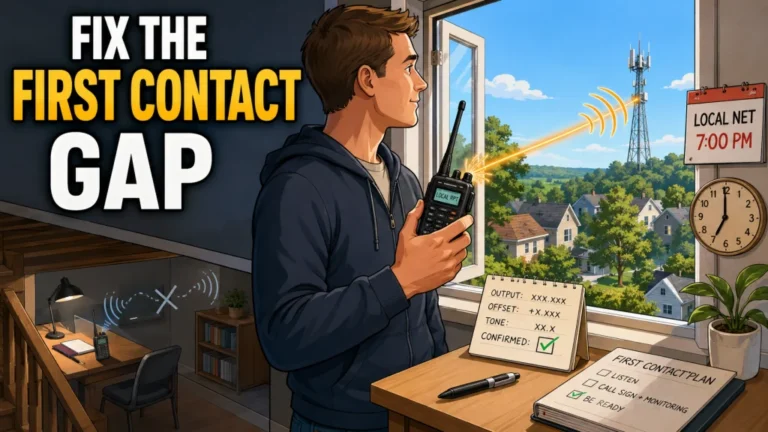
After the call sign appears, the best next step is one complete operating loop: find a signal, configure the radio for that signal, listen long enough to understand the rhythm, and make one simple contact. This is narrower than “learn ham radio,” which is too vague to act on. It also prevents a new licensee from spending the first month changing menus, watching reviews, and never hearing another operator.
For many Technicians, a local repeater is the easiest place to build that loop. The ARRL’s first-contact guidance recommends finding a repeater, listening to its operating procedures, and using your call sign when the channel is clear. The details still depend on the repeater. You may need its receive frequency, transmit offset, access tone, and any local net or identification practices before your radio can use it correctly.
- Find one local repeater or simplex frequency that shows real activity.
- Confirm the exact frequency, offset direction, offset amount, and access tone.
- Program that information into the exact radio you will use.
- Listen through several exchanges or part of a scheduled net.
- Write down your call sign phonetically and one short opening line.
- Choose a quiet moment or a beginner-friendly net for the first transmission.
The order matters. Programming ten repeaters that nobody near you uses creates a full memory bank without creating a contact. Listening first tells you whether the repeater is active, how operators identify, whether a net has a formal check-in sequence, and when there is room to speak. That information lowers the social barrier as much as correct programming lowers the technical barrier.
A low-pressure first contact does not need to prove anything. On a quiet repeater, stating your call sign and that you are monitoring may be enough to invite a response. On a scheduled net, follow the net control operator’s instructions and give only the information requested. If no one answers, that is not evidence that you failed the hobby. It may mean the repeater is quiet, your signal is not reaching it, the access tone is wrong, or the timing was poor.
New operators who are still deciding what part of amateur radio fits them can use the broader beginner ham radio overview to compare local communication, emergency-preparedness interests, mobile use, and HF goals. The immediate objective remains smaller: make one repeatable path work before adding another band, mode, or radio.
What the Exam Table Cannot Prove
At the exam table, I can verify that a candidate met the examination requirement and that the application paperwork is ready for the VEC process. I cannot tell from a passing score whether that person will find an active repeater, program a radio correctly, make a first contact, stay active, or decide the hobby is not a good fit. Claiming a percentage for any of those outcomes would turn a real observation into a statistic the session records do not support.
The same caution applies to future volunteering. Passing Technician does not mean a new licensee will later become a Volunteer Examiner, and an exam session cannot predict that path. A General Class or higher licensee may seek accreditation through a VEC, but FCC rule 97.509 limits which examination elements a VE may administer according to the VE’s license class. A General Class VE may administer Technician examinations, an Advanced or Amateur Extra Class VE may administer General examinations, and only an Amateur Extra Class VE may administer Amateur Extra examinations.
This distinction is useful because the exam measures a defined body of knowledge, while operating confidence develops through repeated use. Someone can pass without yet knowing the local repeater tone, the programming software for a specific radio, or what to say during a net check-in. That is not a contradiction in the licensing system. It is the reason the post-exam transition needs practical guidance instead of another round of test questions.
Final Thoughts: Turn the License Into One Working Path
The confusion after passing is normal because the exam establishes minimum knowledge, not a complete operating workflow. The three questions I hear at that transition are connected: the FCC grant determines when a first-time applicant may transmit, the intended operating path determines the right radio category, and one correctly configured local signal creates the first realistic chance to speak.
I would rather see a new Technician make one modest repeater contact with equipment that fits the local conditions than buy a more capable station with no plan for using it. Check ULS, choose one operating goal, verify one active frequency, and prepare one low-pressure contact. Once that loop works, the next decision becomes much clearer.
FAQs
📻 Can I transmit as soon as I pass the Technician exam?
Not if this is your first amateur license. Wait until your call sign and license grant appear in the FCC ULS database. Existing licensees who pass an upgrade fall under a separate temporary operating authority rule.
💰 Do I pay the $35 FCC fee to the exam team?
No. The FCC application fee is paid directly to the FCC, not to the VE team. Any exam-session fee is separate and varies by VEC or testing organization.
⏱️ How long will it take to receive my ham radio call sign?
Processing time varies, so do not rely on a fixed one-to-three-day promise. Watch the FCC application and license records, complete any required payment promptly, and use the granted ULS record as the point when a first-time applicant may transmit.
🛒 Should I buy a handheld immediately after passing?
Only after checking whether local VHF or UHF activity is reachable where you expect to operate. A handheld is convenient, but local coverage, terrain, indoor signal loss, programming, and antenna limits may make another setup more suitable.
📡 What should my first on-air step be?
Find one active local repeater or simplex frequency, program the exact settings, and listen before transmitting. A scheduled beginner-friendly net can provide a clearer check-in structure than calling at a random quiet time.
📝 Does passing the exam mean I am ready to operate alone?
It means you met the examination requirement. Operating still requires applying the rules to your equipment, local frequencies, and communication habits, so a mentor, club, or guided first contact can shorten the gap.
Sources and References
- Henry Rhodes, VE session notes and approved author record: internal firsthand documentation supporting the recurring post-exam questions and the distinction between passing an exam and becoming comfortable on the air.
- Electronic Code of Federal Regulations, 47 CFR 97.5: station-license requirement and the ULS license-grant condition that applies before a first-time applicant may transmit.
- Electronic Code of Federal Regulations, 47 CFR 97.9: operator license grants and temporary higher-class operating authority for qualifying existing licensees after an upgrade examination.
- Federal Communications Commission, Schedule of Application Fees: current personal-license application fee schedule, including new amateur licenses and vanity call signs.
- ARRL, FCC Application Fee Instructions: payment workflow, fee exemptions for ordinary operator-class upgrades and sequential call-sign requests, and the separation between FCC and exam-session fees.
- ARRL, Making Your First Contact: practical guidance on finding, listening to, and making a first contact through an FM repeater.
- Electronic Code of Federal Regulations, 47 CFR 97.509: VE accreditation and administering authority by amateur operator license class.